
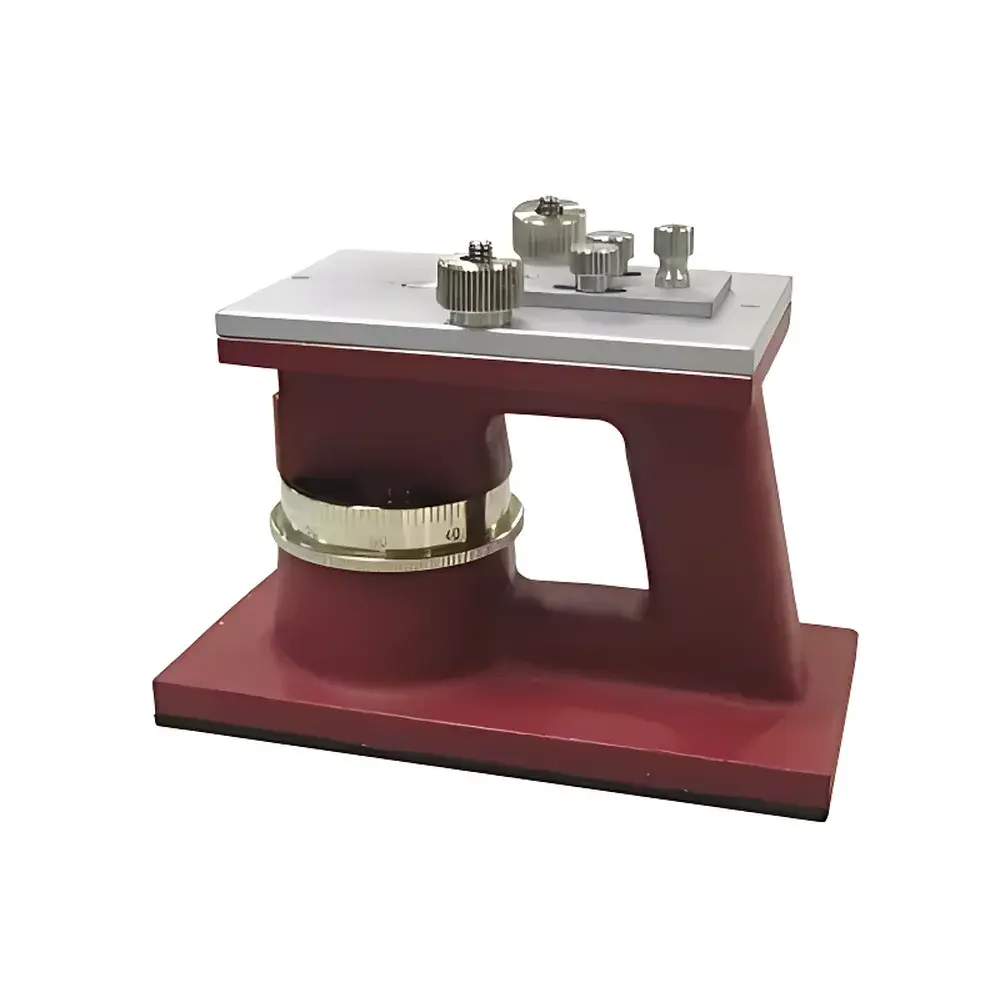
Precision Fiber Microtome by SDLATLAS
| Brand | SDLATLAS |
|---|---|
| Origin | Guangdong, China |
| Manufacturer Type | Direct Manufacturer |
| Country of Origin | China |
| Model | F214 |
| Price Range | USD 7,000 – 14,000 |
Overview
The SDLATLAS F214 Precision Fiber Microtome is an engineered instrument designed specifically for the textile and fiber science community to produce ultra-thin, dimensionally stable cross-sectional and longitudinal sections of natural, synthetic, and blended fibers. Unlike general-purpose microtomes, the F214 integrates a calibrated mechanical advance mechanism, adjustable specimen holder geometry, and vibration-damped blade carriage to ensure consistent slice thickness control—critical for high-resolution optical microscopy (OM), scanning electron microscopy (SEM), and Fourier-transform infrared (FTIR) mapping. Its operation relies on precise linear displacement of the fiber sample against a fixed tungsten-carbide or diamond-coated blade, enabling reproducible sectioning in the range of 0.5–20 µm, depending on fiber modulus, diameter, and mounting medium hardness. The device supports both paraffin-embedded and resin-embedded specimens, and its compact benchtop architecture complies with ISO 13934-1 and ASTM D1017 guidelines for fiber morphology preparation prior to tensile, thermal, or spectroscopic characterization.
Key Features
- Adjustable section thickness control via micrometer-driven feed mechanism (graduated in 0.5 µm increments)
- Dual-mode specimen holder accommodating single fibers (≥8 µm diameter) and fiber bundles (up to 2 mm width)
- Interchangeable blade system compatible with disposable steel blades and reusable diamond knives
- Vibration-isolated base plate with anti-slip rubber feet for stable operation on laboratory benches
- Tool-free blade alignment system with angular calibration reference marks for optimal cutting angle (±1° repeatability)
- Integrated LED illumination strip for real-time visual verification of section continuity and ribbon formation
- Non-corrosive anodized aluminum housing with IP20-rated electrical enclosure for long-term durability in humid lab environments
Sample Compatibility & Compliance
The F214 accommodates a broad spectrum of fiber types—including cotton, wool, polyester, nylon, aramid, carbon, glass, and biodegradable cellulose derivatives—regardless of crystallinity or surface treatment. Specimens must be pre-embedded in low-viscosity epoxy resins (e.g., Spurr’s or Epon 812) or paraffin wax (melting point 56–58 °C) to ensure structural integrity during sectioning. All mechanical tolerances and dimensional repeatability meet ISO/IEC 17025 requirements for accredited fiber testing laboratories. The instrument is CE-marked per Machinery Directive 2006/42/EC and conforms to IEC 61000-6-2 (EMC immunity) and IEC 61000-6-4 (EMC emission) standards. It supports GLP-compliant documentation workflows when paired with traceable calibration logs and operator ID tagging in downstream imaging software.
Software & Data Management
While the F214 operates as a standalone mechanical instrument without embedded firmware or touchscreen interface, it is fully interoperable with third-party digital microscopy platforms such as Olympus Stream, Zeiss ZEN, and Thermo Scientific Teneo SEM Suite. Calibration certificates—including blade alignment verification reports and feed accuracy validation data—are provided in PDF and CSV formats compliant with FDA 21 CFR Part 11 requirements (when used with validated electronic record systems). Optional USB-mounted digital calipers and motorized stage adapters enable semi-automated batch sectioning protocols, with metadata (date/time, operator ID, section count, thickness setting) exportable via CSV or XML for LIMS integration.
Applications
- Morphological analysis of fiber cross-sections to assess lumen structure, cuticle layer integrity, and fibril orientation in natural fibers
- Quality control of melt-spun synthetic filaments for void distribution, skin-core heterogeneity, and additive dispersion uniformity
- Failure analysis of high-performance fibers after tensile, UV, or hydrolytic aging tests
- Preparation of transmission electron microscopy (TEM) grids requiring ultrathin serial sections (<100 nm) when used with cryo-adapted accessories
- Validation of fiber surface modification efficacy (e.g., plasma treatment, enzymatic etching) through layer-depth profiling
- Supporting ASTM D7269 (Standard Test Method for Tensile Properties of Single Textile Fibers) and ISO 5079 (Determination of Breaking Force and Elongation of Single Yarns) sample prep workflows
FAQ
What is the minimum recommended fiber diameter for reliable sectioning on the F214?
Fibers with nominal diameters ≥8 µm (e.g., fine Merino wool, standard PET filament) yield optimal ribbon formation and minimal compression artifacts. Sub-8 µm fibers (e.g., nano-cellulose or spider silk analogs) require specialized embedding and cryo-sectioning accessories.
Can the F214 be used for biological fibers such as collagen or silk fibroin?
Yes—provided specimens are fixed (e.g., glutaraldehyde/formaldehyde), dehydrated, and infiltrated with low-shrinkage resins. Recommended protocol follows ISO 10993-12 for biocompatibility sample preparation.
Is blade replacement tooling included with the instrument?
Yes—the standard delivery package includes a precision blade holder wrench, alignment gauge, and torque-limiting screwdriver calibrated to 0.3 N·m for safe knife installation.
Does SDLATLAS provide traceable calibration services for the F214?
Yes—annual calibration services are available through SDLATLAS’s CNAS-accredited metrology lab (Certificate No. CNAS L9287), covering feed accuracy, blade parallelism, and specimen advance linearity.
What maintenance intervals are recommended for sustained performance?
Lubrication of the micrometer feed screw and carriage rails is required every 200 operating hours; blade cleaning with ethanol and lint-free wipes is advised before each session. Full preventive maintenance is scheduled at 1,000-hour intervals.






