
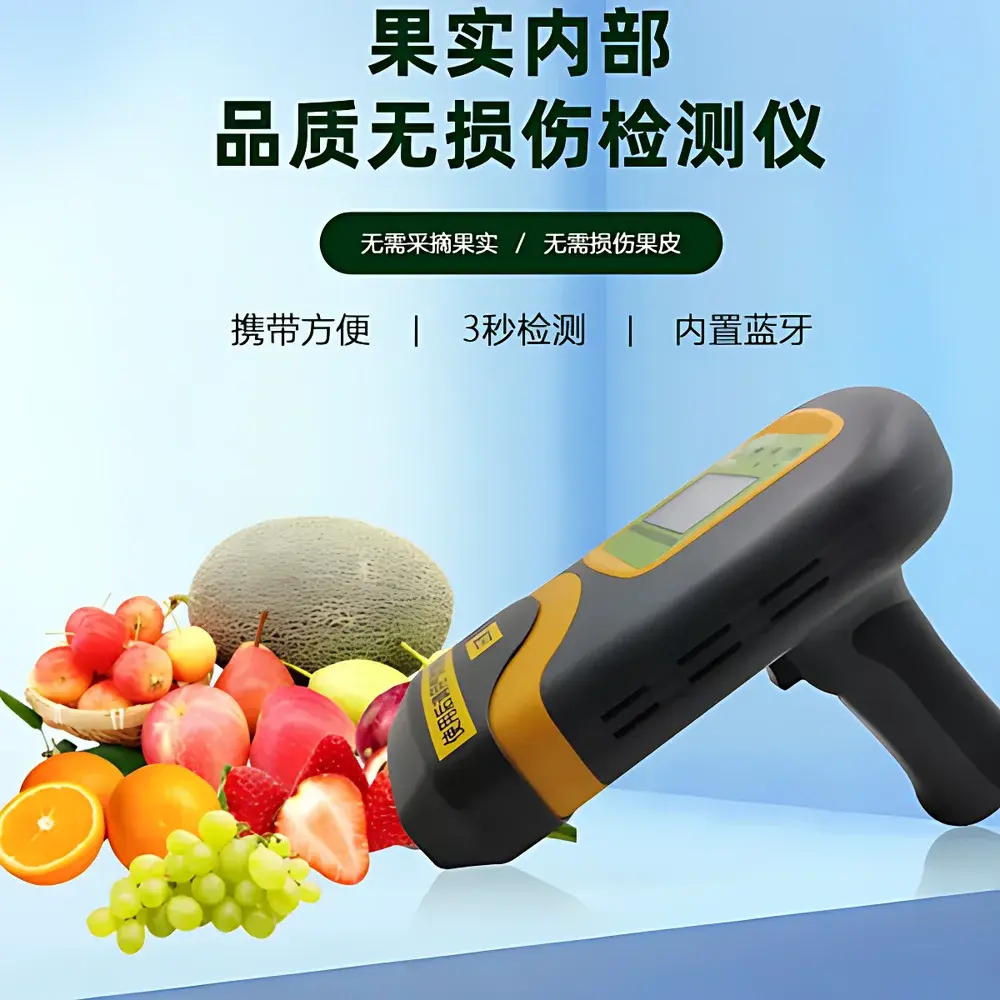
Jingcheng Huatai H100C Non-Destructive Fruit Saccharimeter
| Brand | Jingcheng Huatai |
|---|---|
| Origin | Zhejiang, China |
| Model | H100C |
| Instrument Type | Non-Destructive |
| Detection Wavelength Range | 650–950 nm |
| Light Source | Halogen Lamp |
| Measurement Parameters | Brix (°Bx), Titratable Acidity (TA), Dry Matter Content (DMC), Moisture Content, Internal Browning, Core Rot/Mold |
| Compatible Fruits (H100C) | Kiwifruit, Avocado, Plum, Apricot, Loquat, Waxberry (Myrica rubra), Corn (fresh ear), Potato |
| Measurement Time | ≤3 s per sample |
| Display | LCD Screen |
| Power Supply | Rechargeable 2000 mAh Li-ion Battery (≥1500 measurements per full charge) |
| Charging Input | DC 12 V / 1.5 A |
| Data Interface | USB 2.0 + Bluetooth 4.2 |
| Operating Environment | 5–30 °C, ≤85% RH |
| Dimensions & Weight | 110 × 160 × 169 mm, 400 g |
| Housing Material | ABS Plastic |
| Prediction Accuracy (Brix) | RMSEP ≈ ±0.5 °Bx (model- and sample-dependent) |
| Spectral Data Export | Raw NIR reflectance spectra (ASCII/CSV) supported |
Overview
The Jingcheng Huatai H100C Non-Destructive Fruit Saccharimeter is a portable near-infrared (NIR) reflectance spectrometer engineered for rapid, non-invasive assessment of internal quality attributes in intact horticultural produce. Based on diffuse reflectance spectroscopy in the 650–950 nm spectral window—spanning the first overtone and combination bands of C–H, O–H, and N–H bonds—the instrument quantifies key compositional parameters without mechanical penetration or tissue disruption. This optical measurement principle enables real-time prediction of soluble solids content (expressed as °Brix), titratable acidity (TA), dry matter content (DMC), moisture distribution, and early-stage physiological disorders including internal browning and core rot. Designed for field-deployable use in orchards, packinghouses, cold storage facilities, and research laboratories, the H100C delivers consistent, operator-independent readings under ambient conditions (5–30 °C, ≤85% RH), supporting objective decision-making across pre-harvest monitoring, postharvest sorting, and breeding program evaluation.
Key Features
- Non-destructive measurement: No fruit puncturing, slicing, or juice extraction required—preserves sample integrity for downstream use or sale.
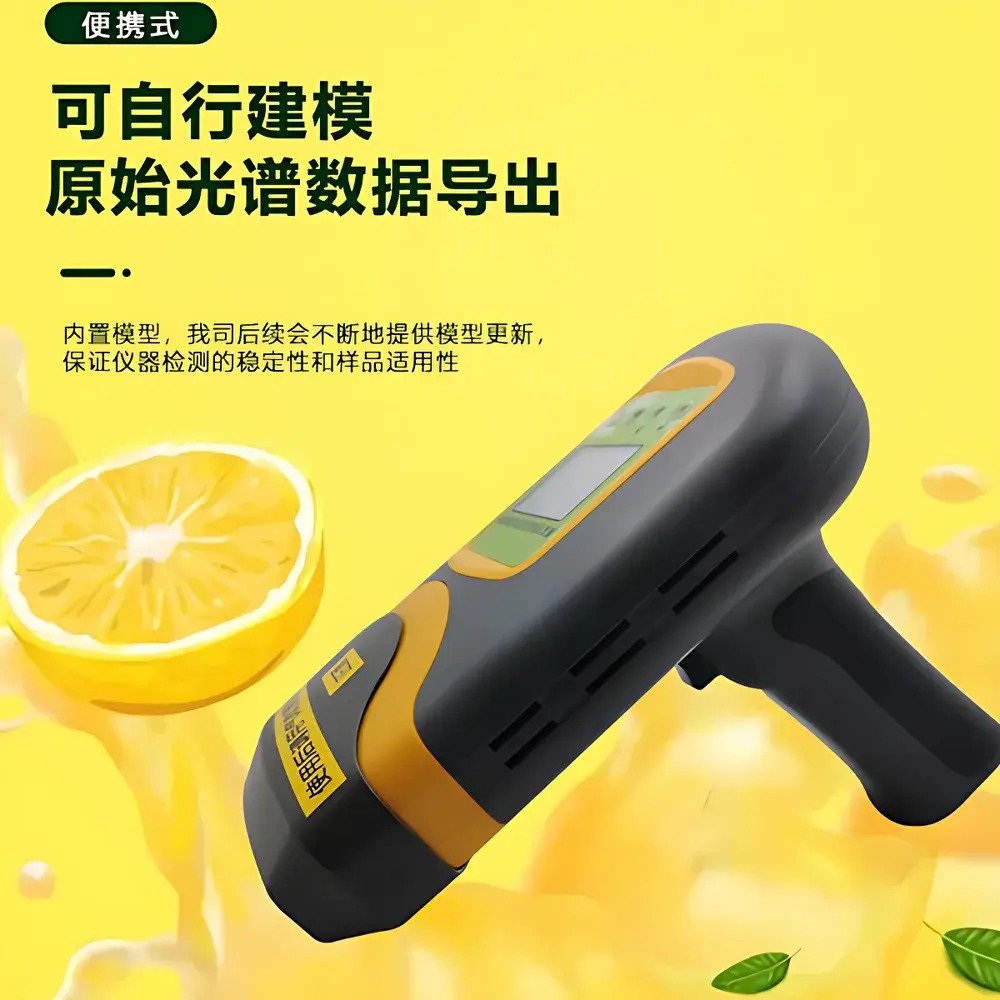
- Dual-data output mode: Real-time display of calibrated predictions on integrated LCD screen; simultaneous export of raw NIR spectra (ASCII/CSV) for advanced chemometric analysis.
- Modular calibration architecture: Pre-installed predictive models for kiwifruit, avocado, plum, apricot, loquat, waxberry, fresh corn, and potato; model updates delivered via secure firmware update protocol.
- Field-ready power system: 2000 mAh rechargeable Li-ion battery supports ≥1500 consecutive measurements per charge; includes universal DC 12 V / 1.5 A charger with international plug adaptors.
- Robust industrial design: IP54-rated ABS housing (110 × 160 × 169 mm, 400 g) withstands routine handling in humid, dusty, or temperature-variable environments.
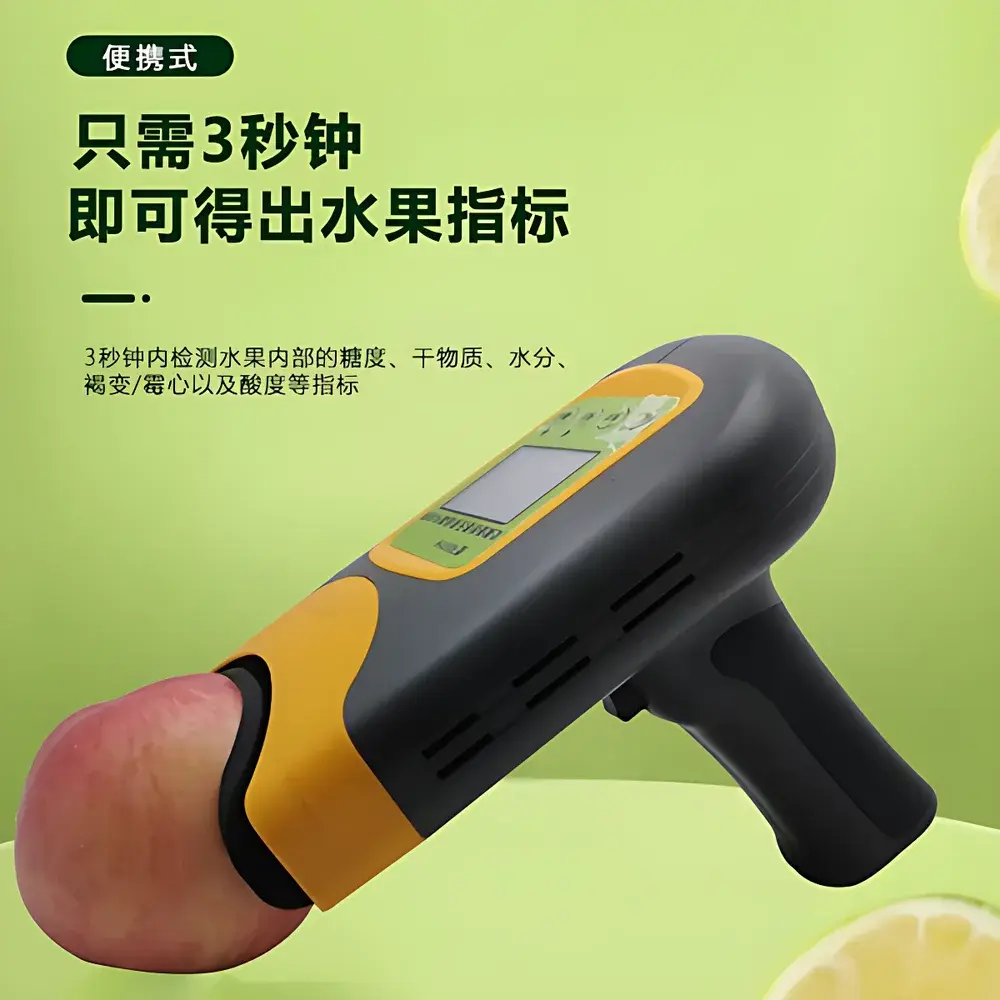
- Multi-parameter capability: Single 3-second measurement yields concurrent estimates of °Brix, TA, DMC, moisture gradient, and spectral indices correlated with enzymatic browning and fungal colonization.
Sample Compatibility & Compliance
The H100C is validated for use with specific fruit morphologies and skin characteristics defined by its optical aperture geometry and spectral response profile. The H100C variant is optimized for medium-to-small fruits with smooth-to-slightly-rough epidermis and moderate translucency (e.g., kiwifruit, avocado, plum). Its 650–950 nm detection range avoids strong water absorption peaks while retaining sensitivity to carbohydrate and organic acid vibrational signatures. While not certified to ISO/IEC 17025 or ASTM E1655 for metrological traceability, the instrument conforms to general principles of NIR method validation outlined in AOAC Official Method 2011.01 (for fruit Brix) and follows GLP-aligned data integrity practices—including timestamped measurement logs, user-defined sample IDs, and audit-ready raw spectral archives. All firmware and model updates are version-controlled and digitally signed to ensure reproducibility across instrument fleets.
Software & Data Management
Data acquisition and management are facilitated through the proprietary HC-Link Desktop Suite (Windows 10/11 compatible), which provides secure USB or Bluetooth 4.2 connectivity. The software enables batch export of prediction results (CSV), synchronized raw spectrum files (with wavelength calibration metadata), and instrument configuration backups. For regulated environments, HC-Link supports optional 21 CFR Part 11-compliant user authentication, electronic signatures, and immutable audit trails—configurable per organizational SOPs. Researchers may import exported spectra into third-party platforms (e.g., Unscrambler X, MATLAB, Python scikit-learn) for custom PLS, PCR, or machine learning model development. All spectral preprocessing steps—including Savitzky-Golay smoothing, multiplicative scatter correction (MSC), and first-derivative transformation—are documented and repeatable within the software environment.
Applications
- Pre-harvest maturity scheduling: Objective determination of optimal harvest windows based on dynamic °Brix/TA ratios in kiwifruit or avocado.
- Postharvest quality grading: High-throughput sorting of plums and apricots by internal dry matter content to align with export market specifications.
- Varietal screening: Rapid phenotyping of breeding populations for sugar accumulation kinetics and resistance to internal browning in loquat and waxberry.
- Storage condition optimization: Monitoring moisture loss and enzymatic degradation trends in cold-stored potatoes and fresh corn ears.
- Supply chain traceability: Linking NIR-derived quality metrics to blockchain-based lot records for retailer compliance reporting.
- Academic research: Acquisition of reference-grade spectral libraries for developing open-source NIR calibration models applicable to regional cultivars.
FAQ
How does the H100C achieve non-destructive sugar measurement?
It uses contact-mode diffuse reflectance NIR spectroscopy: light from a stabilized halogen source penetrates 2–5 mm into fruit tissue, and backscattered photons are collected by a fiber-optic sensor array. Chemometric models correlate spectral absorbance patterns with reference laboratory measurements (e.g., refractometry, titration, oven-drying).
Can I develop my own calibration models?
Yes—raw spectra (wavelength-indexed intensity values) are fully exportable in ASCII/CSV format. Users must collect representative reference data using validated wet-chemistry methods and apply multivariate regression techniques (e.g., PLS-R) in external software.
Is the instrument suitable for regulatory submission?
While not FDA-cleared or CE-marked as a medical device, the H100C meets technical prerequisites for inclusion in GMP-aligned quality control protocols when deployed with documented validation reports, model performance summaries (RMSEP, R²), and instrument calibration logs.
What maintenance is required?
No consumables or optical alignment needed. Clean the measurement window with lint-free cloth and isopropyl alcohol before each use; recalibrate baseline annually using supplied ceramic reference tile.






