
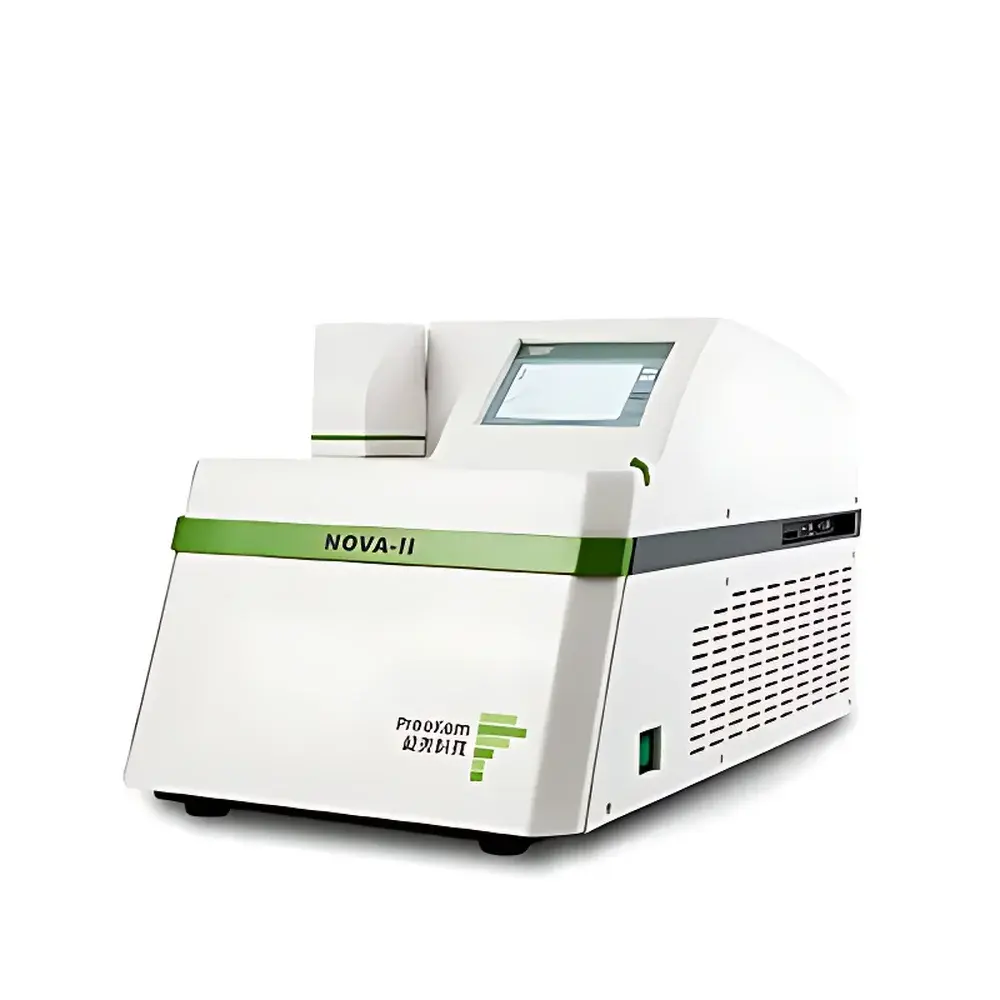
PreeKem Yitao NOVA-2S Single-Mode Microwave Synthesis System
| Brand | PreeKem / Yitao |
|---|---|
| Origin | Shanghai, China |
| Manufacturer Type | Direct Manufacturer |
| Region of Origin | Domestic (China) |
| Model | NOVA-2S |
| Price | Upon Request |
| Temperature Range | −20 °C to 350 °C |
| Pressure Range | 0–4 MPa |
| Microwave Power Output | 500 W |
| Magnetron Frequency | 2450 MHz |
| Stirring Mechanism | Magnetic Stirring |
| Reaction Vessel Capacity | 10 mL and 30 mL |
Overview
The PreeKem Yitao NOVA-2S Single-Mode Microwave Synthesis System is an engineered platform for high-precision, reproducible microwave-assisted organic synthesis, inorganic material preparation, and catalytic reaction screening. Unlike multimode cavity systems, the NOVA-2S employs a vector-modeled single-mode resonant cavity with precisely tuned microwave feed coupling—enabling highly focused electromagnetic energy delivery directly to the sample zone. This architecture ensures exceptional spatial field homogeneity and power density (>100 W/cm³ typical at 500 W output), resulting in rapid, uniform volumetric heating and minimized thermal gradients across small-volume reaction mixtures. Designed for laboratory-scale R&D environments—including medicinal chemistry, materials science, and process development—the system supports closed-vessel operation under controlled temperature and pressure, facilitating kinetic studies, optimization of reaction pathways, and scalable parameter transfer to continuous-flow or kilolab platforms.
Key Features
- Single-mode resonant cavity with vector-based electromagnetic field modeling for optimal mode purity and energy localization
- Integrated PID-controlled microwave power modulation—dynamically adjusts magnetron output in real time to maintain setpoint accuracy ±1 °C and ramp rate fidelity within ±0.5 °C/min
- Dual independent real-time monitoring: non-contact infrared pyrometry (−20–350 °C, resolution 0.1 °C) and piezoelectric pressure transduction (0–4 MPa, resolution 0.01 MPa)
- Interlocked safety lid mechanism with automatic lock-on activation, thermal/pressure interlocks, and fail-safe release only after cooling to <60 °C and depressurization to <0.1 MPa
- Optimized forced-air cooling path with external compressed air interface (optional air compressor required) enabling post-reaction quenching in <90 seconds for 10 mL vessels
- Touch-enabled 7-inch color LCD interface with intuitive method editor, live curve overlay (T vs. t, P vs. t), and embedded audit trail logging compliant with GLP documentation requirements
Sample Compatibility & Compliance
The NOVA-2S accommodates standard sealed quartz or reinforced PTFE-lined reaction vessels (10 mL and 30 mL nominal volumes), compatible with common solvents including DMF, DMSO, NMP, acetonitrile, and ethylene glycol. Vessels are rated for sustained operation up to 4 MPa and 350 °C, meeting ISO 17025-relevant mechanical integrity criteria for pressurized chemical reactors. The system’s control firmware and data handling architecture support ALCOA+ principles—ensuring attributable, legible, contemporaneous, original, accurate, complete, consistent, enduring, and available records. While not pre-certified for FDA 21 CFR Part 11, the software architecture provides configurable electronic signature fields, user access levels, and immutable method/data export (CSV, PDF, XML) suitable for validation under GxP frameworks.
Software & Data Management
The embedded SynthOS™ v3.2 operating system features a modular GUI with drag-and-drop method sequencing, multi-step ramp-hold-cool profiles, and real-time dual-axis plotting. All experimental parameters—including power history, temperature derivative (dT/dt), and pressure slope—are timestamped and stored locally on industrial-grade flash memory (≥300 methods, ≥500 experiment logs). USB 2.0 port enables firmware updates and secure data offload without network connectivity. When paired with the optional VOCA Auto-Sampling Module, the software automatically switches between manual and automated workflows, managing X-Y-Z robotic arm positioning (±0.02 mm repeatability) and rack indexing across up to four interchangeable sample trays—supporting unattended 96-position batch processing with vessel-level status feedback.
Applications
- Rapid optimization of cross-coupling reactions (Suzuki, Heck, Buchwald–Hartwig) under inert atmosphere
- High-temperature hydrothermal synthesis of MOFs, perovskites, and metal oxide nanoparticles
- Accelerated esterification, amidation, and heterocycle formation with improved selectivity vs. conventional oil-bath heating
- Kinetic profiling via sequential isothermal holds at varying microwave power levels
- Method scouting for API intermediate synthesis under ICH Q5A/Q5B-relevant stress conditions
FAQ
What vessel types are certified for use with the NOVA-2S at maximum pressure and temperature?
Standard quartz vessels with PTFE/PEEK seals are validated for continuous operation at 4 MPa and 350 °C. Alternative chemically resistant liners (e.g., Hastelloy C-276 inserts) may be used subject to third-party pressure rating verification.
Is the system compatible with inert gas purging or vacuum-assisted vessel loading?
Yes—vessels feature dual-port fittings supporting Schlenk-line integration for O₂-free loading and in-situ gas substitution prior to sealing.
Does the NOVA-2S meet electromagnetic compatibility (EMC) standards for laboratory deployment?
The unit complies with CISPR 11 Group 1 Class B emission limits and IEC 61326-1 immunity requirements for professional laboratory equipment.
Can reaction data be exported in machine-readable format for LIMS integration?
All datasets export natively as CSV or XML with metadata headers (operator ID, timestamp, vessel ID, calibration traceability flags), enabling direct ingestion into LabVantage, STARLIMS, or custom SQL-based repositories.
What maintenance intervals are recommended for the magnetron and waveguide assembly?
Under normal usage (≤8 hrs/day, ≤500 cycles/year), magnetron service life exceeds 5,000 hours; waveguide inspection is advised annually or after 1,000 high-pressure cycles—no routine lubrication or alignment required.



