
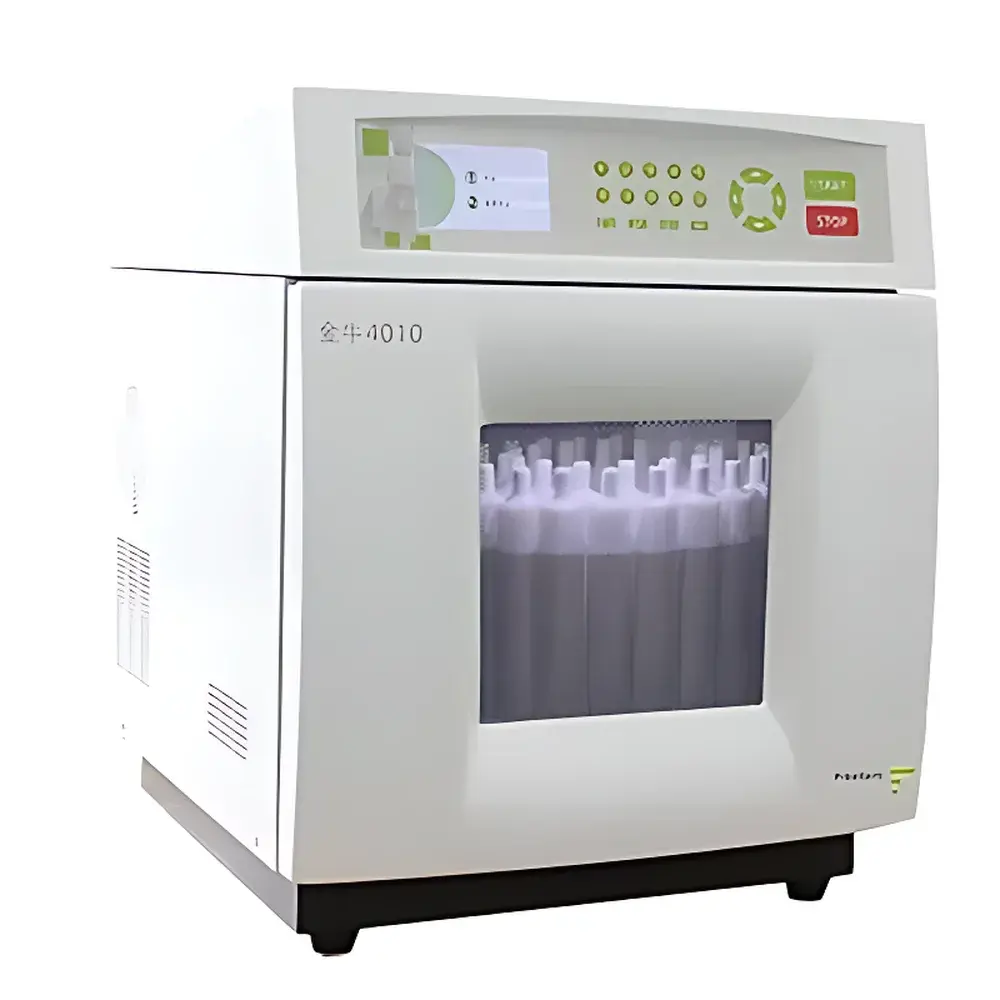
PreeKem Cash Cow Microwave Digestion System for Third-Party Testing Laboratories
| Brand | PreeKem |
|---|---|
| Origin | Shanghai, China |
| Manufacturer Type | Direct Manufacturer |
| Origin Category | Domestic (China) |
| Model | Cash Cow |
| Quotation | Upon Request |
| Cavity Grade | Industrial-Grade |
| Batch Capacity | 40 Samples |
| Microwave Source | Dual Magnetron |
| Max Temperature | 400 °C |
| Max Pressure | 2200 psi |
Overview
The PreeKem Cash Cow Microwave Digestion System is an industrial-grade, high-throughput sample preparation platform engineered specifically for accredited third-party testing laboratories operating under ISO/IEC 17025, CNAS, or equivalent regulatory frameworks. It employs closed-vessel microwave-assisted acid digestion—a thermally accelerated decomposition method that uses controlled microwave energy to rapidly break down organic matrices and mineralize inorganic analytes in solid or semi-solid samples. The system operates on the principle of dielectric heating, where microwave radiation (2450 MHz) induces molecular friction within acidic reagents (e.g., HNO₃, HCl, HF, H₂O₂), generating uniform volumetric heating inside sealed quartz or high-purity PTFE-TFM vessels. This enables complete dissolution of complex matrices—including soils, sludge, biological tissues, polymers, and food products—while minimizing elemental loss, contamination risk, and blank interference. Designed for routine compliance-driven workflows, the Cash Cow delivers reproducible digestion efficiency across multi-element ICP-MS, ICP-OES, and AAS analyses without manual intervention between cycles.
Key Features
- Industrial-grade cavity constructed entirely from electropolished 316L stainless steel—resistant to aggressive acids (including aqua regia and hydrofluoric acid vapors) and certified for ≥5 years corrosion-free operation under GLP-compliant usage conditions.
- Dual magnetron power delivery (≥2000 W total output) ensures homogeneous field distribution and rapid thermal ramping, supporting consistent digestion kinetics across all 40 positions simultaneously.
- Real-time, non-invasive bottom-surface infrared temperature monitoring with continuous axial scanning—eliminates reliance on platinum resistance probes and provides direct measurement of actual sample-zone thermal conditions.
- Full-cavity pressure surveillance via redundant piezoresistive sensors; automatic microwave cutoff triggers if any vessel exceeds preset safety thresholds (up to 2200 psi), ensuring fail-safe containment integrity.
- Self-locking door mechanism with integrated torque-sensing interlock and emergency stop circuitry—complies with IEC 61000-6-4 (EMC) and IEC 61010-1 (safety) requirements for Class II laboratory equipment.
- High-efficiency forced-air cooling system featuring corrosion-resistant centrifugal blower and optimized convection ducting—reduces post-digestion cooldown time by >40% compared to passive systems, enabling back-to-back batch processing.
Sample Compatibility & Compliance
The Cash Cow accommodates standard 55 mL high-pressure digestion vessels (TFM-lined quartz or reinforced PFA), compatible with EPA Methods 3051A, 3052, ASTM D5511, ISO 11466, and GB/T 17141–1997. Its 40-position rotor supports heterogeneous sample types—including environmental solids (sediments, fly ash), clinical specimens (hair, tissue), consumer product materials (plastics, textiles), and agricultural commodities—without cross-contamination. All hardware and firmware meet CE marking requirements and support audit-ready documentation per FDA 21 CFR Part 11 when paired with optional electronic signature modules. The cavity design conforms to ISO 14644-1 Class 8 cleanroom-compatible installation standards.
Software & Data Management
The graphical control interface runs on embedded Linux OS with intuitive touch-screen navigation. Real-time dual-parameter plots (temperature vs. pressure vs. time) are rendered with millisecond-level timestamp resolution and auto-scaled axes. Method libraries support up to 100 user-defined protocols, each storing full traceability metadata: operator ID, vessel barcode, digestion sequence log, and deviation alerts. Raw data exports comply with ASTM E1382-22 for analytical instrument data interchange (CSV, XML, PDF). Audit trails record all parameter modifications, method executions, and system events—enabling full retrospective review during regulatory inspections or ISO 17025 proficiency assessments.
Applications
- Environmental testing labs performing heavy metal analysis (Pb, Cd, As, Hg) in soil, sediment, and wastewater sludge per EPA SW-846.
- Food safety accreditation bodies quantifying nutrient elements (Ca, Mg, Fe, Zn) and contaminants (Al, Sn, Ni) in fortified foods and dietary supplements.
- Pharmaceutical QC units validating elemental impurities (ICH Q3D) in active pharmaceutical ingredients and excipients.
- Geochemical research facilities preparing geological reference materials for multi-isotope ratio determination (e.g., Sr, Nd, Pb).
- Recycling industry laboratories assessing critical raw material content (Li, Co, Ni) in spent lithium-ion battery cathodes.
FAQ
What safety certifications does the Cash Cow hold?
It complies with IEC 61010-1 (Electrical Safety), IEC 61000-6-4 (EMC Emission), and meets CE directive requirements for laboratory equipment. Full test reports available upon request.
Can the system be integrated into LIMS or ELN platforms?
Yes—via RS-232, USB, or optional Ethernet TCP/IP interface using ASTM E1382-compliant data schema and configurable API endpoints.
Is remote monitoring supported?
Local network-based web server enables real-time status viewing and method initiation from any browser-enabled device within the same subnet; no cloud dependency or external data routing.
What maintenance intervals are recommended?
Annual calibration verification of IR sensor and pressure transducers is advised; cavity inspection and gasket replacement every 24 months under typical third-party lab throughput (≥300 batches/year).
Does it support method validation per ISO 17025 Clause 7.2.2?
Yes—the software logs all critical process parameters with immutable timestamps and digital signatures, fulfilling documented evidence requirements for method verification and uncertainty estimation.



