
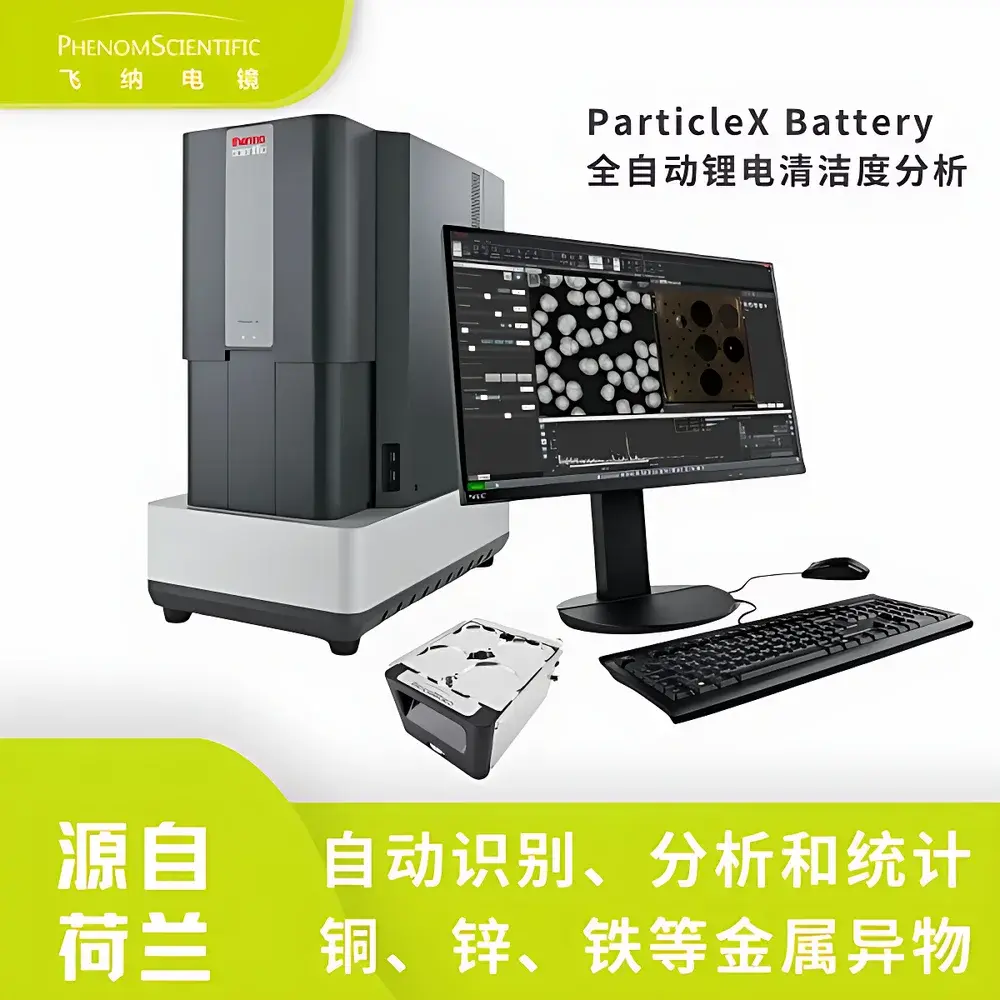
Phenom ParticleX Battery Automated Cleanliness Analysis System for Lithium-ion Battery Materials
| Brand | Phenom |
|---|---|
| Origin | Netherlands |
| Manufacturer Type | Original Equipment Manufacturer (OEM) |
| Import Category | Imported Instrument |
| Model | ParticleX Battery |
| Instrument Type | Benchtop Scanning Electron Microscope (SEM) |
| Electron Source | Cerium Hexaboride (CeB₆) |
| Secondary Electron Resolution | 8 nm |
| Maximum Magnification | 200,000× |
| Accelerating Voltage Range | Standard Modes: 2 kV, 5 kV, 10 kV, 15 kV, 20 kV |
| Advanced Mode | Continuously Adjustable from 4.8 kV to 20.5 kV |
| Backscattered Electron Resolution | 8 nm |
| Standard Detectors | Backscattered Electron Detector (BSE), Energy-Dispersive X-ray Spectrometer (EDS) |
| Optional Detector | Secondary Electron Detector (SED) |
Overview
The Phenom ParticleX Battery is a fully automated, benchtop scanning electron microscope (SEM)-based cleanliness analysis system engineered specifically for the lithium-ion battery industry. It integrates high-resolution SEM imaging with energy-dispersive X-ray spectroscopy (EDS) to enable rapid, quantitative identification, morphological characterization, and elemental classification of metallic and magnetic particulate contaminants—including Fe, Cu, Cr, Ni, Zn, and Ag—in cathode and anode active materials, coatings, slurries, and separator films. Unlike conventional SEM-EDS workflows requiring manual region selection and operator-dependent thresholding, ParticleX Battery implements a standardized, repeatable, and audit-ready analysis protocol compliant with evolving internal quality standards and industry best practices. Its core measurement principle relies on high-efficiency electron beam scanning coupled with real-time EDS spectral acquisition and automated particle segmentation algorithms trained on battery-relevant contamination signatures. This enables trace-level detection down to sub-micron particles while maintaining statistical confidence across large-area surveys (up to 100 × 100 mm).
Key Features
- End-to-end automation: Fully unattended operation—from vacuum pump-down (<60 s via tri-chamber differential pumping) to multi-region SEM mapping, particle detection, EDS point analysis, and report generation.
- CeB₆ thermionic electron source: 3,000-hour nominal lifetime with stable emission current and minimal brightness drift; eliminates unplanned downtime associated with tungsten filament failure.
- Benchtop architecture with integrated SEM-EDS: Fixed working distance and co-aligned detectors ensure consistent signal collection without recalibration between imaging and microanalysis modes.
- Customizable analysis logic: User-defined particle classification rules (e.g., size thresholds, aspect ratio filters, elemental inclusion/exclusion criteria), statistical grouping, and pass/fail logic aligned with internal QC specifications or supplier agreements.
- High-throughput sample handling: Motorized 100 × 100 mm stage supports batch analysis of up to 12 electrode coupons or slurry filters per session with positional repeatability <1 µm.
Sample Compatibility & Compliance
ParticleX Battery accommodates standard battery material substrates including Al/Cu foils, coated electrodes (dry/wet), cross-sectioned cells, and filtration residues collected on polycarbonate or mixed-cellulose ester membranes. Sample preparation follows ASTM E2927-21 (Standard Practice for SEM/EDS Analysis of Particulate Contamination) and ISO 16232-5 (Road Vehicles – Cleanliness of Components of Fluid Circuits – Part 5: Determination of Particle Contamination by SEM/EDS). The system supports GLP-compliant data integrity through embedded audit trails, user access controls, and electronic signature capability—fully compatible with FDA 21 CFR Part 11 requirements when deployed in regulated manufacturing environments. All EDS spectra are stored with full metadata (beam parameters, dwell time, detector geometry, calibration date), enabling retrospective reprocessing and inter-laboratory comparison.
Software & Data Management
The ParticleX Battery software suite operates as a standalone application built on a deterministic real-time acquisition engine. It features a modular workflow editor allowing QA engineers to define custom analysis sequences—including stage navigation patterns, focus routines, beam condition switching, and conditional branching based on intermediate results. Quantitative outputs include particle count per unit area, size distribution histograms (equivalent circular diameter), morphology descriptors (circularity, convexity, solidity), and elemental composition heatmaps. Reports are exportable in PDF, CSV, and XML formats—with configurable templates supporting company branding, regulatory headers, and automatic inclusion of instrument calibration certificates and daily verification logs. Raw data archives are stored in vendor-neutral HDF5 format, ensuring long-term readability independent of software version updates.
Applications
- Raw material qualification: Screening cathode precursors (e.g., NMC, LFP), graphite/anode blends, and conductive additives for ferrous and non-ferrous particulates prior to slurry formulation.
- In-process monitoring: Detection of wear debris from milling, mixing, coating, and calendering equipment—enabling root-cause analysis of process-induced contamination.
- Failure investigation: Correlating metallic particle morphology and chemistry with field return data (e.g., micro-shorts, thermal runaway events) to identify upstream failure modes.
- Supplier quality assurance: Enforcing standardized cleanliness metrics across tier-1 and tier-2 suppliers using shared analysis protocols and reference datasets.
- R&D optimization: Evaluating effectiveness of new filtration media, solvent purification methods, or dry-room particulate control strategies via statistically robust comparative studies.
FAQ
Does ParticleX Battery require external vibration isolation or dedicated HVAC?
No. Its compact, mass-damped benchtop design meets ISO 10816-1 vibration sensitivity requirements for laboratory-grade SEMs and operates reliably in standard ISO Class 8 cleanrooms without active isolation platforms.
Can the system analyze particles embedded within electrode coatings?
Yes—cross-sectional analysis mode supports focused ion beam (FIB)-prepped or cryo-fractured samples. EDS depth profiling (with appropriate matrix correction models) provides semi-quantitative elemental distribution data up to ~1–2 µm beneath the surface.
How is measurement reproducibility verified?
Each analysis run includes automated daily verification using certified NIST-traceable reference particles (SiO₂, Al₂O₃, Fe₂O₃) mounted on the same sample holder. System performance reports log resolution, EDS peak intensity stability, and particle detection sensitivity against pre-established acceptance criteria.
Is remote diagnostics and software update support available?
Yes. Secure TLS-encrypted remote access allows Phenom Field Application Scientists to perform health checks, parameter optimization, and firmware updates—subject to customer-configured network policies and IT approval.
What training options are offered for operators and QA personnel?
Phenom University delivers role-based curricula: Level 1 (Operator Certification), Level 3 (Method Development), and Level 5 (Advanced Failure Analysis), delivered onsite or at regional Phenom Application Centers in Shanghai, Beijing, and Guangzhou. All courses include hands-on sessions with real battery samples and documented competency assessments.





