
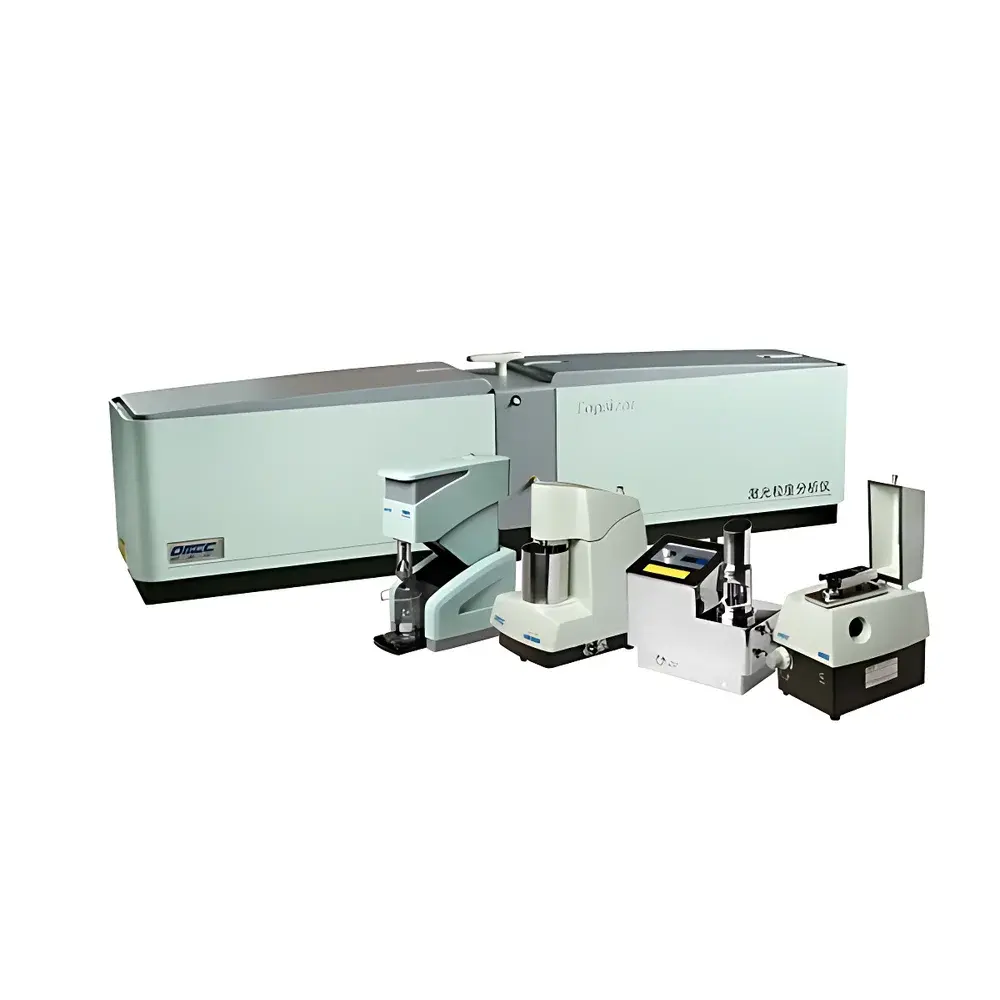
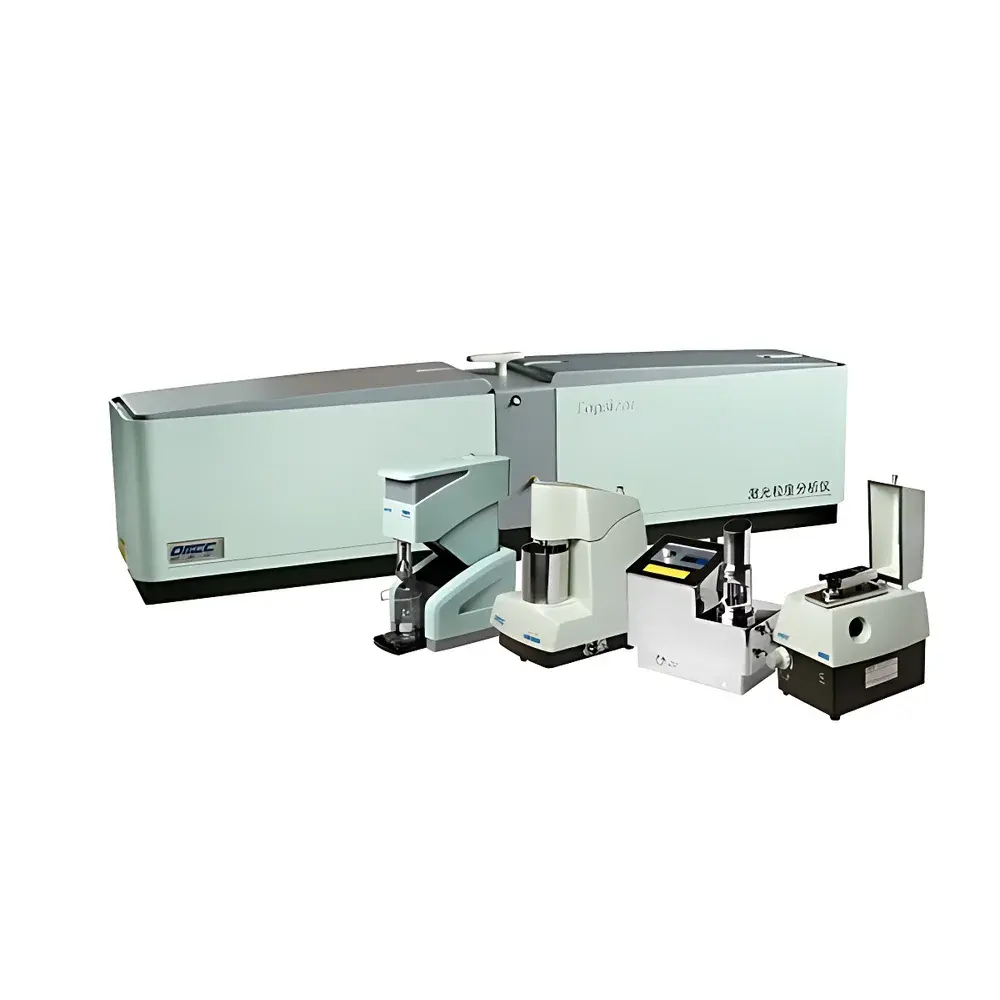
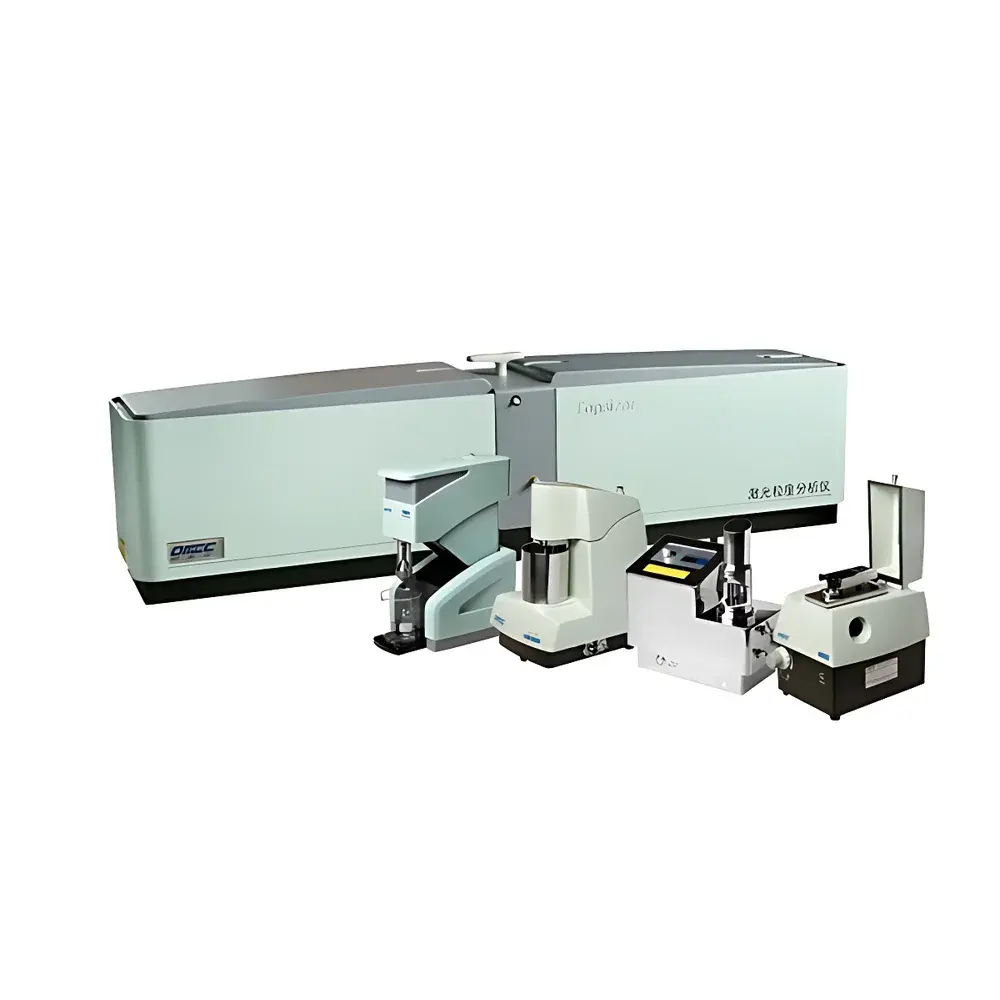
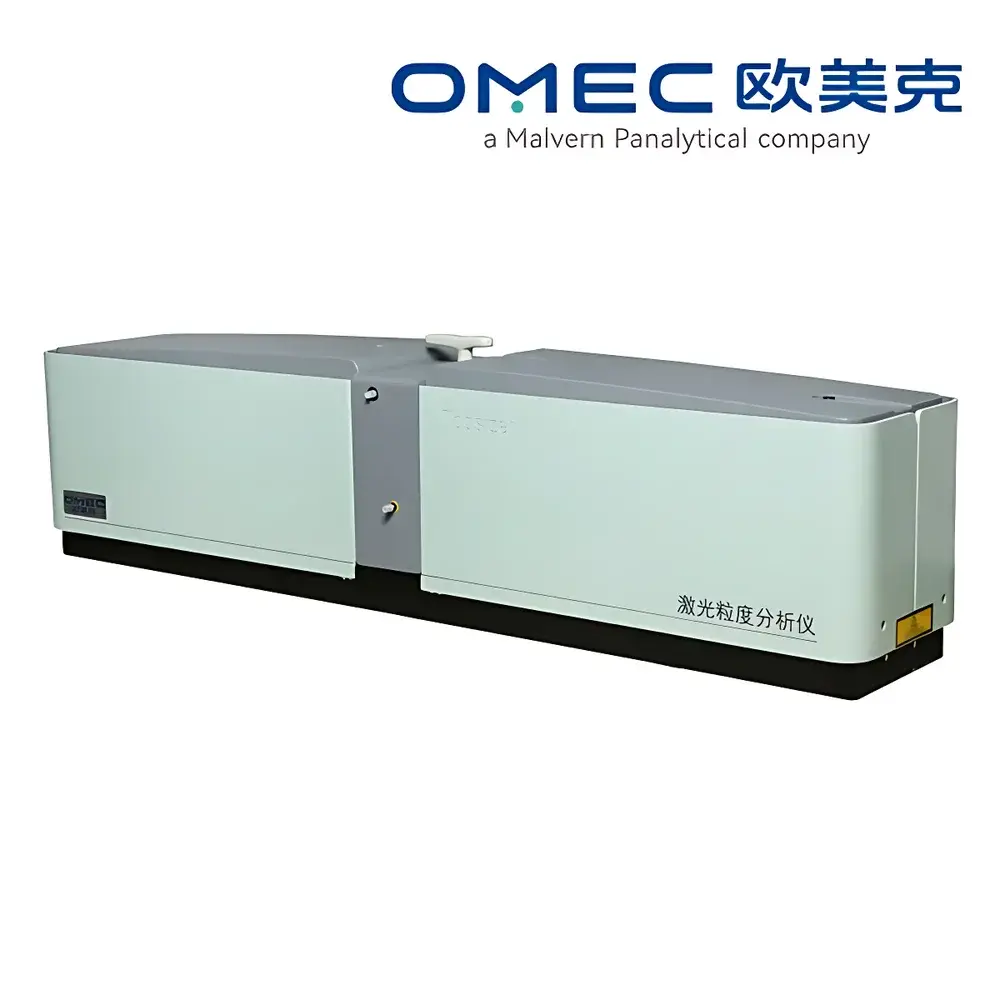
OMEC Topsizer Laser Particle Size Analyzer
| Brand | OMEC |
|---|---|
| Origin | Guangdong, China |
| Manufacturer Type | Manufacturer |
| Product Category | Domestic |
| Model | Topsizer |
| Dispersion Method | Dry & Wet Dispersion |
| Instrument Type | Laboratory Laser Particle Size Analyzer |
| Measurement Range | 0.02–2000 µm (wet), 0.1–2000 µm (dry) |
| Repeatability | ≤0.5% (D50 of standard reference material) |
| Measurement Time | ≤10 s (typical) |
| Optical Principle | Full-range Mie scattering theory |
| Detector Channels | 98-channel 3D detection system (forward, side, large-angle, and backward scattering) |
| Scattering Angle Range | 0.016°–140° |
| Dual Light Sources | He-Ne laser (632.8 nm) + blue semiconductor laser (466 nm) |
| Laser Stability | Power fluctuation <0.5%, polarization ratio >500:1, TEM₀₀ mode >95% |
| Optical Platform | Monolithic high-precision aluminum alloy base |
| Optical Design | Sealed linear optical path with post-Fourier single-lens transformation |
| Fourier Lens Focal Length | Extended for enhanced large-particle sensitivity |
| Software Compliance | Fully compliant with FDA 21 CFR Part 11 and GMP Annex 11 requirements for computerized systems (user roles, audit trail, electronic signatures, data integrity) |
Overview
The OMEC Topsizer Laser Particle Size Analyzer is a high-performance, dual-source laboratory instrument engineered for precise, reproducible, and traceable particle size distribution (PSD) analysis across an exceptionally broad dynamic range—from sub-100 nm nanoparticles to coarse particles up to 2000 µm. It operates on the physical principle of Mie light scattering theory, rigorously applied across the full measurement range without segmentation or interpolation. The system integrates a stabilized helium-neon (632.8 nm) primary laser with a complementary blue semiconductor source (466 nm), enabling high-fidelity angular resolution across forward, side, large-angle, and backward scattering domains. This dual-wavelength architecture eliminates conventional angular blind zones and significantly enhances resolution for both trace populations of coarse particles and low-concentration nanoscale fractions—critical for R&D validation, QC release testing, and formulation optimization in pharmaceuticals, advanced ceramics, battery materials, and specialty chemicals.
Key Features
- Dual-wavelength optical system: 632.8 nm He-Ne laser (TEM₀₀ >95%, polarization ratio >500:1) and 466 nm blue semiconductor laser, jointly covering scattering angles from 0.016° to 140°
- 98-channel 3D photodetector array with spatially optimized geometry, ensuring seamless signal capture without angular gaps
- Sealed linear optical path built on a monolithic high-stiffness aluminum optical platform, eliminating stray light from reflective components and preventing dust-induced drift
- Post-Fourier single-lens design with extended focal length, enabling accurate detection of low-angle scattering signals critical for particles >500 µm
- Fully automated alignment: real-time software-controlled beam centering and laser angle calibration, maintaining optical stability over extended operation cycles
- Integrated background noise suppression: automatic electrical background measurement prior to each acquisition, minimizing electronic offset effects
Sample Compatibility & Compliance
The Topsizer supports both wet and dry dispersion modalities, accommodating diverse sample types including aqueous suspensions, organic solvents, metal powders, glass microspheres, polymer latexes, and heat-sensitive APIs. Its wet dispersion module (SCF-105B or SCF-108A) features a 316L stainless-steel circulation cell, programmable centrifugal pumping (up to 4000 rpm), and continuously adjustable 50 W ultrasonic energy—optimized for de-agglomeration without cavitation damage. The dry dispersion unit (DPF-110) employs piezoelectric vibration control, triple-stage feed regulation, and pressure-sensing feedback (0.05–0.6 MPa), ensuring consistent aerosol generation while preserving particle morphology. All optical and mechanical subsystems conform to IEC 60825-1:2014 Class 1 laser safety standards. Instrument design and software architecture comply with ISO 13320:2020 (particle size analysis — laser diffraction methods) and support regulatory validation under USP , EP 2.9.31, and ASTM E799-22.
Software & Data Management
The Topsizer Control & Analysis Suite is a modular, role-based application built for GLP/GMP environments. It provides full 21 CFR Part 11 compliance—including hierarchical user permissions, electronic signatures, immutable audit trails, and time-stamped metadata logging for every measurement event. SOP-driven workflows enforce standardized test protocols; the system auto-detects connected dispersion modules and validates optical status pre-run. Real-time signal-to-noise assessment ensures data fidelity, while integrated refractive index and absorption coefficient databases support accurate Mie inversion for >200 common materials. Distribution outputs include volume-, surface-area-, length-, and number-based representations, all interconvertible within a single session. Export formats include CSV, XML, PDF reports with embedded metadata, and direct integration with LIMS via OPC UA or RESTful API.
Applications
The Topsizer delivers validated performance across regulated and industrial applications: monitoring micronization efficiency in inhalation drug development; quantifying agglomerate breakage during slurry processing in lithium-ion cathode manufacturing; verifying narrow PSD specifications for toner particles and pigment dispersions; characterizing fractal dimension shifts in flocculated wastewater solids; and benchmarking grinding mill output consistency in mineral processing. Its ability to resolve bimodal distributions with <1% Dv50 repeatability—verified using NIST-traceable SRM 1963 and SRM 1970—makes it suitable for method transfer between R&D, pilot plant, and QC laboratories.
FAQ
Does the Topsizer meet FDA 21 CFR Part 11 requirements for electronic records and signatures?
Yes—the software includes configurable user roles, mandatory electronic signatures for critical actions, tamper-evident audit trails with operator ID and timestamp, and secure data archiving compliant with ALCOA+ principles.
Can the instrument distinguish between primary particles and agglomerates in dry powder analysis?
Yes—by combining controlled dispersion pressure gradients, real-time mass flow monitoring, and multi-angle scattering deconvolution, the system enables differentiation of dispersion state-dependent shifts in Dv10/Dv50 ratios.
Is method validation support available for pharmacopeial compliance (e.g., USP )?
Yes—OMEC provides IQ/OQ documentation templates, system suitability test protocols, and technical guidance aligned with USP Chapter and ISO 13320 Annex A.
What maintenance is required to sustain optical alignment accuracy over time?
None—the sealed linear optical path and motorized auto-alignment system eliminate manual recalibration; routine verification uses built-in reference scatterers and is fully automated.
How does the dual-laser configuration improve resolution for polydisperse samples?
The 466 nm blue source increases angular separation for sub-200 nm particles, while the 632.8 nm source maintains optimal signal-to-noise for coarse fractions; combined inversion yields higher-resolution bimodal and trimodal distribution reconstruction.



