
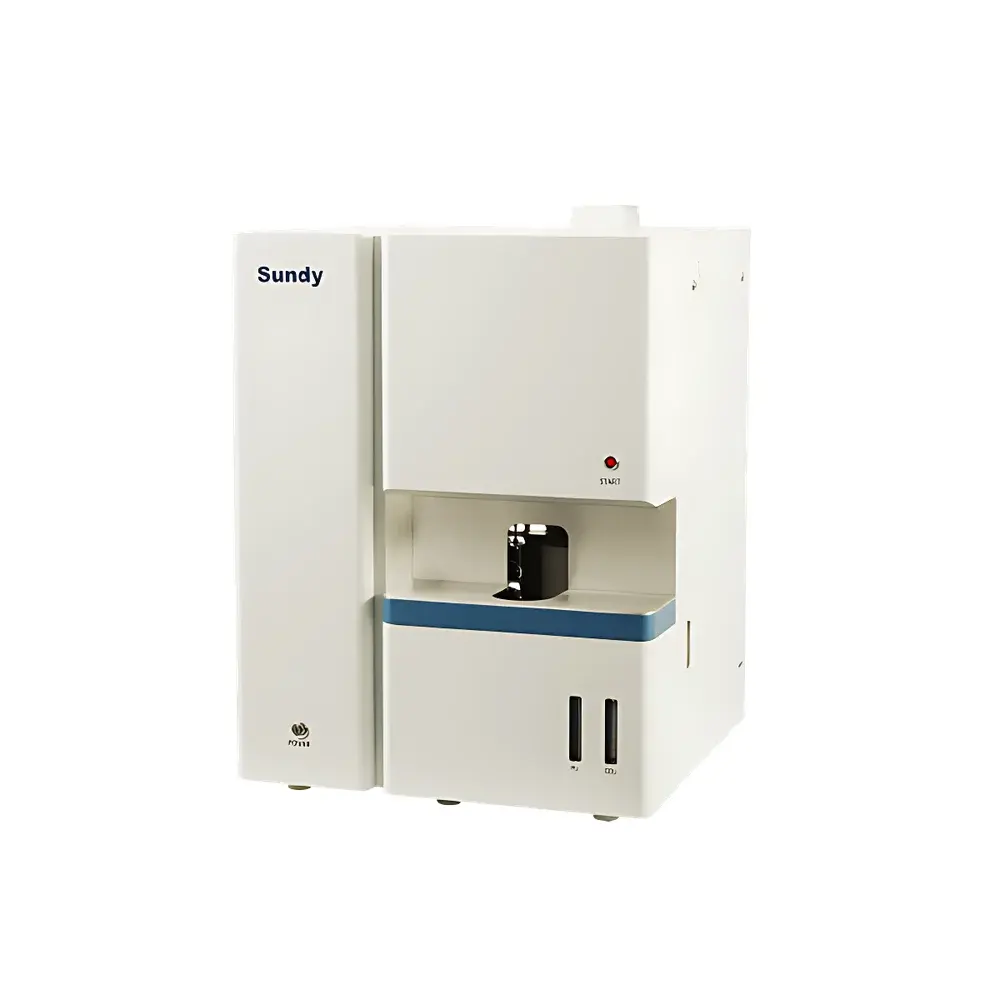
Sundys SDAF1600b Ash Fusion Temperature Tester
| Brand | Sundy |
|---|---|
| Origin | Hunan, China |
| Model | SDAF1600b |
| Sample Capacity | 1–16 pcs |
| Temperature Range | Ambient to 1600 °C |
| Temperature Accuracy | ±1 °C |
| Temperature Resolution | 1 °C |
| Atmosphere Control | Oxidizing and Weakly Reducing (via Sealed Carbon or Gas Flow: CO/CO₂ or H₂/CO₂ mixtures) |
| Max Power | 4.2 kW |
| Supply Voltage | AC 220 V ±10 %, 50 Hz ±1 Hz |
| Compliance | GB/T 219–2008, GB/T 30726–2014 |
Overview
The Sundys SDAF1600b Ash Fusion Temperature Tester is a fully automated, high-precision instrument engineered for the quantitative determination of ash fusion temperatures (AFT) in solid fuels—primarily coal and solid biomass—according to internationally recognized standard test methods. It operates on the principle of high-temperature optical observation under controlled atmospheric conditions, where ash cones are heated at standardized rates while their morphological transformations (deformation, softening, hemispherical, and fluid temperatures) are captured in real time via a calibrated industrial-grade imaging system. The instrument integrates a robust 1600 °C high-temperature furnace with active atmosphere management, precision temperature control, and advanced image-based feature detection—enabling reproducible, operator-independent AFT measurement critical for boiler design, slagging/fouling prediction, and fuel quality specification in power generation and metallurgical applications.
Key Features
- High-throughput batch processing: Simultaneous analysis of up to 16 standardized ash cones per run, reducing average cycle time to ≤3 hours per batch under GB/T 219–2008 protocol.
- Triaxial stereoscopic imaging system: Dual-angle, synchronized camera architecture delivers true 3D visualization of cone geometry evolution—enhancing discrimination between subtle shape transitions (e.g., hemispherical vs. fluid state).
- Active optical compensation: Integrated LED-based auxiliary illumination ensures consistent contrast across varying ash emissivity and surface texture, extending sample compatibility to low-reflectivity or highly porous ash residues.
- Maintenance-free quartz viewport: Proprietary smoke-scavenging technology prevents carbon deposition and condensate accumulation on the optical window; no manual cleaning or periodic replacement required during routine operation.
- Quartz plate heating: Localized thermal management of the viewing window minimizes water vapor condensation—preserving optical clarity throughout prolonged high-humidity ash melting sequences.
- Hermetic furnace sealing: High-temperature elastomeric gasket at the furnace port maintains stable gas composition (±0.5% vol. accuracy) during weakly reducing atmosphere tests using sealed carbon or dynamic CO/CO₂ or H₂/CO₂ blends.
- Gas leak detection & interlock: Real-time pressure decay monitoring with audible/visual alarm and automatic heater shutdown upon detection of ≥0.1 kPa/min pressure loss—ensuring compliance with laboratory safety protocols.
Sample Compatibility & Compliance
The SDAF1600b supports standardized ash cones prepared from coal, lignite, anthracite, petcoke, and solid biomass feedstocks (e.g., wood pellets, agricultural residues), conforming to specimen geometry and preparation requirements outlined in GB/T 219–2008 and GB/T 30726–2014. Its dual-atmosphere capability enables strict adherence to both oxidizing (air) and weakly reducing (carbon-sealed or gas-controlled) test conditions mandated by these standards. All critical hardware—including furnace insulation, combustion tube, crucibles, and sample holders—is fabricated from high-purity, vacuum-sintered refractory materials certified for continuous service at 1600 °C. The system meets CE marking requirements for industrial monitoring equipment (2014/30/EU EMC Directive and 2014/35/EU LVD Directive) and supports audit-ready documentation for GLP-compliant laboratories.
Software & Data Management
Control and analysis are executed via dedicated Windows-based software compliant with FDA 21 CFR Part 11 requirements, including electronic signatures, role-based access control, and immutable audit trails for all method parameters, raw image sequences, temperature logs, and final AFT determinations. The software implements ISO/IEC 17025-aligned uncertainty propagation algorithms—automatically calculating expanded uncertainty (k=2) for each reported DT, ST, HT, and FT based on calibration certificate data, thermal gradient mapping, and pixel-resolution-limited edge detection error. Export formats include CSV (for LIMS integration), PDF reports with embedded time-stamped video thumbnails, and DICOM-compatible image stacks for third-party morphometric validation.
Applications
- Coal quality assessment for utility boiler feedstock selection and slagging propensity modeling.
- Biomass co-firing feasibility studies—evaluating ash behavior under mixed-fuel combustion conditions.
- R&D of low-ash or additive-modified fuels targeting elevated fusion temperatures.
- Quality control in coke production and mineral processing where ash fusibility impacts sinter strength and blast furnace burden distribution.
- Regulatory compliance testing for environmental permits requiring AFT reporting (e.g., EPA Method 137, EN 15148).
- Academic research on silicate phase equilibria and low-melting eutectic formation in complex ash systems.
FAQ
What standards does the SDAF1600b support?
It is fully compliant with GB/T 219–2008 (coal) and GB/T 30726–2014 (solid biomass), and its hardware architecture accommodates ASTM D1857, ISO 540, and EN 15148 test protocols with minor configuration adjustments.
Can the instrument operate under inert atmospheres such as pure N₂ or Ar?
Yes—the gas delivery module supports programmable flow control of any non-reactive or reducing gas mixture; optional mass flow controllers enable precise stoichiometric tuning for specialized research applications.
Is remote diagnostics supported?
The embedded industrial controller provides secure TLS-encrypted remote access for firmware updates, log retrieval, and real-time thermal profile monitoring—subject to customer network security policy approval.
What maintenance intervals are recommended for the imaging subsystem?
No scheduled maintenance is required for the optical path; the quartz viewport remains contamination-free for ≥12 months under typical usage (200+ tests/month). Camera cooling fans and power supply capacitors are rated for 50,000 hours MTBF.
How is temperature uniformity validated across the sample zone?
Each unit undergoes factory thermal mapping using 9-point NIST-traceable thermocouple arrays; a certificate of uniformity (±1.5 °C over 25 mm diameter zone at 1500 °C) is supplied with delivery documentation.
Related Products




