
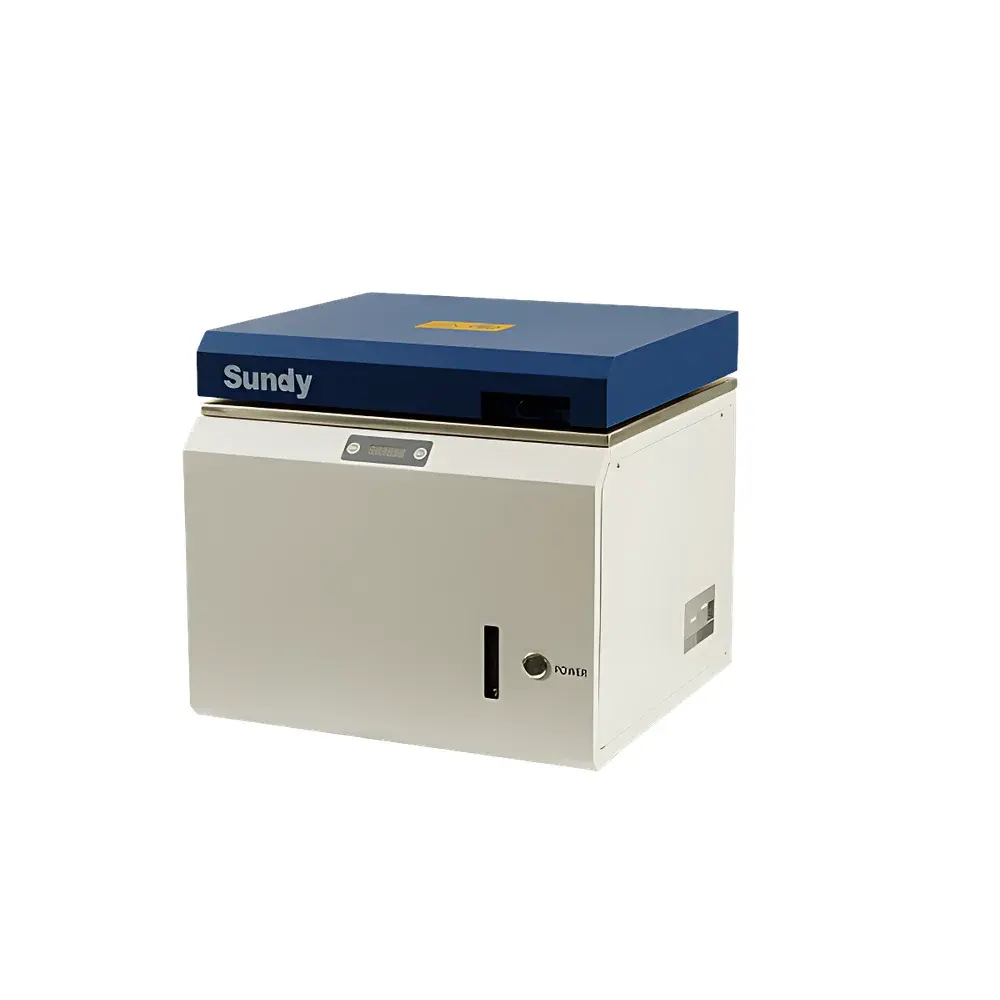
Sundy SDTGA500 Automated Moisture Analyzer
| Brand | Sundy |
|---|---|
| Model | SDTGA500 |
| Origin | Hunan, China |
| Instrument Type | Automatic Thermogravimetric Moisture Analyzer |
| Standards Compliance | GB/T 212–2008, GB/T 211–2017, DL/T 2029–2019 |
| Sample Capacity | 12 positions |
| Analytical Water Sample Mass | 0.9–1.1 g |
| Total Moisture Sample Mass | 10–12 g (user-definable range) |
| Test Duration | 15–40 min (analytical moisture), 25–60 min (total moisture) |
| Temperature Control Range | Ambient to 150 °C |
| Temperature Accuracy | ±2 °C |
| Max Power Consumption | 1.5 kW |
| Sample Particle Size Compatibility | ≤0.2 mm, 3 mm, 6 mm |
| Balance Resolution | 0.1 mg (imported high-precision weighing module) |
| Dimensions (W×D×H) | 450 mm × 480 mm × 450 mm |
| Net Weight | ~40 kg |
| Power Supply | AC 220 V ±10 %, 50 Hz ±1 Hz |
| Nitrogen Purge Function | Yes, with optimized flow control |
| Safety Features | Auto-diagnostic, power-fail recovery, thermal self-protection |
| Data Output | Real-time mass tracking, GLP-compliant audit trail, CSV/PDF report export, LAN-enabled remote monitoring |
Overview
The Sundy SDTGA500 is an automated thermogravimetric moisture analyzer engineered for precise, repeatable determination of moisture content in solid fuels and industrial bulk materials—including coal, coke, mineral ores, and solid biomass. It operates on the principle of controlled thermal drying under defined atmospheric conditions, continuously monitoring sample mass loss as a function of time and temperature. By integrating high-stability microbalance technology with programmable heating profiles and optional nitrogen purge capability, the SDTGA500 delivers traceable, standards-aligned results in accordance with GB/T 211–2017 (Total Moisture in Coal), GB/T 212–2008 (Proximate Analysis of Coal), and DL/T 2029–2019 (Automated Instrumental Determination of Total Moisture). Its design prioritizes operational robustness in high-throughput laboratory and quality control environments where regulatory compliance, inter-laboratory reproducibility, and instrument uptime are critical.
Key Features
- Twelve-position carousel enables unattended sequential analysis—reducing operator intervention while maintaining strict thermal and gravimetric consistency across all samples.
- Top-and-bottom dual-hinged furnace lid accelerates heat dissipation between cycles, minimizing cooldown delay and supporting rapid turnaround for back-to-back determinations.
- Integrated nitrogen purge system features dynamic flow regulation, reducing nitrogen consumption by up to 40% versus conventional constant-flow setups—without compromising moisture removal efficiency or measurement repeatability.
- Furnace chamber constructed from high-grade austenitic stainless steel (310S) ensures superior thermal reflectivity and long-term resistance to oxidation at elevated temperatures (up to 150 °C), contributing to uniform heating across all sample crucibles.
- Imported 0.1 mg resolution analytical balance module is mechanically decoupled from the heating zone and equipped with active draft compensation—delivering stable, drift-corrected mass readings throughout the entire drying cycle.
- Embedded control firmware supports asynchronous multi-instrument operation: a single host PC can coordinate scheduling, real-time data acquisition, and alarm management for multiple SDTGA500 units via standard TCP/IP communication.
- Comprehensive safety architecture includes overtemperature cutoff, door-open interlock, automatic recalibration upon power restoration, and continuous hardware self-diagnosis—ensuring uninterrupted operation in 24/7 QA/QC workflows.
Sample Compatibility & Compliance
The SDTGA500 accommodates diverse particle size fractions—0.2 mm (for analytical moisture per GB/T 212), 3 mm, and 6 mm (for total moisture per GB/T 211)—with user-configurable sample mass ranges (0.9–1.1 g for analytical moisture; 10–12 g for total moisture, extendable within instrument limits). All test protocols adhere to mandatory procedural constraints outlined in national standards, including specified drying temperatures (e.g., 105–110 °C for analytical moisture; 145 °C for total moisture under nitrogen), maximum allowable mass change thresholds (<0.001 g/30 s for endpoint detection), and mandatory blank correction routines. The system supports full GLP documentation: each run logs operator ID, timestamp, environmental ambient data (optional external sensor integration), calibration history, and raw mass-vs.-time datasets—archivable in immutable format for internal audit or regulatory inspection (e.g., CNAS, CMA, or third-party ISO/IEC 17025 assessments).
Software & Data Management
The bundled SDTGA Control Suite runs on Windows OS and provides role-based access control, electronic signature support, and full 21 CFR Part 11 readiness—including audit trail logging of all parameter changes, result modifications, and user logins. Data export options include timestamped CSV files for LIMS integration, formatted PDF reports with embedded chromatogram-style mass-loss curves, and direct database push to SQL Server or Oracle via ODBC. Remote diagnostics and firmware updates are supported over secure HTTPS, and optional SNMP integration allows centralized health monitoring across enterprise-wide instrument fleets.
Applications
- Coal preparation plants: routine monitoring of incoming raw coal, washed coal, and blended feedstocks for contractual moisture specification compliance.
- Power generation facilities: verification of fuel moisture prior to combustion—critical for boiler efficiency modeling and emissions calculation (e.g., NOx, CO2).
- Metallurgical coke laboratories: assessment of moisture stabilization post-quenching and before blast furnace charging.
- Mineral processing QC labs: moisture quantification in iron ore fines, bauxite, and phosphate rock—impacting downstream drying energy budgets and pelletizing performance.
- Biomass co-firing validation: determination of inherent moisture in wood chips, agricultural residues, and torrefied pellets per EN 14774 or ASTM D3173.
FAQ
Does the SDTGA500 meet international standards such as ASTM or ISO?
It is fully aligned with Chinese national standards (GB/T series) widely adopted in Asia-Pacific trade. While not pre-certified to ASTM D3173 or ISO 589, its thermogravimetric methodology, temperature control fidelity (±2 °C), and balance precision (0.1 mg) satisfy the core technical requirements of those methods—validation per local regulatory authority is recommended.
Can the instrument be integrated into an existing LIMS environment?
Yes—via configurable CSV export, ODBC-compliant database connectors, or custom REST API endpoints (available under extended support agreement).
Is nitrogen supply mandatory for total moisture testing?
Per GB/T 211–2017 and DL/T 2029–2019, nitrogen purge is required for total moisture determination in air-sensitive or oxidizable samples (e.g., low-rank coals); the SDTGA500’s flow-optimized system minimizes operating cost without sacrificing method integrity.
What maintenance intervals are recommended for long-term accuracy?
Balance calibration verification every 24 hours (automated), furnace temperature sensor validation quarterly, and crucible cleaning after each batch—full preventive maintenance annually by certified Sundy field service engineers.
How is data integrity ensured during power interruption?
The system retains all active run metadata and mass-time profiles in non-volatile memory; upon restart, it resumes measurement from the last recorded point—including thermal ramp continuation and endpoint re-evaluation—without data loss or manual re-entry.




