
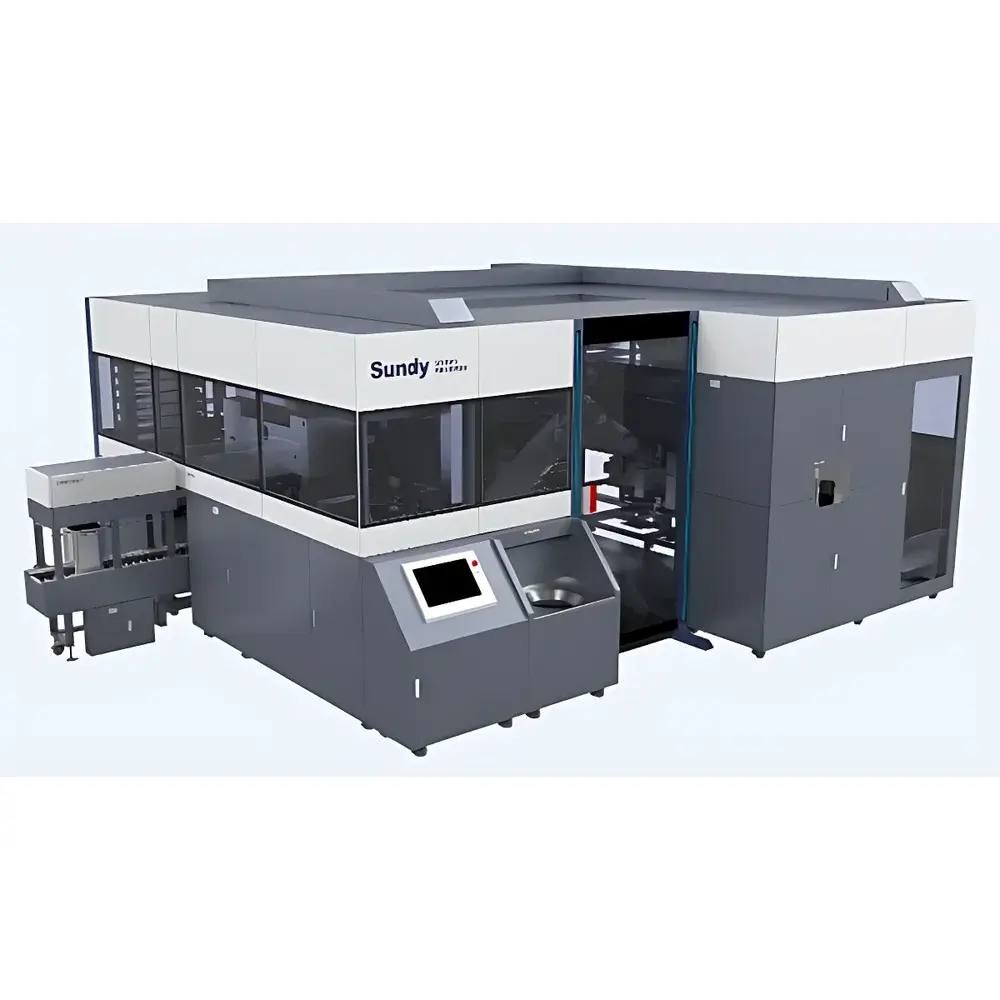
SUNDY SDRPS Robotic Sample Preparation System for Coal
| Brand | SUNDY |
|---|---|
| Origin | Hunan, China |
| Manufacturer Type | Authorized Distributor |
| Product Origin | Domestic (China) |
| Model | SDRPS |
| Pricing | Upon Request |
| Max. Feed Size | ≤100 mm |
| Feed Mass Range | 30–1000 kg (for 13 mm top size), 25–1000 kg (for 6 mm top size) |
| Output Samples | 6 mm total moisture sample ≥1.25 kg (1–5 portions) |
| Max. Power Consumption | 85 kW |
| Drying Method | Low-temperature forced-air drying (WindTec® technology, 40–50 °C) |
| Sample Throughput | ~30 min inter-sample interval (standard configuration) |
| Milling Recovery Rate | ≥98% (except for atypical coal types) |
| Division Methods | Primary & secondary mass-based division |
| Division Error | ≤10% |
| Robot Axes | 6-axis industrial robot |
| Compliance | GB/T 474, GB/T 19494.2, GB/T 19494.3, GB/T 12642 |
Overview
The SUNDY SDRPS Robotic Sample Preparation System is an integrated, ISO-aligned automation platform engineered for high-fidelity coal sample preparation in power generation, metallurgy, cement, chemical, and third-party testing laboratories. It implements a closed-loop, weight-monitored workflow grounded in gravimetric process control and robotic material handling—ensuring strict adherence to GB/T 474 (Coal Sample Preparation) and GB/T 19494.2 (Mechanized Coal Sampling – Part 2: Sample Preparation). The system employs Couette-type sealed crushing, mass-based division, and WindTec® low-temperature forced-air drying to preserve intrinsic coal properties—including moisture distribution, volatile matter integrity, and particle size distribution—without thermal degradation or oxidation artifacts. Unlike conventional batch systems, the SDRPS operates as a continuous, traceable process: every mass transfer event—from feed loading through 13 mm/6 mm/3 mm crushing, 0.2 mm pulverization, and final packaging—is validated by in-line load cells and logged with timestamped audit trails. This architecture enables full chain-of-custody documentation required under GLP-compliant QA/QC frameworks and supports integration into enterprise LIMS environments via standardized OPC UA or Modbus TCP interfaces.
Key Features
- 6-axis industrial robot performing end-to-end sample transport, container inversion, and localized cleaning using heated air jets and rotary brushes—eliminating manual intervention and cross-contamination risk.
- Batch-synchronized cleaning protocol: representative wash samples are drawn from each feed lot and cycled through all critical processing zones (6 mm crusher, 3 mm crusher, 0.2 mm mill) prior to main sample introduction—ensuring zero carryover between batches.
- Sealed drop-chute crushing stations with post-crush dust settling delay: particulate-laden air is retained within enclosed chambers until gravitational sedimentation completes, minimizing airborne loss and maximizing recovery (>98% milling yield verified per GB/T 19494.3 precision protocols).
- WindTec® drying module operating at 40–50 °C: delivers uniform thermal energy through forced convection across bulk coal layers, achieving equilibrium moisture without altering proximate analysis parameters—validated against ASTM D3173 and ISO 589 standards.
- Real-time gravimetric validation at all 7 critical nodes (feed hopper, primary crusher outlet, 6 mm divider inlet/outlet, 3 mm crusher outlet, mill inlet/outlet, final package)—enabling dynamic loss-rate calculation and automatic corrective action (e.g., extended vibration, secondary air purge) when recovery falls below threshold.
- Transparent polycarbonate guarding with LED-lit viewing zones: permits visual verification of container cleanliness, residual adhesion, and mechanical actuation status—supporting operator confidence and regulatory walkthrough readiness.
Sample Compatibility & Compliance
The SDRPS accommodates raw coal feed with nominal top sizes up to 100 mm and moisture contents ranging from 3% (bituminous) to >25% (lignite), enabled by adaptive moisture sensing and conditional pre-drying logic. Its modular design allows configuration-specific compliance with national and international coal testing standards: GB/T 474 (sample reduction accuracy), GB/T 19494.2 (preparation bias control), GB/T 19494.3 (precision validation methodology), and GB/T 12642 (robot positioning repeatability ±0.1 mm). All weight measurements are traceable to national metrology institutes via factory-calibrated 3000 kg/0.01 kg resolution load cells, with calibration logs archived alongside sample metadata. The system meets electromagnetic compatibility requirements per GB/T 17626 series and operates within Class II explosion-proof zones when equipped with optional ATEX-certified components.
Software & Data Management
The embedded SDRPS Control Suite provides role-based access (operator, supervisor, administrator) with full 21 CFR Part 11 compliance: electronic signatures, immutable audit trails, and configurable retention policies (default: 10-year rolling archive). Each sample generates a structured XML report containing raw weight timestamps, division ratios, drying duration/temperature profiles, robot motion logs, and deviation alerts—with optional export to CSV, PDF, or direct LIMS push via RESTful API. Remote diagnostics utilize encrypted TLS 1.3 tunnels; predictive maintenance models analyze motor current harmonics, bearing temperature trends, and actuator cycle counts to forecast component wear 72+ hours in advance. Firmware updates are delivered over secure OTA channels with dual-signature verification.
Applications
Primary deployment domains include coal-fired power plant quality assurance labs (fuel acceptance testing per DL/T 520), national commodity inspection agencies (CNAS-accredited testing per GB/T 18666), steel industry coke blend optimization (ASTM D3172 compliance), and academic research on coal pyrolysis kinetics. The system supports co-preparation of parallel samples for inter-laboratory comparison studies and integrates natively with automated ash fusion analyzers, calorimeters, and XRF spectrometers via IEC 61850-9-2 synchronized triggering. Optional add-ons include real-time total moisture analyzers (ISO 589-compliant NIR modules) and RFID-tagged sample containers for warehouse-level traceability.
FAQ
Does the SDRPS comply with ISO/IEC 17025 requirements for accredited testing laboratories?
Yes—the system’s gravimetric validation architecture, documented uncertainty budgets (<±0.15% RSD for mass division), and full audit trail functionality satisfy ISO/IEC 17025:2017 Clause 7.7 (Sampling) and Clause 7.8 (Reporting of Results).
Can the robot handle oversized foreign material (e.g., tramp metal, rock) without damage?
The 13 mm primary crusher incorporates torque-limiting clutches and real-time current monitoring; detected anomalies trigger immediate shutdown and visual alarm—preventing mechanical overload.
Is remote firmware update capability available without onsite technician support?
Yes—OTA updates are cryptographically signed and staged during scheduled maintenance windows; rollback functionality ensures system stability if validation fails.
What is the mean time between failures (MTBF) for the robotic arm under continuous operation?
Per GB/T 12642-2023 accelerated life testing, MTBF exceeds 15,000 operational hours at 90% duty cycle, with preventive maintenance intervals set at 2,000-hour intervals.
How is data integrity ensured during network outages?
All process data is buffered locally on redundant industrial SSDs (RAID 1) and automatically synchronized upon network restoration—zero data loss guaranteed per IEC 62443-3-3 Annex A.





