
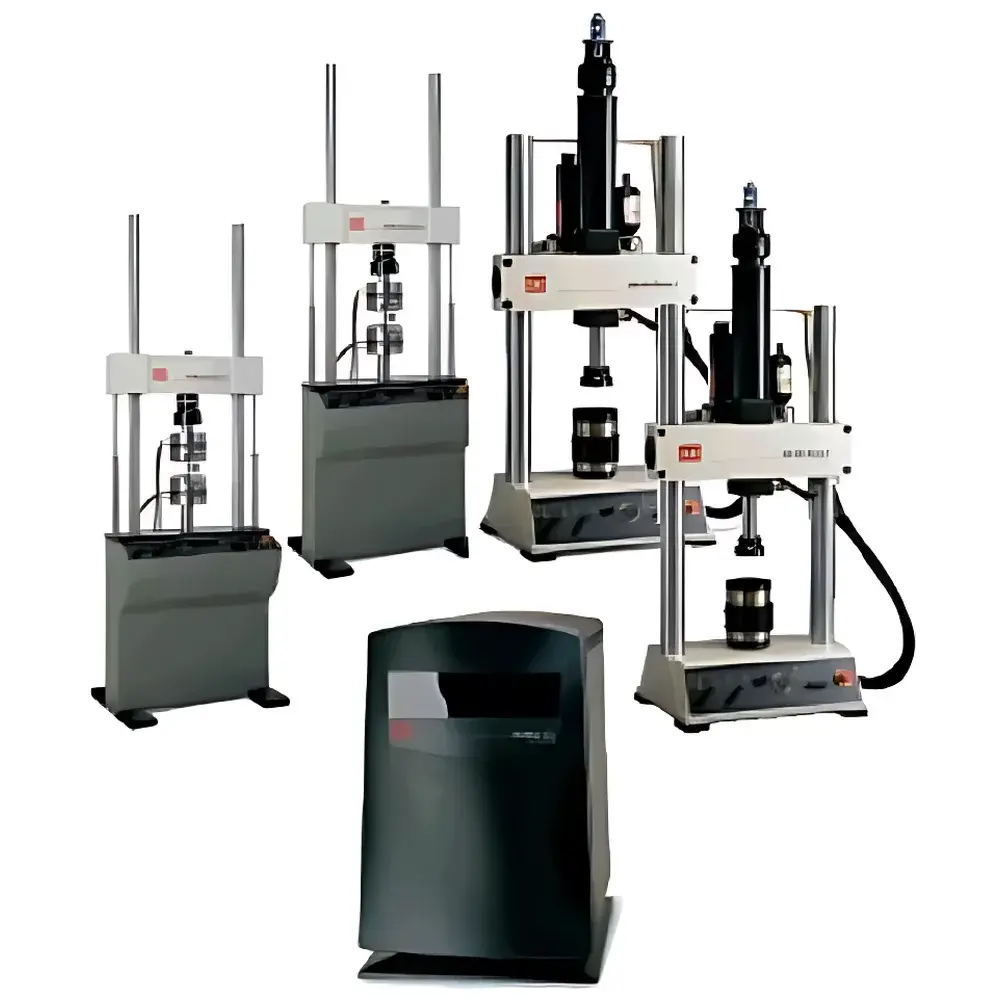
MTS 810 Electro-Hydraulic Servo Material Testing System
| Brand | MTS |
|---|---|
| Origin | USA |
| Model | 810 |
| Type | Electro-Hydraulic Servo Fatigue Testing Machine |
| Controller | TestStar II Digital Controller |
| Software | MPT Dynamic Test Software |
| Test Modes | Tension-Compression, Torsion, Combined Axial-Torsional Loading |
| Compliance | ASTM E4, E8, E9, E21, E606, E647, ISO 1099, ISO 6892-1, ISO 12106, USP <1033>, FDA 21 CFR Part 11 (with audit trail enabled) |
Overview
The MTS 810 Electro-Hydraulic Servo Material Testing System is a high-performance, closed-loop controlled dynamic testing platform engineered for precision mechanical characterization of structural and functional materials under cyclic, static, and combined loading conditions. Based on the fundamental principles of servo-hydraulic actuation—where high-bandwidth hydraulic actuators are regulated by real-time feedback from load cells, extensometers, and rotary encoders—the system delivers exceptional force fidelity, displacement resolution, and waveform reproducibility across frequencies ranging from quasi-static (0.001 Hz) to high-cycle fatigue (up to 100 Hz, depending on configuration and specimen stiffness). Designed for rigorous R&D, quality assurance, and certification testing in aerospace, automotive, biomedical, and energy sectors, the MTS 810 meets the metrological and operational demands of international material standards including ASTM, ISO, and USP protocols.
Key Features
- Electro-hydraulic servo architecture with high-stiffness load frame and low-inertia actuators, enabling stable control during high-amplitude, high-frequency cycling
- TestStar II digital controller featuring 16-bit analog-to-digital conversion, 20 kHz servo update rate, and integrated real-time signal conditioning for load, displacement, strain, and torque channels
- MPT Dynamic Test Software providing intuitive test method scripting, multi-channel synchronization, harmonic waveform generation (sine, triangle, square, user-defined), and automated compliance correction per ASTM E606
- Modular test capability supporting axial-tension/compression, pure torsion, and true biaxial axial-torsional coupling—critical for evaluating anisotropic or shear-sensitive materials
- Integrated environmental compatibility: standardized mounting interfaces for furnace systems (–150 °C to +1200 °C), cryogenic chambers, and corrosion test enclosures
- Hardware-level safety interlocks, emergency stop redundancy, and overload protection compliant with ISO 13850 and IEC 61508 SIL2 requirements
Sample Compatibility & Compliance
The MTS 810 accommodates standardized and custom specimens per ASTM E399 (compact tension), E1820 (J-integral), E1290 (crack-tip opening displacement), ISO 12737 (CTOD), and ISO 15653 (adhesive lap shear). Specimen geometries include round, flat, notched, and pre-cracked configurations up to 250 mm gauge length. Fixture options span wedge-grip, hydraulic grip, pneumatic grip, and high-precision ball-screw alignment systems ensuring ≤ ±0.02° angular misalignment. All calibration procedures adhere to ISO/IEC 17025-accredited methodologies; force verification follows ASTM E4 using NIST-traceable deadweight standards. System validation documentation supports GLP/GMP audits and regulatory submissions under FDA 21 CFR Part 11 when configured with electronic signature and audit trail modules.
Software & Data Management
MPT software operates on Windows-based industrial PCs with deterministic real-time kernel extensions. It supports hierarchical test method libraries, parameterized test templates (e.g., “High-Cycle Fatigue – R = 0.1, 10⁷ cycles”), and automatic pass/fail evaluation against user-defined acceptance criteria. Raw data streams (load, displacement, strain, temperature, torque) are recorded at ≥1 kHz sampling rate with time-synchronized metadata (operator ID, calibration date, environmental conditions). Export formats include ASCII CSV, HDF5, and ASTM E1432-compliant XML for traceability. Data integrity is enforced via SHA-256 hashing, write-once-read-many (WORM) archival options, and role-based access control aligned with 21 CFR Part 11 Annex 11 requirements.
Applications
- High- and low-cycle fatigue life prediction under constant amplitude and spectrum loading (e.g., FALSTAFF, Mini-FALSTAFF)
- Fatigue crack growth rate (da/dN) measurement per ASTM E647 using compact tension (CT) and middle-crack tension (M(T)) specimens
- Thermo-mechanical fatigue (TMF) analysis with synchronized thermal cycling and mechanical strain control
- Fracture toughness evaluation (KIc, JIc, δ5) under static and rising-load conditions
- Mechanical property mapping of additively manufactured alloys, composites, and shape-memory alloys under multiaxial states
- Creep-fatigue interaction studies per ASME BPVC Section III, Division 5
FAQ
What standards does the MTS 810 support for fatigue testing?
ASTM E606 (strain-controlled fatigue), E647 (crack growth), E466 (force-controlled constant amplitude), ISO 1099 (axial fatigue), and ISO 12106 (bending fatigue), among others.
Can the system perform combined axial-torsional fatigue tests?
Yes—using optional dual-actuator configurations and MPT’s synchronized multi-axis control module.
Is the TestStar II controller compatible with third-party sensors?
Yes, provided they output standard ±10 V analog signals or RS-422/SSI digital outputs meeting MTS’ signal conditioning specifications.
Does the system support automated calibration reporting?
Yes—calibration history, uncertainty budgets, and traceability certificates are generated in PDF and XML formats per ISO/IEC 17025 requirements.
How is data integrity ensured during long-duration fatigue tests?
Via continuous checksum validation, redundant storage paths, and timestamped audit logs with operator authentication—fully compliant with 21 CFR Part 11 when enabled.



