
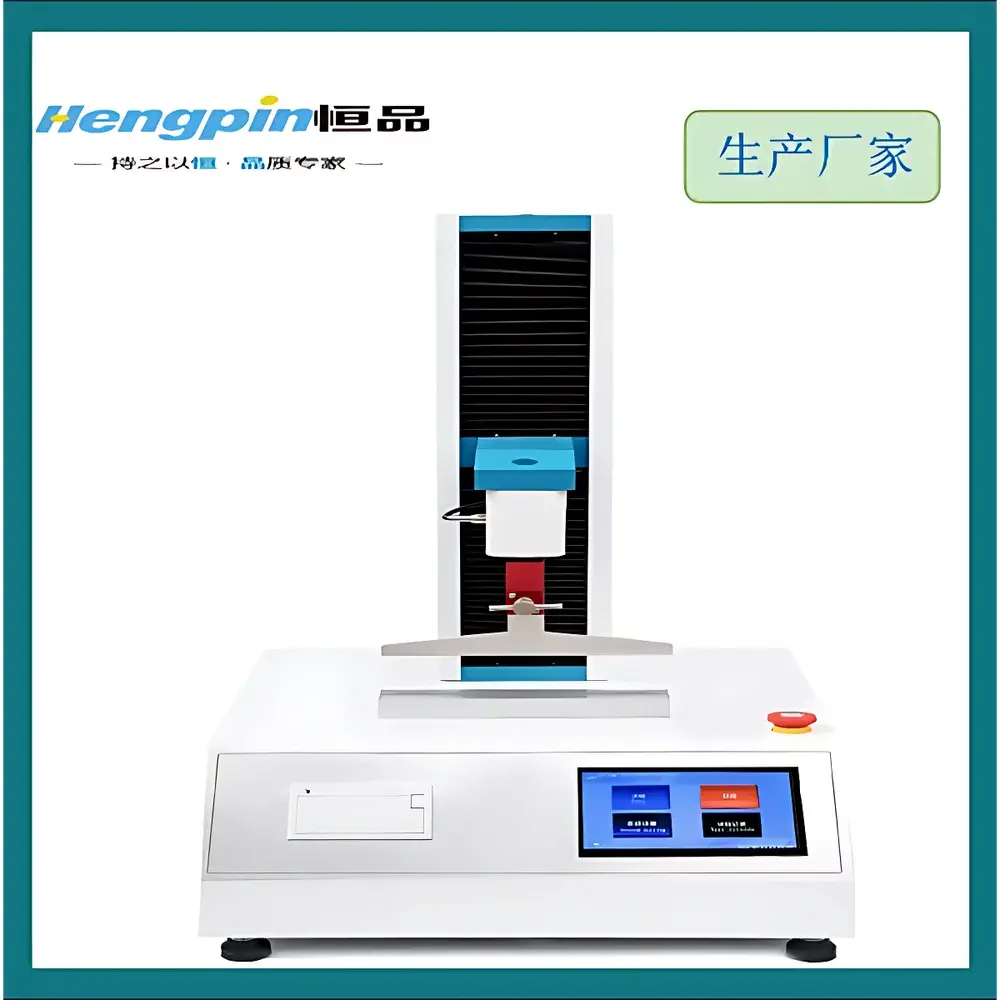
Jihengpin HP-DLT Stiffness Tester for Electrical Insulating Paper
| Brand | Jihengpin |
|---|---|
| Origin | Shandong, China |
| Manufacturer Type | Direct Manufacturer |
| Country of Origin | China |
| Model | HP-DLT |
| Price Range | USD 1,400 – 4,200 |
| Max Test Force | 50 N (optional ranges available) |
| Force Resolution | 0.001 N |
| Force Accuracy | ±1% of reading |
| Displacement Resolution | 0.01 mm |
| Displacement Accuracy | ±1% |
| Speed Range | 1–600 mm/min (digital DC motor control) |
| Test Space | 300 mm |
| Dimensions (W×D×H) | 540 × 280 × 1450 mm |
| Weight | ~70 kg |
| Power Supply | 200 V, 50 Hz |
| Operating Environment | 10–45 °C, 20–80% RH |
| Compliance | GB/T 5019.2–2009 |
| Display | Full Chinese LCD interface |
| Control Mode | Touch-key + optional PC software (USB/RS232) |
Overview
The Jihengpin HP-DLT Stiffness Tester is a precision single-column mechanical testing instrument engineered specifically for the quantitative evaluation of bending resistance—commonly referred to as “stiffness”—in thin, flexible sheet materials used in electrical insulation applications. It operates on the principle of controlled three-point bending under quasi-static loading, where a defined specimen span is subjected to a centrally applied force via a moving crosshead. The resulting load-deflection curve is processed in real time to calculate stiffness (expressed in mN·m or g·cm, per GB/T 5019.2–2009), a critical parameter governing handling performance, winding integrity, die-cutting fidelity, and interlayer mechanical stability in high-voltage insulation systems. Designed for routine QC/QA laboratories in manufacturers of insulating papers, mica tapes, polyester films, metal foils, separator membranes, and backsheet laminates, the HP-DLT delivers repeatable, traceable measurements aligned with national standard methodologies while maintaining full compatibility with international material qualification workflows.
Key Features
- High-stability drive system: Digital DC motor coupled with precision planetary gearbox ensures smooth, low-noise motion across the full speed range (1–600 mm/min), with built-in overcurrent, overvoltage, and overload protection.
- Low-backlash transmission: Arc-synchronous timing belt and ground precision ball screw assembly guarantee minimal hysteresis and long-term positional repeatability.
- Self-aligning universal joint fixture: Cross-pin configuration with angular constraint limits eliminates eccentric loading and compensates for minor specimen irregularities—preserving sensor linearity and test validity.
- Full-featured LCD operator interface: 5.7-inch monochrome TFT display with intuitive Chinese menu navigation; real-time dynamic rendering of test force (N), displacement (mm), peak load, stiffness value, and crosshead velocity.
- Automatic calibration protocol: Onboard self-calibration sequence verifies force transducer linearity and zero offset prior to each test session—supporting GLP-compliant documentation requirements.
- Programmable test sequencing: Users define pre-set parameters (span length, speed, target displacement or load limit); system executes full cycle autonomously, including automatic stop upon completion or overload detection.
- Integrated safety architecture: Dual-limit mechanical switches and software-enforced travel boundaries prevent actuator overtravel and protect both operator and load cell.
Sample Compatibility & Compliance
The HP-DLT accommodates standardized specimens per GB/T 5019.2–2009—including 38 mm wide × 70 mm long strips of electrical insulating paper, mica tape, polyimide film, PET, PP, aluminum foil, lithium-ion battery separators, and photovoltaic backsheet composites. Its modular fixture design supports rapid tooling changes without recalibration. While optimized for Chinese national standards, the instrument’s measurement methodology is technically harmonized with ISO 2493 (paper and board stiffness), ASTM D747 (rigidity of plastic materials), and TAPPI T 543 (bending resistance of paper). All force and displacement signals are traceable to national metrological standards, and raw data output meets minimum audit trail requirements for internal quality systems operating under ISO 9001 or IATF 16949 frameworks.
Software & Data Management
The base configuration includes embedded firmware with non-volatile memory for storing up to 100 test records, including timestamp, operator ID (manual entry), sample ID, stiffness result, and full load-displacement curve points. Optional PC-integrated software (supplied on USB drive) enables advanced functionality: automated report generation (PDF/Excel), statistical process control (SPC) charting (X̄-R, Cp/Cpk), multi-curve overlay comparison, user-defined pass/fail thresholds, and electronic signature support. Data export complies with FDA 21 CFR Part 11 basic requirements—audit trail logging, user access levels, and immutable record retention—making it suitable for regulated environments where documentation integrity is mandatory.
Applications
- Quality conformance testing of cellulose-based and synthetic insulating papers supplied to transformer and motor manufacturers.
- Process validation of calendering, resin impregnation, and thermal curing steps affecting stiffness in mica tape production.
- Batch release verification for polymer films used in capacitor dielectrics and flexible printed circuit substrates.
- R&D screening of novel composite backsheet materials for photovoltaic modules under accelerated aging protocols.
- Comparative analysis of anode/cathode separator stiffness in lithium-ion battery cell design—correlating mechanical rigidity with electrode stack compressibility and thermal runaway mitigation.
- Failure root cause investigation when delamination, wrinkling, or poor slitting performance is observed during high-speed converting operations.
FAQ
What standards does the HP-DLT comply with?
It is fully compliant with GB/T 5019.2–2009 for electrical insulating paper stiffness testing. Its mechanical design and measurement algorithms are also compatible with ISO 2493, ASTM D747, and TAPPI T 543.
Can the instrument be integrated into a laboratory LIMS or MES system?
Yes—via optional RS232 or USB virtual COM port, the device supports ASCII-based command-response communication for automated job dispatch and result ingestion.
Is force calibration traceable to national standards?
Yes. The load cell is factory-calibrated using certified dead-weight standards traceable to CNAS-accredited metrology institutes; calibration certificates are provided with each unit.
What maintenance is required for long-term accuracy?
Annual verification of force and displacement linearity is recommended. No routine lubrication is needed—the timing belt and ball screw are sealed and lifetime greased.
Does the system support bilingual (Chinese/English) operation?
The standard interface is Chinese-only; English-language firmware and PC software are available upon request for export configurations.




