
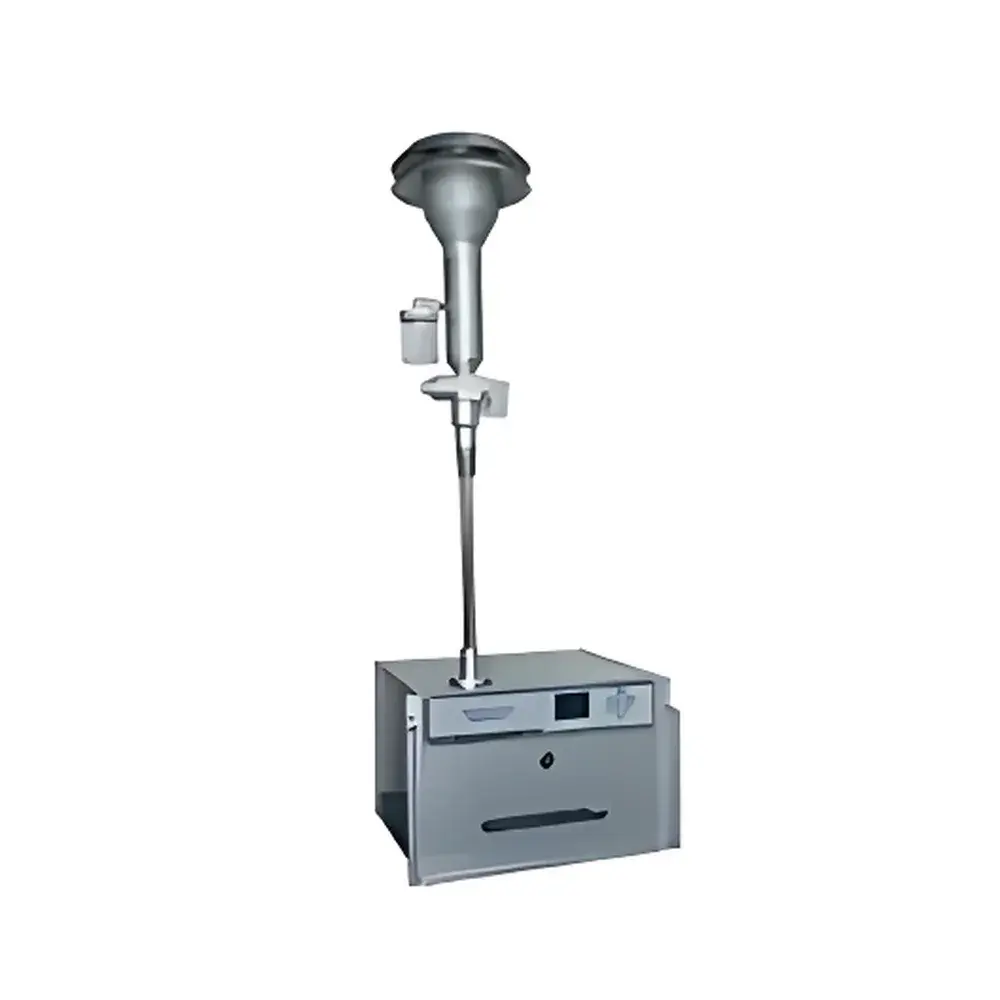
SkyRay Instrument EPM-2050 Online Atmospheric Particulate Matter Analyzer
| Brand | SkyRay Instrument |
|---|---|
| Origin | Jiangsu, China |
| Manufacturer Type | Manufacturer |
| Country of Origin | Domestic (China) |
| Model | EPM-2050 |
| Price Range | USD 21,000 – 35,000 (FOB) |
| Measurement Method | Beta-ray Absorption (β-ray) |
| Measured Parameters | PM₂.₅, PM₁₀, TSP |
| Radioisotope Source | Carbon-14 (¹⁴C), Activity ≤ 100 µCi |
| Detection Limit | ≤ 2 µg/m³ (24-hr avg) |
| Concentration Range | 0–1000 µg/m³ or 0–10,000 µg/m³ |
| Resolution | 0.1 µg/m³ |
| Accuracy | ≤ ±5% (24-hr avg) |
| Flow Rate | 16.67 L/min (±2% stability) |
| Measurement Cycle | Adjustable, ≤ 60 min |
| Parallelism | ≤ ±10% |
| Display Interval | Default 1 hr, user-configurable |
| Operating Temp. (Analyzer) | 15–40 °C |
| Operating Humidity | ≤ 90% RH |
| Power Supply | AC 220 V ±10%, 50 Hz |
| Dimensions (L×W×H) | 417 × 483 × 382 mm |
| Weight | 25 kg (analyzer), 7.5 kg (pump) |
Overview
The SkyRay Instrument EPM-2050 Online Atmospheric Particulate Matter Analyzer is an industrial-grade, continuous ambient air monitoring system engineered for high-reliability quantification of airborne particulate mass concentrations. It operates on the beta-ray absorption principle — a gravimetric reference method endorsed by the U.S. Environmental Protection Agency (EPA) and standardized in ISO 10473, EN 12341, and China’s HJ 653–2013. As ambient air is drawn through a size-selective inlet (e.g., PM₂.₅, PM₁₀, or TSP cyclone), particles are deposited onto a moving filter tape. A low-activity ¹⁴C beta radiation source emits electrons; attenuation of the beta flux—measured via a high-efficiency scintillation photomultiplier tube—is directly proportional to the accumulated particle mass. Unlike Geiger-Müller detectors, this solid-state detection architecture delivers superior signal-to-noise ratio, long-term stability (>5 years operational lifetime), and immunity to voltage drift or aging-related gain loss.
Key Features
- Regulatory-Compliant Beta-Ray Methodology: Fully aligned with EPA Reference Method PS-3 and equivalent national standards for regulatory-grade PM monitoring.
- Integrated Dynamic Heating System (DHS): Heats the entire sample pathway—including inlet line, flow path, and filter chamber—to suppress water vapor condensation while preserving semi-volatile organic compounds (SVOCs) and ammonium nitrate fractions critical for chemical speciation studies.
- Single-Channel Gravimetric Architecture: Particle collection and beta measurement occur within the same physical channel, eliminating mechanical tape transport errors common in dual-path systems.
- Ultra-Low Maintenance Design: Filter tape consumption minimized via adaptive sampling algorithms; standard operation supports ≥2 years of unattended use without tape replacement under typical urban ambient conditions.
- Robust Environmental Adaptation: Full-tube heating enables rapid thermal response during sudden ambient temperature/humidity shifts; certified operation from −40 °C to +50 °C at the inlet and 15–40 °C at the analyzer chassis.
- Modular Cut-Point Flexibility: Compatible with EPA-certified sharp-cut cyclones (TSP, PM₁₀, PM₂.₅, and optional PM₁) for multi-fractional aerosol characterization in research and compliance applications.
Sample Compatibility & Compliance
The EPM-2050 accepts standard 47-mm or 50-mm diameter quartz or Teflon-coated glass fiber filters and integrates seamlessly with NIOSH/ISO-compliant inlet assemblies. Its measurement traceability is anchored to primary gravimetric calibration protocols per ISO/IEC 17025-accredited laboratories. The instrument meets electromagnetic compatibility (EMC) requirements per IEC 61326-1 and safety standards per IEC 61010-1. Radiation shielding complies with IAEA Safety Standards Series No. SSG-11, ensuring no detectable external dose rate (>0.1 µSv/h) beyond the enclosure. Data integrity adheres to principles supporting GLP and GMP environments, including audit-trail-enabled firmware logging and time-stamped event records.
Software & Data Management
Built-in embedded Linux OS supports dual-language (English/Chinese) GUI with real-time graphical display of concentration trends, flow diagnostics, heater status, and system health metrics. Internal flash memory retains ≥180 days of 1-minute averaged data (including raw beta counts, temperature, pressure, flow, and humidity). Data export is supported via USB, RS-232/485 serial, Ethernet (TCP/IP Modbus RTU/TCP), and analog 4–20 mA outputs. Optional SkyRay DataLink software provides remote configuration, firmware updates, spectral diagnostics, QA/QC flagging (e.g., flow deviation >±5%, heater fault), and automated report generation compliant with China’s CNEMC format and EU Air Quality Directive reporting templates.
Applications
- Ambient air quality monitoring networks (national, provincial, and municipal)
- Source apportionment and receptor modeling support through synchronized multi-fraction PM data
- Background station measurements in rural, alpine, or marine environments
- Industrial fence-line and community exposure assessment
- Long-term trend analysis for environmental impact assessments and regulatory permitting
- Early-warning systems for haze episodes and transboundary dust events
FAQ
Is the ¹⁴C source exempt from nuclear regulatory licensing in most jurisdictions?
Yes — with activity ≤100 µCi, the EPM-2050 qualifies as a “generally licensed device” under U.S. NRC 10 CFR 31.11 and equivalent frameworks in the EU (Council Directive 2013/59/Euratom) and China (HJ 1155–2021), requiring only site registration, not individual source licensing.
Can the EPM-2050 be integrated into existing SCADA or air quality management platforms?
Yes — native Modbus TCP/RTU, ASCII serial protocol, and configurable analog outputs enable plug-and-play integration with Siemens Desigo, Honeywell Experion, or open-source platforms like ThingsBoard and Grafana.
What calibration frequency is recommended for regulatory compliance?
Annual field calibration using NIST-traceable check weights and dynamic flow verification is sufficient per EPA QA/G-1 guidance; zero/span checks may be performed quarterly using clean air and calibrated aerosol generators.
Does the instrument support co-location studies with TEOM or FDMS instruments?
Yes — synchronized timestamping, adjustable cycle times (15–60 min), and parallel analog/digital outputs allow direct comparison with tapered element oscillating microbalance (TEOM) or filter dynamic measurement system (FDMS) reference analyzers.







