
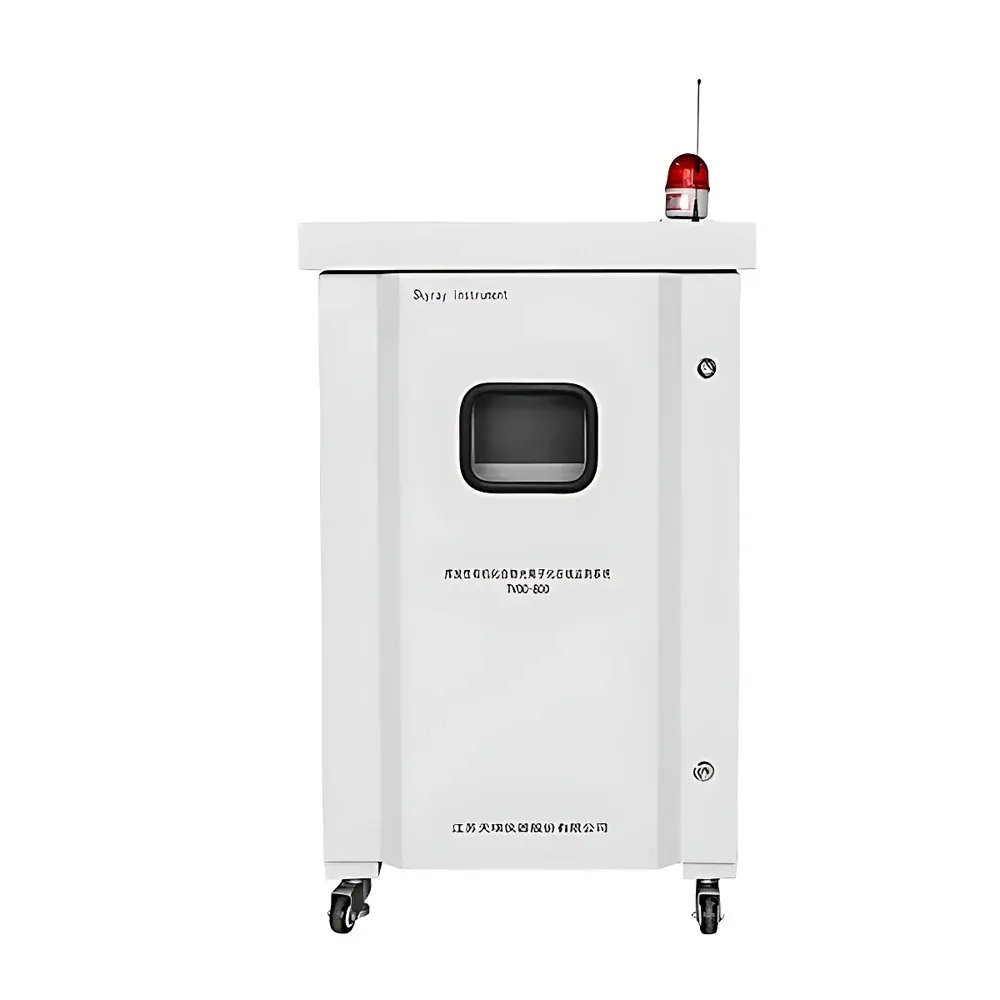
SkyRay Instrument TVOC-800 Portable Photoionization Detector (PID) Based Online VOC Monitoring System
| Brand | SkyRay Instrument |
|---|---|
| Origin | Jiangsu, China |
| Manufacturer Type | Manufacturer |
| Origin Category | Domestic |
| Model | TVOC-800 |
| Detection Principle | Photoionization Detection (PID) |
| Instrument Type | Portable |
| Typical Configuration | TVOC Analyzer |
| Detection Range | 0–20 / 200 / 1000 ppm (field-selectable) |
| Resolution | ≤10 ppb |
| Accuracy | ≤±10% of Full Scale |
| Response Time | ≤20 s |
Overview
The SkyRay Instrument TVOC-800 is a field-deployable, continuous online monitoring system engineered for real-time quantification of total volatile organic compounds (TVOCs) and individual volatile organic compounds (VOCs) in ambient and industrial stack emissions. It operates on the fundamental principle of photoionization detection (PID), wherein ultraviolet (UV) photons from a high-stability lamp (typically 10.6 eV or 11.7 eV) impart sufficient energy to ionize VOC molecules without fragmentation. The resulting positive ions and electrons are collected at biased electrodes, generating a current proportional to analyte concentration. As a non-destructive, non-combustive technique, PID preserves sample integrity—enabling downstream analysis or recovery where required. Designed for compliance with regulatory frameworks governing fugitive and point-source emissions, the TVOC-800 meets the technical specifications outlined in Guangdong Provincial Standard DB44/T 1947–2016 (“Technical Requirements for Continuous Automatic Monitoring Systems of VOC Emissions from Fixed Pollution Sources – PID Method”) and aligns with Hebei Provincial Department of Ecology and Environment’s directive on VOC monitoring in key industrial parks. Its architecture supports both organized (stack/duct) and unorganized (fenceline,厂区 boundary, ambient workplace) emission monitoring under GLP-aligned operational protocols.
Key Features
- High-sensitivity imported PID sensor with ≤10 ppb resolution and ≤±10% F.S. accuracy across three user-selectable ranges (0–20 ppm, 0–200 ppm, 0–1000 ppm)
- Integrated dual-stage particulate filtration and condensate removal system to protect sensor integrity and extend maintenance intervals
- Automated sample line purge and backflush functionality to prevent cross-contamination and ensure measurement repeatability
- Sub-60-second analysis cycle time—enabling near-real-time response to concentration transients
- IP65-rated ruggedized enclosure with corrosion-resistant coating, eliminating need for sheltered housing in outdoor deployments
- Multi-protocol data transmission: 4–20 mA analog output (≤500 Ω load), RS485 Modbus RTU, and embedded LTE/WiFi module compliant with HJ/T 212–2017 for seamless integration into national environmental monitoring platforms
- Optional ATEX/IECEx-certified explosion-proof configuration for Zone 1/21 hazardous locations including refueling stations and chemical storage perimeters
Sample Compatibility & Compliance
The TVOC-800 demonstrates broad compatibility with C2–C12 hydrocarbons (e.g., benzene, toluene, xylene, styrene), oxygenates (e.g., acetone, ethanol, ethyl acetate), chlorinated solvents (e.g., trichloroethylene), and sulfur-containing VOCs (e.g., mercaptans), provided their ionization energies fall below the UV lamp photon energy. It excludes methane, ethane, and other saturated alkanes with IE > 12.6 eV. The system is certified under China Environmental Protection Product Certification (CCEP) and conforms to GB/T 38397–2019 for performance evaluation of VOC online analyzers. While not intrinsically compliant with ISO 16000 series or ASTM D6196, its PID methodology is referenced in EPA Method TO-15 Appendix B and EU EN 14181 for QAL2/QAL3 validation pathways. Data logging and audit trails meet minimum requirements for GLP documentation; optional 21 CFR Part 11-compliant software modules are available upon request for regulated pharmaceutical or fine chemical manufacturing environments.
Software & Data Management
Embedded firmware provides local data acquisition, time-stamped storage (≥12 months at 1-min intervals), and onboard trend visualization. The system supports configurable alarm thresholds (pre-set or dynamic), hysteresis-based event triggering, and relay-driven physical alerts. Export formats include CSV and XML for third-party LIMS or SCADA ingestion. Remote access is enabled via secure HTTPS web interface or dedicated desktop application supporting role-based user permissions (operator, technician, administrator). All configuration changes, calibration events, and alarm activations are logged with timestamps and operator IDs—facilitating traceability during regulatory audits. Historical reporting includes customizable hourly/daily/monthly/annual summary tables with statistical parameters (min/max/mean/standard deviation) and graphical overlays for comparative analysis across multiple monitoring points.
Applications
- Continuous fenceline monitoring at petrochemical refineries, paint manufacturing facilities, and adhesive production plants
- Real-time stack emission verification for compliance with local VOC discharge permits (e.g., Shanghai DB31/1025–2020)
- Indoor air quality (IAQ) assessment in semiconductor cleanrooms and pharmaceutical formulation suites
- Leak detection and repair (LDAR) program support via mobile survey mode using integrated GPS tagging
- Emergency response deployment for accidental VOC releases—leveraging rapid startup (<60 s) and battery-backed operation
- Integration with meteorological stations (wind speed/direction, temperature, humidity, pressure) for dispersion modeling inputs
FAQ
What VOC compounds does the TVOC-800 detect?
It detects most VOCs with ionization energies below the installed UV lamp’s photon energy (commonly 10.6 eV), including aromatics, ketones, esters, amines, and sulfides—but not methane, ethane, or Freon-type compounds.
Is calibration traceable to NIST standards?
Yes—factory calibration uses certified gas standards traceable to CNAS-accredited reference materials; field calibration kits with NIST-traceable isobutylene or benzene standards are available as accessories.
Can the system operate unattended for extended periods?
Yes—designed for continuous 24/7 operation with automatic zero/span checks, self-diagnostic routines, and low-power sleep modes during idle cycles.
Does it support remote firmware updates?
Yes—over-the-air (OTA) updates are supported via encrypted TLS channel with digital signature verification to ensure code integrity.
What maintenance intervals are recommended?
Sensor lamp replacement every 6,000 operating hours; particulate filter exchange every 3 months in high-dust environments; full system verification annually per GB/T 38397–2019 QAL3 requirements.
Related Products







