
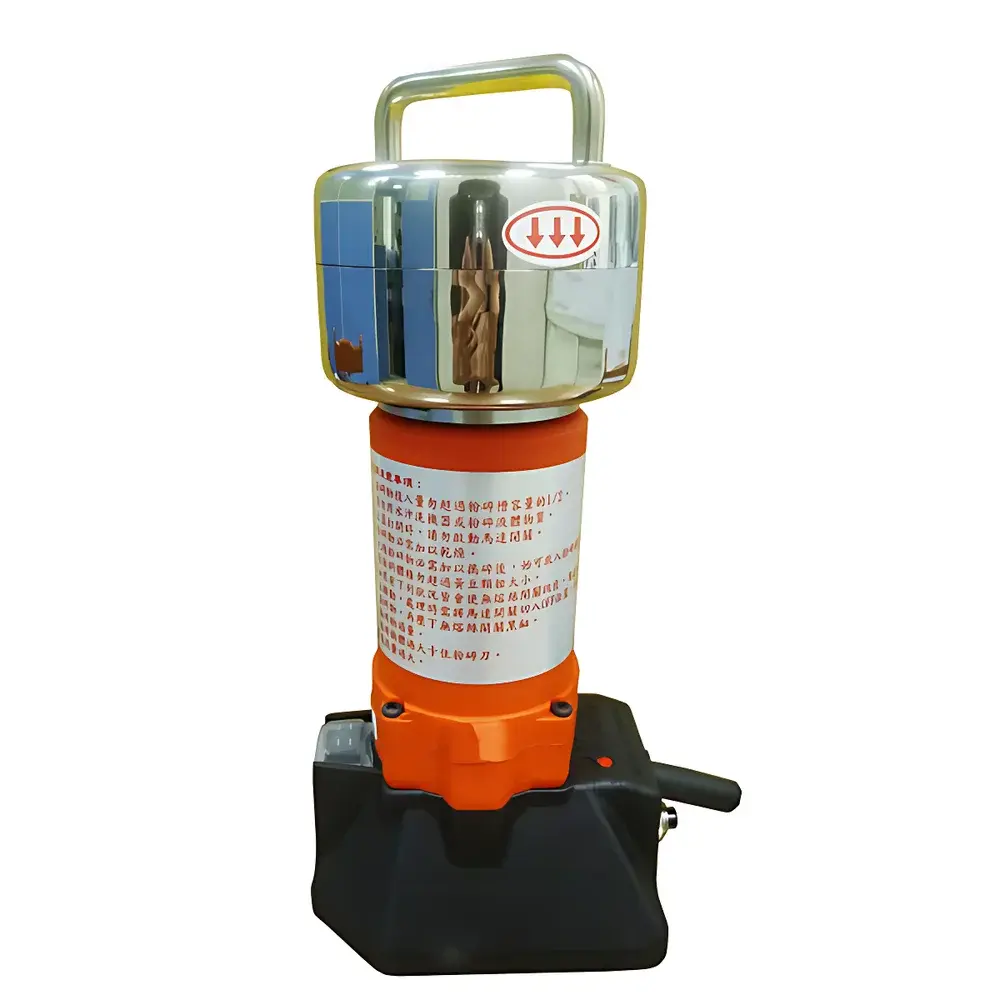
Rong Tsong RT-N01A High-Speed Benchtop Grinder
| Brand | Rong Tsong |
|---|---|
| Origin | Taiwan |
| Model | RT-N01A |
| Motor Power | 300 W |
| Voltage | 220 V AC, single-phase (custom voltage available) |
| Speed | 27,000 rpm |
| Chamber Capacity | 50 g |
| Feed Size | < 25 mm |
| Output Particle Size | 0.01–0.5 mm (≤ 350 µm) |
| Grinding Chamber Dimensions (H × Ø) | 31 × 87 mm |
| Unit Dimensions (W × D × H) | 152 × 105 × 270 mm |
| Net Weight | 2.1 kg |
| Chamber Material | SUS304 stainless steel |
| Blade Material | Heat-treated SUS420 stainless steel |
| Bearing | Imported Japanese precision bearing |
| Thermal Overload Protection | Integrated motor protection switch |
Overview
The Rong Tsong RT-N01A is a compact, high-speed benchtop grinder engineered for rapid, reproducible size reduction of dry, brittle, and moderately hard solid samples in laboratory and pilot-scale environments. It operates on the principle of high-velocity impact comminution: a dynamically balanced, heat-treated stainless-steel rotor blade rotates at 27,000 rpm within a sealed SUS304 grinding chamber, subjecting feed material to repeated centrifugal acceleration and collision against the chamber wall and blade edges. This mechanism enables efficient particle size reduction without significant thermal degradation—critical for temperature-sensitive botanicals, pharmaceutical excipients, and analytical reference standards. Designed for discrete batch processing rather than continuous throughput, the RT-N01A delivers consistent sub-350 µm output with minimal operator intervention and no external cooling requirement. Its 50 g nominal capacity aligns with ASTM E11 and ISO 3310-1 sieve calibration protocols, supporting method development for downstream analysis including XRD, SEM sample prep, dissolution testing, and homogeneity assessment.
Key Features
- Robust 300 W aluminum-housed induction motor with integrated thermal overload protection—prevents coil burnout during extended or repeated operation.
- SUS304 stainless-steel grinding chamber ensures compliance with food-grade and pharmaceutical hygiene requirements (FDA 21 CFR Part 110, EU GMP Annex 15 traceability considerations).
- Heat-treated SUS420 stainless-steel cutting blade provides superior wear resistance and dimensional stability over prolonged use—reducing blade replacement frequency and maintaining grind consistency.
- Precision Japanese ball bearings ensure low-vibration, quiet operation and extended service life under intermittent high-RPM duty cycles.
- Compact footprint (152 × 105 × 270 mm) and lightweight design (2.1 kg) enable flexible placement on fume hoods, laminar flow benches, or mobile lab carts.
- Single-phase 220 V input with optional voltage configuration support facilitates global deployment across regional power infrastructures.
Sample Compatibility & Compliance
The RT-N01A is validated for dry, non-fibrous, non-sticky, and non-oily materials with Mohs hardness ≤ 6.5—including herbal granules, dried plant tissues, mineral powders, ceramic precursors, polymer pellets, and cosmetic pigments. It is not suitable for wet, fibrous (e.g., cellulose-rich stems), elastomeric, or highly abrasive materials (e.g., silicon carbide). Feed particles must be pre-sieved to < 25 mm to prevent chamber jamming and ensure uniform energy transfer. Output fineness ranges from 150–200 mesh (≈ 106–75 µm) depending on material brittleness, moisture content (< 8% w/w recommended), and total grinding duration (typically 15–60 s per cycle). The unit meets CE electromagnetic compatibility (EMC) Directive 2014/30/EU and conforms to IEC 61000-3-2 harmonic current emission limits. Documentation supports GLP-compliant instrument qualification (IQ/OQ) when paired with standardized SOPs for cleaning verification and performance testing.
Software & Data Management
As a manually operated mechanical grinder, the RT-N01A does not incorporate embedded firmware, digital controls, or data logging capabilities. All operational parameters—including run time, number of cycles, and post-grind sieve analysis—are recorded externally via laboratory notebook entries or LIMS-integrated electronic batch records. For regulated environments (e.g., USP <701>, ISO/IEC 17025), users are advised to implement written procedures governing blade calibration checks, chamber cleaning validation (residue limit ≤ 10 ppm), and periodic torque verification of the blade-mounting assembly. Audit trails for maintenance logs and calibration certificates must be retained per FDA 21 CFR Part 11 principles where electronic records are used.
Applications
- Pharmaceutical R&D: Preparation of uniform powder blends for tablet formulation studies and dissolution rate profiling.
- Traditional Medicine Labs: Standardized grinding of dried herbs prior to HPLC fingerprinting or heavy metal screening (USP <232>/<233>).
- Food Safety Testing: Homogenization of composite samples (e.g., spices, grains) for mycotoxin or pesticide residue analysis (AOAC 2007.01).
- Materials Science: Size reduction of ceramic oxides and battery cathode precursors for BET surface area measurement and particle morphology evaluation.
- Environmental Labs: Pulverization of soil aggregates and sediment cores for elemental analysis by ICP-MS or XRF.
FAQ
What is the maximum recommended operating time per cycle to avoid overheating?
Continuous operation beyond 60 seconds is not advised; allow ≥ 90 seconds of cooling between cycles to maintain motor longevity and prevent thermal drift in particle size distribution.
Can the grinding chamber be autoclaved?
No—the chamber contains non-sterilizable seals and thermoplastic components; clean with ethanol or isopropanol followed by air drying per SOP.
Is the RT-N01A compliant with ISO 17025 method validation requirements?
Yes, provided users document and verify repeatability (RSD ≤ 5% for D50 across n=6 replicates) and carry out routine preventive maintenance as outlined in the manufacturer’s technical manual.
Does the unit include a sieve set or particle size analyzer?
No—particle size verification requires external instrumentation such as a laser diffraction analyzer (e.g., Malvern Mastersizer) or certified test sieves per ISO 3310-1.
What maintenance intervals are recommended for optimal performance?
Inspect blade sharpness and chamber integrity every 50 operating hours; replace blade after 200 hours or upon visible edge rounding; lubricate bearings annually using ISO VG 32 synthetic oil.



