
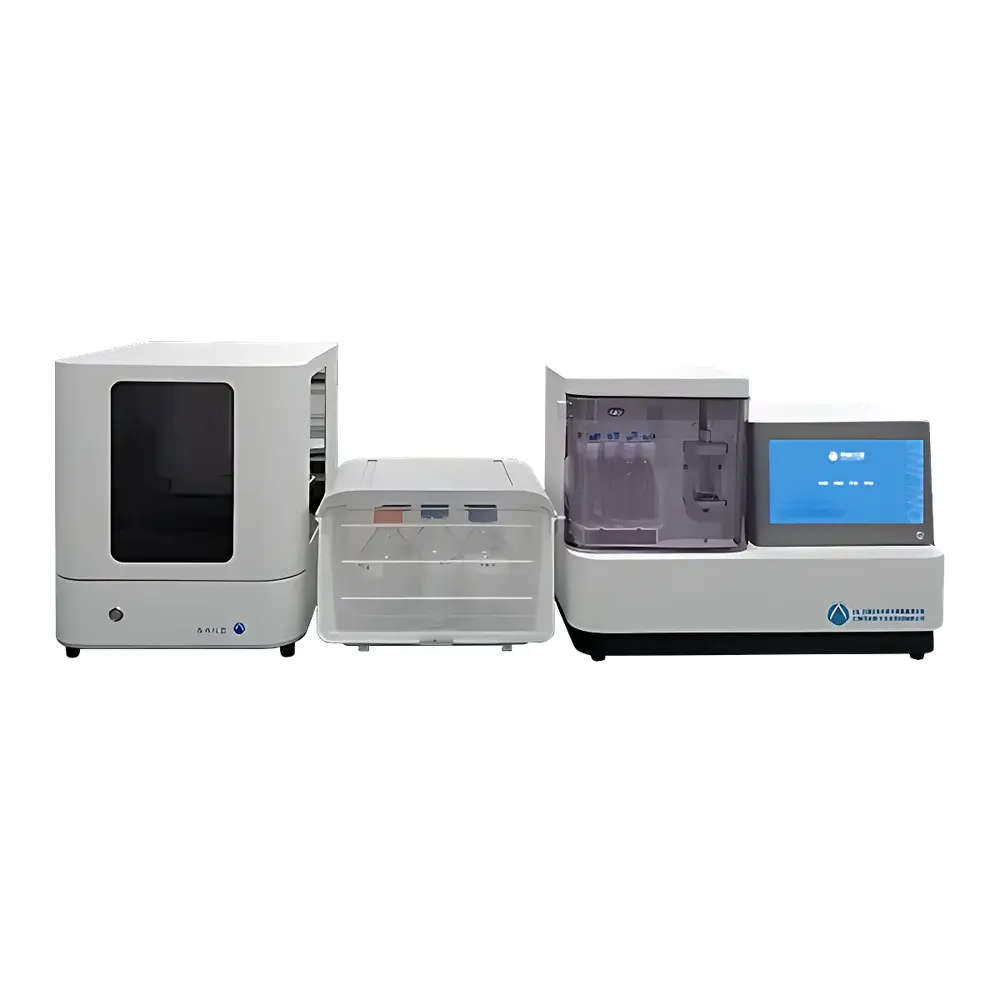
Online Instrument OL2060 Automated Ammonia Nitrogen Analyzer
| Brand | Online Instrument |
|---|---|
| Origin | Shanghai, China |
| Manufacturer Type | Manufacturer |
| Product Category | Domestic |
| Model | OL2060 |
| Instrument Type | Laboratory Analyzer |
| Measurement Principle | Colorimetric Method (Nesslerization) |
| Measurement Range | 0.1–2.0 mg/L (auto-dilution available beyond range) |
| Accuracy | <2% RSD |
| Detection Limit | 0.025 mg/L per HJ 535–2009 |
| Analysis Time | 10 min (Direct Method), 50 min (Distillation Method) |
| Sample Capacity | 25-position or 50-position carousel |
| Measurement Modes | Direct, Coagulation-Precipitation, Distillation |
| Calibration | Multi-point Standard Curve |
| Remote Monitoring | Web-based & mobile-compatible control and data retrieval |
| Compliance | Fully aligned with HJ 535–2009, GB/T 5750.1–2023, and ISO 7150-1 |
Overview
The Online Instrument OL2060 Automated Ammonia Nitrogen Analyzer is a laboratory-grade, fully integrated system engineered for precise, trace-level quantification of ammonia nitrogen (NH₃-N) in aqueous environmental samples. It implements the standardized colorimetric Nesslerization method—based on the formation of a yellow-brown colloidal complex between ammonium ions and alkaline potassium iodomercuric iodide—measured spectrophotometrically at 420 nm. Designed to comply strictly with Chinese national standards HJ 535–2009 (for environmental water quality analysis) and GB/T 5750.1–2023 (for drinking water testing), as well as internationally referenced ISO 7150-1, the OL2060 ensures metrological traceability and regulatory acceptability across municipal, industrial, and research laboratories. Its architecture supports both direct measurement and distillation pretreatment, enabling reliable analysis across diverse matrices—including surface water, groundwater, domestic wastewater, and high-salinity or turbid industrial effluents—without manual intervention.
Key Features
- Fully automated workflow: Integrated robotic sample handling, reagent dispensing, distillation (optional module), color development, photometric detection, and waste containment—all synchronized under embedded control logic.
- Dual-mode analytical flexibility: Supports direct analysis for low-interference samples and distillation-coupled analysis for samples requiring matrix separation (e.g., seawater, digested sludge supernatants).
- Auto-dilution capability: Dynamically extends effective measurement range beyond 2.0 mg/L while maintaining <2% accuracy through gravimetric or volumetric dilution protocols.
- Sealed, operator-safe operation: All reagent handling and distillation occur within closed-loop pathways; no open-vessel transfers or manual pipetting required. Waste is automatically collected in designated containment vessels.
- Modular integration readiness: Compatible with third-party automated distillation units via standardized I/O interfaces (RS-485, Modbus TCP), enabling seamless upgrade of legacy systems without full replacement.
- Calibration integrity: Implements multi-point standard curve generation with built-in drift compensation and blank subtraction—validated per GLP-aligned calibration verification procedures.
Sample Compatibility & Compliance
The OL2060 accommodates sample volumes consistent with HJ 535–2009 (50 mL for distillation, 10–50 mL for direct assay) and maintains strict adherence to reagent stoichiometry and reaction timing specified in both HJ 535–2009 and GB/T 5750.1–2023. It accepts samples in standard 16 mm × 100 mm borosilicate glass tubes or polypropylene vials, with optional barcode scanning for LIMS traceability. The system meets essential requirements for ISO/IEC 17025-compliant laboratories, including audit-ready electronic records, instrument performance logs, and user-access-level authentication. Data export formats include CSV, PDF analytical reports, and XML (ASTM E1384-compliant) for integration into enterprise QA/QC platforms.
Software & Data Management
The OL2060 runs on a Linux-based embedded OS with a web-responsive GUI accessible via local network or secure remote connection (TLS 1.2+). Software features include real-time status dashboards, scheduled run queues, automatic QC flagging (e.g., absorbance saturation, calibration deviation >5%), and configurable alarm thresholds. All analytical events—including reagent lot tracking, maintenance timestamps, and user-initiated actions—are logged with immutable timestamps and operator IDs, satisfying FDA 21 CFR Part 11 requirements for electronic records and signatures when deployed in regulated environments. Data backups are performed daily to internal SSD and optionally mirrored to network-attached storage (NAS) or cloud endpoints via SFTP.
Applications
- Regulatory compliance monitoring for municipal wastewater treatment plants (WWTPs) reporting to local EPBs under China’s “Water Pollution Prevention and Control Action Plan”.
- Source water surveillance in drinking water utilities validating raw intake and finished water quality per GB 5749–2022.
- Industrial effluent characterization for chemical, pharmaceutical, and food processing facilities subject to discharge permit limits.
- Academic and research laboratories conducting nitrogen cycle studies, nitrification/denitrification kinetics, or method validation projects.
- Environmental consulting firms performing field-to-lab chain-of-custody analyses where reproducibility and minimal analyst variability are critical.
FAQ
Does the OL2060 require external distillation equipment for all sample types?
No—distillation is only activated when selected in the method protocol. Direct and coagulation-precipitation modes operate entirely within the analyzer’s integrated manifold.
Can calibration curves be imported from external LIMS or generated in-house?
Yes—the software supports manual entry, CSV upload of standard concentration/absorbance pairs, and automated curve fitting with linear or quadratic regression options.
What maintenance intervals are recommended for long-term operational stability?
Daily: Waste container check and optical path wipe. Weekly: Reagent line purge and pump calibration verification. Annually: Photometer wavelength validation and distillation coil descaling (if applicable).
Is the system compatible with ISO 17025 internal audit documentation requirements?
Yes—audit trails, calibration records, preventive maintenance logs, and method validation reports are exportable in PDF/A-1b format with embedded digital signatures.
How is data security ensured during remote access sessions?
All remote connections enforce two-factor authentication (2FA), session timeouts after 15 minutes of inactivity, and end-to-end encryption using AES-256 for data-at-rest and TLS 1.3 for data-in-transit.







