
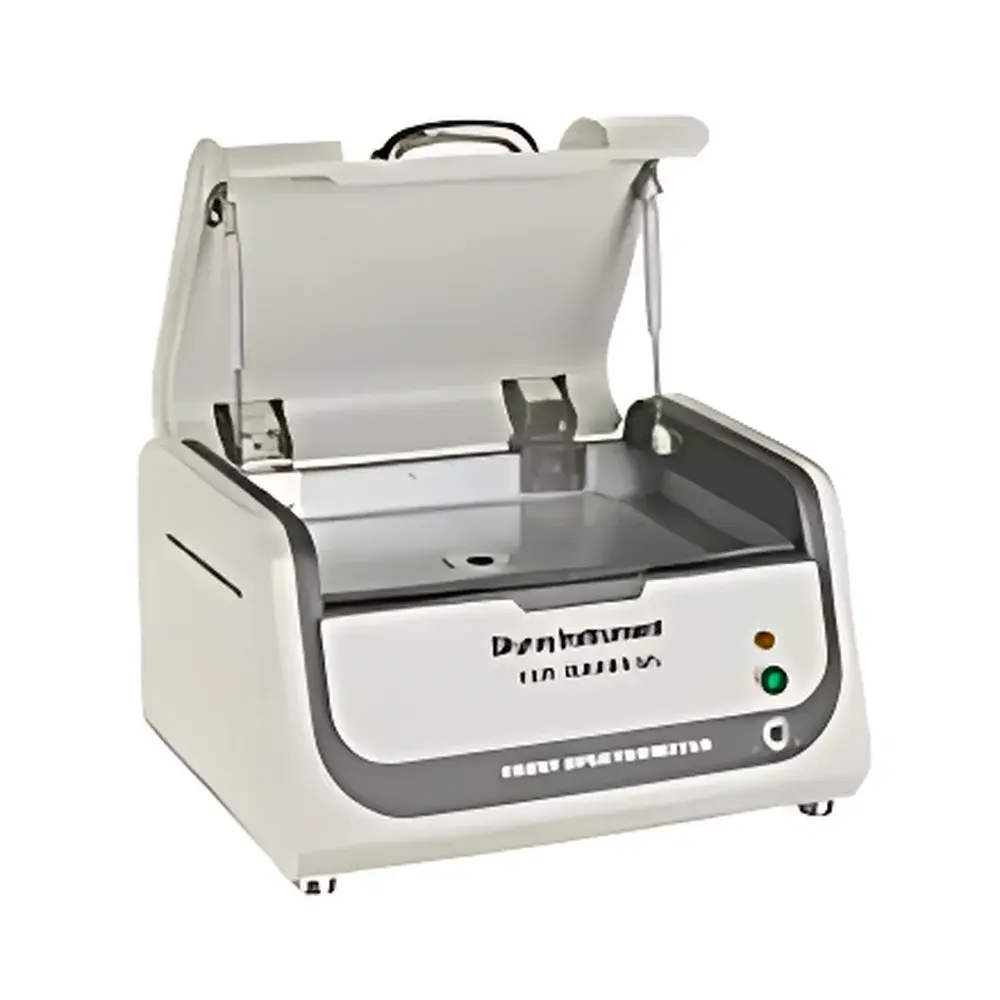
SkyRay Instrument EDX 3000 PLUS Energy Dispersive X-Ray Fluorescence Spectrometer
| Brand | SkyRay Instrument |
|---|---|
| Origin | Jiangsu, China |
| Manufacturer Type | Direct Manufacturer |
| Product Category | Domestic |
| Model | EDX 3000 PLUS |
| Form Factor | Benchtop |
| Application Scope | General-Purpose |
| Elemental Range | S (16) to U (92) |
| Detection Limit | ppm-level |
| Quantification Range | 0.0001 wt% to 99.99 wt% |
| Energy Resolution | 125 eV (at Mn Kα) |
| Detector | FAST-SDD (25 mm² active area) |
Overview
The SkyRay Instrument EDX 3000 PLUS is a benchtop energy dispersive X-ray fluorescence (EDXRF) spectrometer engineered for precise, non-destructive elemental quantification in precious metal alloys—including gold, silver, platinum, palladium, and associated base metals such as copper, zinc, and nickel. Operating on the fundamental principle of X-ray fluorescence emission, the instrument irradiates solid samples with primary X-rays from a high-stability end-window X-ray tube; characteristic secondary X-rays emitted by constituent elements are collected by a large-area FAST-SDD detector and resolved spectrally via digital pulse processing. Its optimized geometry, high-count-rate capability (up to 80,000 cps), and low-noise electronics enable robust detection of trace impurities—such as iridium in platinum-group metals—and accurate quantification across the full concentration range from sub-ppm to bulk composition. Designed for compliance with ISO 8596, ASTM E1621, and GB/T 18043–2000 for jewelry analysis, the EDX 3000 PLUS delivers metrologically traceable results suitable for QC laboratories, assay offices, and regulatory verification workflows.
Key Features
- FAST-SDD detector with 25 mm² active area and 125 eV energy resolution at Mn Kα (5.9 keV), ensuring superior peak separation for adjacent elements (e.g., Pt L-lines vs. Ir L-lines)
- Digital multi-channel analyzer (MCA) with real-time dead-time correction and adaptive pile-up rejection, supporting count rates up to 80,000 cps
- Motorized collimator turret with interchangeable apertures down to 0.2 mm diameter, enabling spatially resolved micro-analysis of fine jewelry features
- Industrial-grade HD camera integrated into the sample chamber, providing live 10× optical magnification and sub-millimeter positioning accuracy
- Automated fundamental parameters (FP) quantification engine with built-in matrix correction algorithms—eliminates manual calibration curve selection and reduces operator dependency
- Robust mechanical architecture: stainless steel vacuum-compatible sample chamber (460 × 298 × 98 mm), precision XYZ motorized stage, and thermal stabilization for operation within 15–30 °C ambient range
Sample Compatibility & Compliance
The EDX 3000 PLUS accepts flat, irregular, or curved solid samples up to 100 mm in diameter and 40 mm in height—including rings, pendants, ingots, scrap fragments, and plated substrates—without requiring destructive preparation. It supports both air and helium purge modes for enhanced light-element sensitivity (S–Cl). All quantitative routines adhere to internationally recognized standards: GB/T 18043–2000 (Chinese national standard for precious metal jewelry), ISO 8596:2020 (XRF instrumentation performance criteria), and ASTM E1621–22 (standard guide for XRF analysis of metal alloys). The system architecture supports audit-ready data integrity: full electronic record retention, user-access logging, and configurable report templates compliant with GLP and GMP documentation requirements.
Software & Data Management
Powered by SkyRay’s proprietary Q-Spec software v4.2, the EDX 3000 PLUS provides a validated, intuitive interface for method development, acquisition control, and post-processing. Key capabilities include multi-layer film analysis, statistical process control (SPC) charting, batch reporting with customizable PDF/Excel export, and secure user-role management (admin, analyst, reviewer). Raw spectral data (.spe) and processed results (.csv/.xlsx) are stored in timestamped, immutable project folders. Software validation documentation—including IQ/OQ protocols and 21 CFR Part 11 readiness assessment—is available upon request for regulated environments.
Applications
- Quantitative analysis of Au, Ag, Pt, Pd, Cu, Zn, Ni, and Rh in jewelry, bullion, dental alloys, and electronic contacts
- Verification of hallmark compliance and detection of prohibited alloying elements (e.g., Cd, Pb, Ni in EU REACH-compliant articles)
- Process control in precious metal refining—monitoring slag composition, anode purity, and electrolyte bath contaminants
- Forensic authentication of antique coins and heritage artifacts using non-invasive stratigraphic profiling
- Research-grade screening of novel catalytic materials containing Pt-group metals and rare-earth dopants
FAQ
Does the EDX 3000 PLUS require vacuum pumping for routine precious metal analysis?
No—air-path analysis is sufficient for elements Na and heavier; optional helium purge improves sensitivity for Mg–Cl when analyzing solder or plating layers.
Can the instrument differentiate between surface plating and bulk composition?
Yes—by combining variable spot size (0.2–4 mm), adjustable tube voltage (4–50 kV), and angle-resolved acquisition, layered structures can be qualitatively assessed; quantitative depth profiling requires complementary techniques such as SEM-EDS.
Is spectral library matching supported for unknown alloy identification?
Yes—the software includes a curated reference library of >120 certified precious metal standards (CRM), with automated pattern-matching and outlier flagging based on chi-square residuals.
What maintenance intervals are recommended for long-term stability?
Annual recalibration of detector resolution and X-ray tube output is advised; detector cooling system and collimator mechanics require biannual inspection per manufacturer guidelines.
How is data security enforced during multi-user operation?
Role-based access control (RBAC), encrypted local storage, and optional network-based audit trail integration ensure compliance with ISO/IEC 27001 information security practices.




