
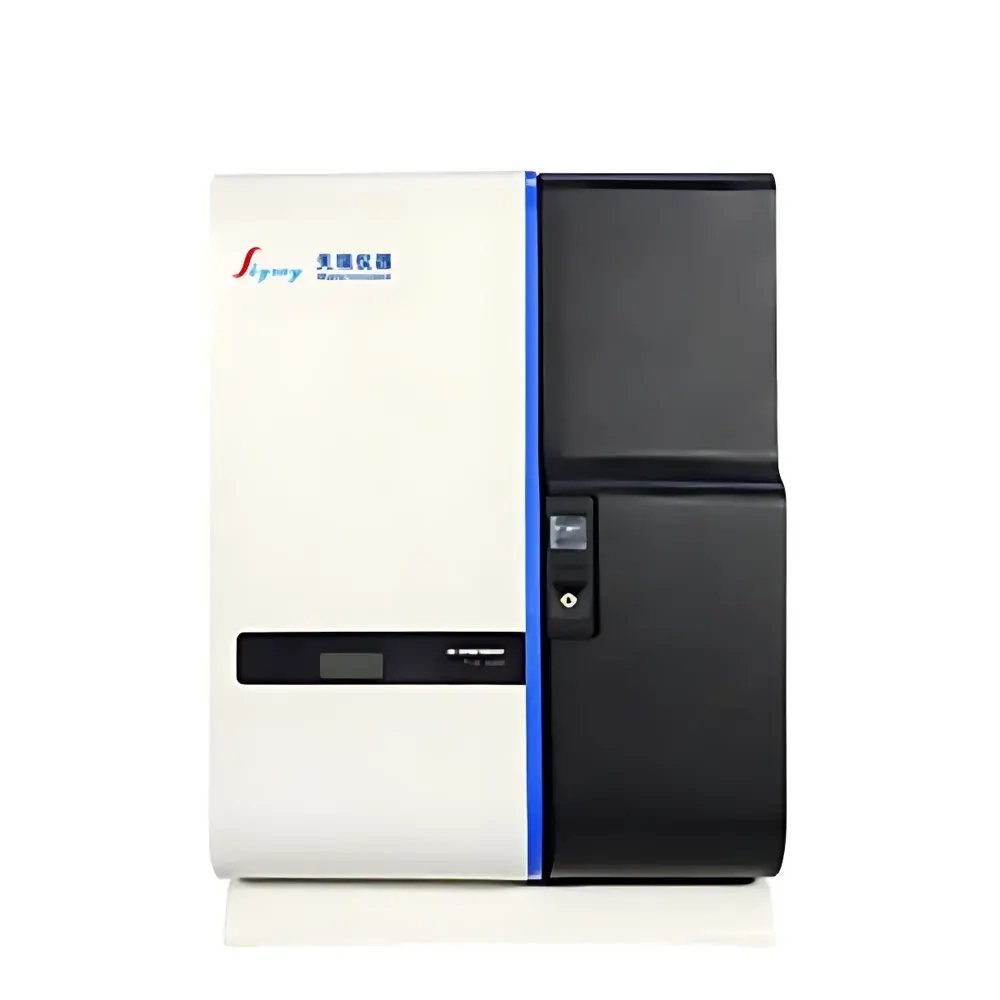
SkyRay TIC-680 Ion Chromatograph
| Brand | SkyRay Instrument |
|---|---|
| Origin | Jiangsu, China |
| Manufacturer Type | Original Equipment Manufacturer (OEM) |
| Product Category | Domestic Laboratory Ion Chromatograph |
| Model | TIC-680 |
| Configuration | Benchtop Dual-Channel IC System with Electrolytic Eluent Generator and Multi-Detector Compatibility |
| Intended Use | General-purpose anion/cation analysis, speciation coupling (AFS/ICP/ICP-MS), and regulatory-compliant water testing per GB 5750.10–2023 |
Overview
The SkyRay TIC-680 Ion Chromatograph is a high-performance, dual-channel benchtop system engineered for precise, reproducible separation and quantification of inorganic anions, cations, cyanide, and low-molecular-weight organic acids in complex matrices. Based on suppressed conductivity detection principles—combined with optional amperometric or UV detection—the TIC-680 employs a robust dual-polarity conductivity detector, electrolytically generated eluents, and intelligent column thermal management to deliver trace-level sensitivity (sub-ppb detection limits) and high-resolution chromatographic performance across diverse sample types. Designed for compliance-driven laboratories, it supports method development and routine analysis aligned with ISO 10304, ASTM D4327, USP , and China’s national standard GB 5750.10–2023 for disinfection by-product determination in drinking water.
Key Features
- Dual-Polarity Conductivity Detector: Simplified four-electrode design with automatic range switching (ppb to ppm), integrated temperature compensation (±0.02 °C stability), and real-time baseline correction—eliminating manual gain adjustment while ensuring consistent response across wide concentration ranges.
- Electrolytic Eluent Generator (EG): On-demand generation of carbonate/bicarbonate and hydroxide-based eluents; enables linear, nonlinear, and step-gradient elution profiles without manual eluent preparation or degassing—critical for multi-analyte methods and long-term unattended operation.
- Ceramic Electromagnetic Injection Valve: Sealed ceramic rotor/stator assembly with stepper motor actuation ensures >100,000 injection cycles, minimal carryover (<0.01%), and positional repeatability ≤0.1°—reducing inter-run variability and eliminating manual valve rotation errors.
- Self-Regenerating Micro-Membrane Suppressor: Continuously regenerated via electrolysis; operates at up to 30 MPa; features <1.5 µL dead volume, background conductivity <0.15 µS/cm, and compatibility with both carbonate and hydroxide eluent systems for flexible method transfer.
- Intelligent Column Compartment: Integrated Peltier-heated/circulated oven with variable-frequency 3D airflow control; maintains ±0.1 °C uniformity across 10–60 °C operating range; supports simultaneous dual-column thermal programming for parallel method execution.
- Dual-Plunger PEEK Pump: High-pressure/low-pressure pulse-compensated dual-piston design with electronic damping; flow accuracy ±0.2% from 0.1–5.0 mL/min; built-in overpressure cutoff (max 35 MPa) and auto-shutdown logic for column protection.
Sample Compatibility & Compliance
The TIC-680 accommodates aqueous extracts, digests, filtrates, and dilute biological fluids—including EPA Method 300.0/300.1 matrices, GB/T 5750 series drinking water samples, food leachates, semiconductor rinse waters, and pharmaceutical excipient solutions. Its hardware architecture and firmware support full audit trail functionality per FDA 21 CFR Part 11 requirements when deployed with validated software configurations. System validation packages include IQ/OQ documentation templates compliant with GLP and ISO/IEC 17025 frameworks. All suppression, detection, and gradient modules are certified to IEC 61000-4 electromagnetic compatibility standards.
Software & Data Management
The SkyRay IC Workstation v3.2 provides unified instrument control, real-time data acquisition (up to 100 Hz sampling), peak integration using adaptive baseline algorithms, and customizable report generation (PDF, CSV, XML). It features native drivers for third-party mass spectrometers (e.g., Thermo Fisher, Agilent), fluorescence detectors, and autosamplers (including XYZ robotic platforms). Data integrity safeguards include user role-based access control, electronic signatures, versioned method storage, and immutable raw-data archiving with SHA-256 checksum verification. Optional LIMS integration is supported via ASTM E1467 and HL7 messaging protocols.
Applications
The TIC-680 serves as a primary analytical platform in environmental monitoring labs (NO₃⁻, SO₄²⁻, ClO₂⁻, BrO₃⁻ in wastewater and surface water), public health institutions (F⁻, NO₂⁻, PO₄³⁻ in drinking water per GB 5750.10–2023), food safety testing (iodide, thiocyanate, benzoate), electronics manufacturing (Cl⁻, SO₄²⁻ in ultrapure water), and pharmaceutical QC (counter-ion profiling in APIs). Its modular detector interface enables hyphenated workflows—e.g., IC-ICP-MS for As(III)/As(V) speciation or IC-AFS for ultra-trace Se(IV)/Se(VI) quantification—without hardware modification.
FAQ
Does the TIC-680 support gradient elution without external eluent mixing modules?
Yes—the integrated electrolytic eluent generator enables fully automated, programmable gradient formation using only deionized water and solid reagents.
Can the system be validated for GMP-regulated environments?
Yes—when configured with audit-trail-enabled software and operated under documented SOPs, the TIC-680 meets core requirements of EU Annex 11 and FDA guidance for computerized system validation.
Is the suppressor compatible with both carbonate and hydroxide eluent chemistries?
Yes—the self-regenerating micro-membrane suppressor is chemically inert across pH 3–12 and thermally stable to 60 °C, supporting method flexibility without hardware swaps.
What maintenance intervals are recommended for the electromagnetic injection valve?
No scheduled maintenance is required; the ceramic valve assembly is rated for ≥100,000 injections with no lubrication or recalibration needed.
How does the dual-polarity detector improve measurement reliability versus conventional five-electrode designs?
By eliminating reference electrode drift and reducing capacitive coupling noise, the two-electrode bipolar configuration achieves higher signal-to-noise ratio and improved long-term baseline stability—particularly during extended gradient runs.




