
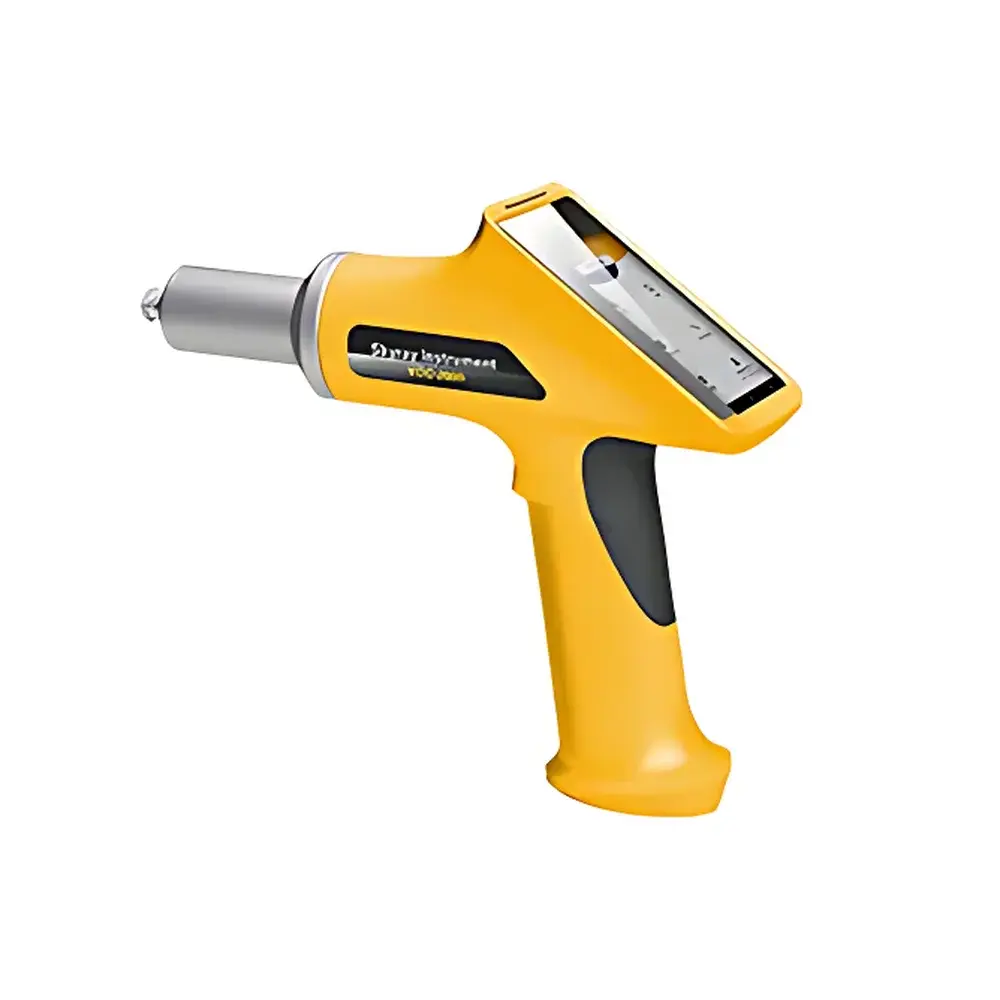
SkyRay VOC-2000 Portable PID-Based Volatile Organic Compounds Detector
| Brand | SkyRay Instrument |
|---|---|
| Origin | Jiangsu, China |
| Manufacturer Type | Direct Manufacturer |
| Product Category | Domestic |
| Model | VOC-2000 |
| Detection Principle | Photoionization Detection (PID) |
| Instrument Type | Portable |
| Typical Configuration | Total VOC (TVOC) Analyzer |
| Measurement Range | 0–40,000 ppm (isobutylene equivalent) |
| Resolution | 0.1 ppm |
| Accuracy | ±10% of reading |
| Response Time (T90) | <4 seconds |
| Operating System | Android-based embedded OS |
| Display | 4-inch capacitive touchscreen |
| Compliance | HJ 1019–2019 (China Technical Guideline for Sampling VOCs in Soil and Groundwater) |
| Data Export | USB mass storage & wireless (Wi-Fi/Bluetooth) |
| Connectivity | Built-in Wi-Fi, Bluetooth 4.2, QR code sharing |
| Power | Rechargeable Li-ion battery (≥8 h typical operation) |
| Environmental Rating | IP54 |
| Weight | ≤420 g |
Overview
The SkyRay VOC-2000 is a field-deployable, handheld photoionization detector (PID) engineered for rapid, on-site quantification of total volatile organic compounds (TVOCs) in air, headspace, and near-surface emissions. Unlike catalytic bead or metal oxide semiconductor sensors, the VOC-2000 employs a 10.6 eV ultraviolet lamp to ionize VOC molecules—enabling selective, real-time detection of aromatic hydrocarbons, ketones, aldehydes, amines, and other photoionizable species with ionization potentials below 10.6 eV. Its compact architecture integrates a high-stability PID sensor module, temperature- and humidity-compensated signal processing circuitry, and an industrial-grade Android platform—delivering laboratory-grade responsiveness without benchtop constraints. Designed explicitly for compliance with China’s HJ 1019–2019 technical guideline for soil and groundwater VOC sampling, the instrument supports standardized field screening workflows used in environmental site assessments, vapor intrusion investigations, and regulatory pre-screening prior to GC-MS confirmation.
Key Features
- Real-time dual-mode display: Simultaneous readout of instantaneous concentration, peak (max), trough (min), rolling average, timestamp, calibration factor, and dynamic trend curve—all rendered on a 4-inch capacitive touchscreen with anti-glare coating.
- Multi-parameter environmental compensation: Integrated temperature and relative humidity sensors feed into the PID algorithm to correct for ambient effects on ionization efficiency and sensor response drift.
- Configurable data logging: Adjustable sampling interval (1 s to 30 min); internal memory stores ≥100,000 data points with time-stamped metadata (GPS optional via paired smartphone).
- Traceable calibration management: Supports multi-point calibration using certified isobutylene standards; stores calibration history with operator ID, date/time, span gas concentration, and deviation metrics.
- Regulatory-ready connectivity: Native support for Wi-Fi and Bluetooth 4.2 enables secure over-the-air firmware updates, remote configuration, and encrypted data transfer to LIMS or cloud platforms.
- Field-optimized ergonomics: Weighing under 420 g with IP54-rated enclosure, the VOC-2000 withstands dust ingress and incidental water splashes during outdoor or industrial use.
Sample Compatibility & Compliance
The VOC-2000 is validated for direct ambient air sampling, headspace analysis of soil gas probes, and point-source emission screening from vents, tanks, or process lines. It detects compounds including benzene, toluene, xylene (BTX), styrene, acetone, methanol, and chlorinated solvents—provided their ionization potential is ≤10.6 eV. While not a replacement for laboratory GC-MS quantification, it meets the performance criteria outlined in HJ 1019–2019 for preliminary site characterization and hotspot delineation. The device does not comply with OSHA PEL or ACGIH TLV reporting requirements out-of-the-box but may be configured for semi-quantitative occupational exposure assessment when operated within its specified accuracy envelope (±10%) and calibrated per manufacturer-recommended intervals.
Software & Data Management
The embedded Android OS runs a purpose-built Java-based application with Chinese and English UI localization. All measurement data—including raw sensor output, compensated values, environmental parameters, and operator annotations—are stored in SQLite format with SHA-256 hash integrity verification. Data export options include USB mass storage (CSV/Excel-compatible), Wi-Fi file transfer, and Bluetooth pairing to mobile devices. The application supports QR-code-based result sharing directly to WeChat, QQ, or email clients—enabling immediate documentation for field reports or chain-of-custody logs. Audit trails record user login events, calibration actions, and configuration changes, satisfying basic GLP traceability requirements for non-GMP field applications.
Applications
- Environmental site assessment: Rapid screening of soil vapor, landfill cover gas, and groundwater plume migration pathways.
- Industrial hygiene: Monitoring fugitive emissions in petrochemical refineries, paint booths, battery electrolyte handling areas, and semiconductor cleanroom perimeter zones.
- Indoor air quality (IAQ): Diagnosing VOC sources in vehicles, newly renovated offices, hospital HVAC systems, and school classrooms.
- Product safety testing: Residual solvent verification in pharmaceutical packaging, leather finishing, printed circuit board cleaning, and adhesive curing processes.
- Emergency response: First-responder triage of chemical spills, confined-space entry evaluation, and post-fire VOC residue mapping.
- Regulatory enforcement: Field validation of compliance with local VOC emission limits during environmental inspections by provincial ecological environment bureaus.
FAQ
What gases does the VOC-2000 detect?
It detects photoionizable VOCs with ionization potentials ≤10.6 eV—including aromatics, alkenes, aldehydes, ketones, and many chlorinated solvents—but does not respond to methane, ethane, CO, CO₂, or highly polar compounds like formic acid.
Is the instrument intrinsically safe for hazardous locations?
No. The VOC-2000 is not certified for Class I, Division 1 or ATEX Zone 0/1 environments. It must be operated outside defined hazardous areas per NFPA 70E and local explosion protection regulations.
Can it be used for personal exposure monitoring?
It is intended for area monitoring and source identification—not continuous personal sampling. For OEL compliance, use only as a qualitative screening tool alongside NIOSH/OSHA-approved passive badges or pump-sampled sorbent tubes.
Does it meet FDA 21 CFR Part 11 requirements?
No. The system lacks electronic signature capability, role-based access control, and immutable audit trail features required for regulated pharmaceutical or clinical trial use.
How often should it be calibrated?
Factory recommendation is daily bump testing with 100 ppm isobutylene standard before use; full 3-point calibration every 7 days or after exposure to >10,000 ppm concentrations.







