
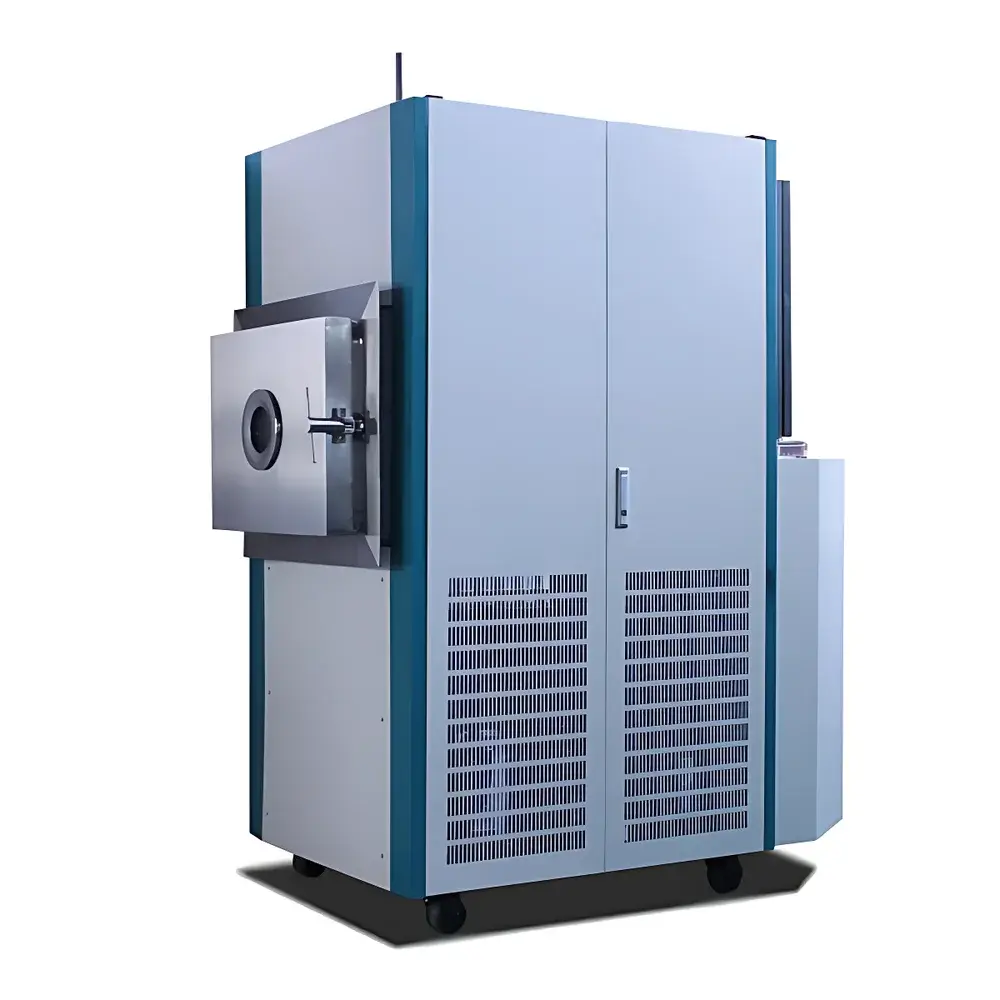
BioCoool BIOCOOL-EP Series “Ice-Core” Pilot-Scale Freeze Dryer
| Brand | BioCoool |
|---|---|
| Origin | Beijing, China |
| Manufacturer Type | Authorized Distributor |
| Product Category | Domestic |
| Model | BIOCOOL-EP |
| Instrument Type | Stoppering Freeze Dryer |
| Application Scale | Pilot-Scale |
| Shelf Area | 1 m² |
| Ultimate Vacuum | ≤1 Pa |
| Condensate Capacity (24 h) | 15 L |
| Cold Trap Temperature | < −110 °C |
| Main Unit Dimensions (W×D×H) | 760 × 1440 × 1900 mm |
Overview
The BioCoool BIOCOOL-EP Series “Ice-Core” Pilot-Scale Freeze Dryer is engineered for high-fidelity lyophilization of thermally sensitive biopharmaceuticals, diagnostic reagents, and advanced functional materials where critical thermal transition temperatures—such as eutectic temperature (Te), melting point (Tm), collapse temperature (Tc), and glass transition temperature (Tg’)—fall significantly below conventional lyophilizer operating limits. Designed around a cryo-centric architecture, the system integrates ultra-low-temperature condensation, deep pre-freezing capability, and precision vacuum control to maintain product integrity during both primary and secondary drying phases. Unlike standard laboratory freeze dryers, the ICE-CORE platform operates with a cold trap base temperature of < −110 °C (extendable to < −165 °C under optimized conditions) and shelf pre-freezing down to < −80 °C—enabling stable solid-state matrix formation even for low-Tg' formulations such as monoclonal antibody aggregates, mRNA-LNPs, or amorphous small-molecule APIs. Its 1 m² shelf area supports scalable process development aligned with ICH Q5C and Q5D guidelines, bridging the gap between benchtop feasibility studies and GMP-compliant manufacturing transfer.
Key Features
- Ultra-deep cold trap: Dual-stage refrigeration system achieves ≤ −110 °C operational temperature; optional enhancement to ≤ −165 °C for extreme low-Tg’ applications.
- High-integrity thermal insulation: Chamber walls insulated with ≥100 mm vacuum-insulated panels (VIPs), minimizing heat ingress and ensuring stable sub-zero shelf temperatures.
- Programmable stoppering mechanism: Motor-driven vertical actuator integrated at base level enables fully automated, force-controlled vial stoppering; eliminates manual intervention and ensures consistent seal integrity across 10–30 mL serum vials.
- Intelligent drying control: Real-time升华 end detection via pressure rise test (PRT) and residual moisture endpoint verification using integrated capacitance-based moisture sensing—both triggered automatically per cycle phase.
- Multi-mode backfill system: Three-stage programmable inert gas (N₂ or Ar) reintroduction—slow, medium, and fast—minimizes particle displacement in fragile lyophilized cakes (e.g., porous scaffolds or nanostructured powders).
- Robust vacuum regulation: Proportional throttle valve enables dynamic vacuum setpoint adjustment during primary and secondary drying—critical for optimizing sublimation rate while preventing melt-back or collapse.
- Fully redundant safety architecture: Includes overcurrent, compressor high/low-pressure cut-off, shelf overtemperature lockout, vacuum pump overload protection, and interlocked drain valve logic.
Sample Compatibility & Compliance
The BIOCOOL-EP accommodates a broad range of sample formats—including serum vials (10–30 mL), trays (up to 1 m²), and custom molds—suitable for lyophilizing proteins, peptides, vaccines, oligonucleotides, probiotics, and specialty polymers. Its validated performance aligns with key regulatory expectations: vacuum stability and repeatability support ASTM F2376-22 (Standard Practice for Lyophilization Process Development); temperature uniformity meets ISO 22042:2021 (Lyophilizer Performance Qualification); and data integrity features—including audit-trail-enabled electronic records, user-level access control, and time-stamped event logging—are compatible with FDA 21 CFR Part 11 requirements when deployed with configured PC database storage. Optional IQ/OQ documentation packages are available upon request.
Software & Data Management
The system runs on an industrial-grade PLC paired with a 10.1″ capacitive touchscreen HMI, supporting intuitive navigation without reference manuals. It stores up to 2,000 user-defined or factory-loaded lyophilization protocols, each containing multi-step shelf temperature ramps, vacuum profiles, and gas backfill parameters. Data acquisition occurs at 50 ms intervals for shelf temperature, condenser temperature, chamber pressure, and condensate weight (via load cell). Storage options include internal flash memory (3-month retention), USB export (FAT32-formatted drives), and real-time TCP/IP streaming to external SQL databases. Remote monitoring is supported via Ethernet/Wi-Fi up to 1.5 km from host PC; mobile web interface allows live viewing of all process variables and alarm status. All curves—including shelf temp vs. time, pressure vs. time, and moisture trend—are exportable as CSV or PDF for analytical review and regulatory submission.
Applications
- Development of lyophilized mAb formulations requiring Tg’ < −40 °C
- Stabilization of lipid nanoparticle (LNP)-encapsulated mRNA therapeutics
- Processing of sterile diagnostic enzyme kits with narrow thermal margins
- Freeze-drying of probiotic strains and live biotherapeutic products (LBPs)
- R&D of amorphous solid dispersions and co-amorphous systems
- Material science applications: cryo-structuring of aerogels, MOFs, and nanocellulose scaffolds
FAQ
What is the lowest achievable shelf temperature during pre-freezing?
Shelf temperature can be stabilized at ≤ −80 °C, verified per ASTM E2259-21 calibration protocol.
Does the system support in-situ determination of eutectic temperature (Te)?
Yes—integrated resistance temperature detector (RTD) array enables offline and online Te mapping; raw thermogram data is exportable for derivative analysis.
How is data integrity ensured for GxP environments?
All electronic records include immutable timestamps, operator ID, and change history; optional 21 CFR Part 11 compliance package includes digital signature, role-based permissions, and electronic audit trail.
Can the cold trap be upgraded to −165 °C without hardware modification?
A factory-installed dual-refrigerant cascade option is required; standard configuration delivers ≤ −110 °C.
Is cleaning validation supported?
Full-access bottom-mounted stopper actuator and removable shelf carriers enable complete CIP-compatible interior access; surface temperature mapping ports are provided for sterilization cycle qualification.



