
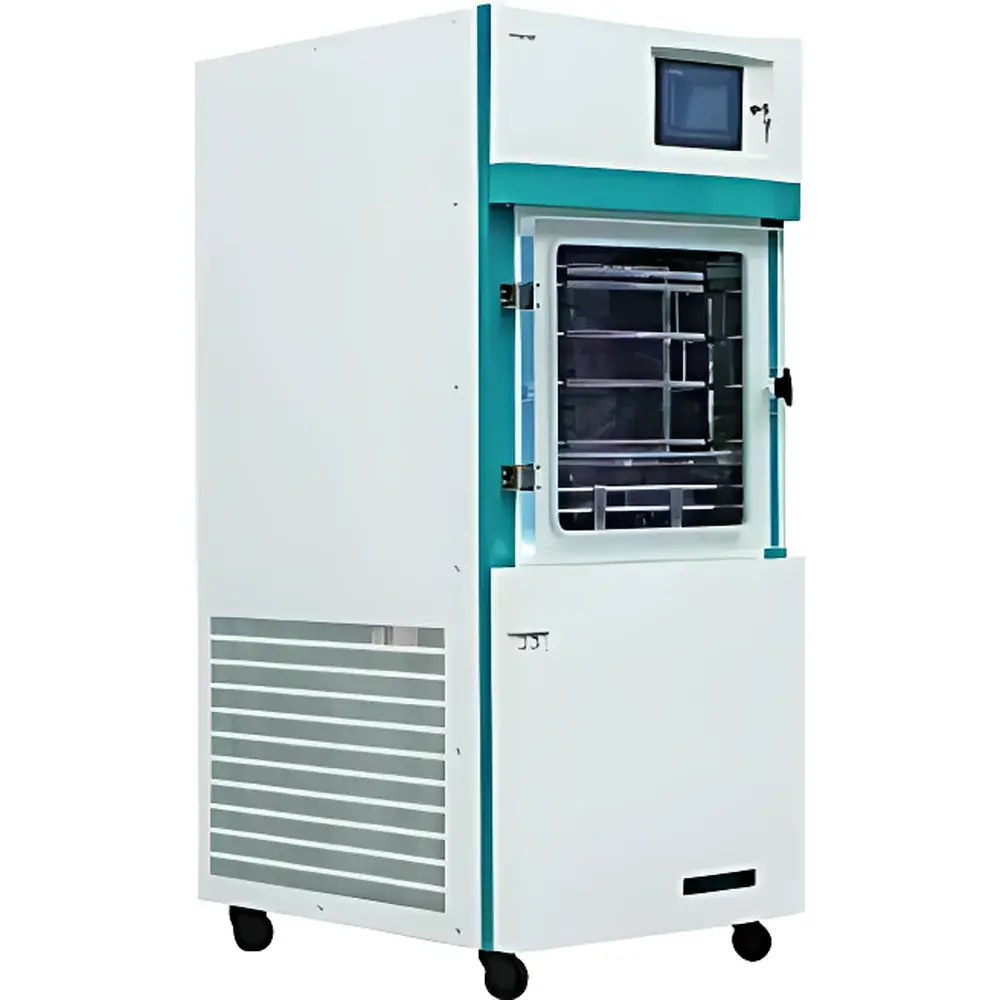
BioCoool Pilot10-15E Benchtop Pilot-Scale Freeze Dryer
| Brand | BioCoool |
|---|---|
| Origin | Beijing, China |
| Manufacturer Type | Authorized Distributor |
| Product Category | Domestic |
| Model | Pilot10-15E |
| Instrument Type | Shelf-Type Freeze Dryer |
| Application Scope | Pilot-Scale Production |
| Lyophilization Area | 1.0 m² |
| Ultimate Vacuum | <3 Pa |
| Condensate Capacity (24h) | 15 kg/24h |
| Cold Trap Temperature | <−85 °C |
Overview
The BioCoool Pilot10-15E is a benchtop pilot-scale shelf-type freeze dryer engineered for reproducible, scalable lyophilization of thermolabile biopharmaceuticals, diagnostic reagents, and research-grade biological materials. It operates on the fundamental principle of sublimation under deep vacuum and controlled thermal cycling—removing water from frozen samples while preserving structural integrity, activity, and stability. Designed to bridge laboratory process development and small-batch GMP-compliant manufacturing, the system integrates a high-efficiency dual-stage refrigeration circuit, precision-engineered stainless-steel drying chamber, and an industrial-grade vacuum manifold. Its 1.0 m² shelf area supports uniform heat transfer across standard 300–500 mm diameter trays or multiple vial racks, enabling batch processing of up to ~10 L aqueous solution per cycle (assuming typical solids content of 2–5% w/v). The cold trap’s <−85 °C operating temperature ensures efficient condensation of volatile solvents and robust ice capture during extended cycles—critical for formulations containing low-eutectic-point excipients or residual organic solvents.
Key Features
- Aerospace-grade acrylic viewing door—optically clear, seamless, leak-tight, and resistant to thermal stress-induced microcracking.
- Shelf pre-freezing capability: shelves cool independently to −40 °C prior to primary drying, eliminating separate ultra-low freezer dependency and reducing process variability.
- High-reliability imported scroll compressor with oil-free operation, delivering stable refrigeration performance and <62 dB(A) acoustic output at 1 m distance.
- Domestic high-speed dual-stage rotary vane vacuum pump (≥12 m³/h nominal pumping speed), equipped with gas ballast and automatic anti-suckback valve for extended service life and solvent tolerance.
- Fully programmable PLC-based control system supporting up to 500 user-defined lyo protocols—including ramp-hold segments, pressure-controlled drying (PCD), and partial pressure modulation via nitrogen bleed.
- Fuzzy PID-controlled shelf heating with real-time thermal loop monitoring, ±0.3 °C shelf temperature uniformity (measured at 5 points per shelf), and overtemperature cut-off protection.
- Non-electric cold trap defrost: utilizes internal heat exchange recovery—no resistive heating elements, eliminating hot-spot risks and reducing defrost time to 2 h for immersion methods).
- 10.1″ industrial capacitive touchscreen HMI with intuitive icon-driven navigation; no manual required for routine operation, recipe loading, or alarm acknowledgment.
Sample Compatibility & Compliance
The Pilot10-15E is validated for aqueous solutions, suspensions, and pastes with eutectic temperatures above −40 °C—covering common formulations such as monoclonal antibody buffers, ELISA reagent kits, probiotic powders, and botanical extracts. It meets mechanical safety requirements per GB/T 19001–2016 (equivalent to ISO 9001:2015) and electromagnetic compatibility per GB/T 18268.1–2010 (IEC 61326-1). While not certified to FDA 21 CFR Part 11 out-of-the-box, its audit-ready data architecture—including timestamped event logs, operator ID tagging, and electronic signature support (via optional PC database integration)—facilitates qualification under GLP and GMP Annex 11 frameworks. All temperature and vacuum sensors are NIST-traceable and field-calibratable per ASTM E2876–22 guidelines.
Software & Data Management
Data acquisition occurs at 20 Hz (50 ms interval) for shelf temperature, product thermocouple (optional), chamber pressure, and condenser temperature. Three storage tiers are supported: (1) embedded 4 GB flash memory retaining ≥90 days of continuous cycle data (compressed binary format); (2) USB 2.0 port for export to FAT32-formatted drives (up to 128 GB); and (3) optional Ethernet-connected PC database (SQL Server or SQLite backend) enabling centralized review, trend analysis, and CSV/PDF report generation. All stored datasets include full metadata: cycle ID, operator tag, ambient conditions, alarm history, and version-stamped protocol parameters. Calibration logs (temperature and vacuum) are digitally signed and retained separately for regulatory inspection readiness.
Applications
- Process development of sterile injectables and lyophilized vaccines in R&D labs.
- Small-batch production of clinical trial materials (Phase I–II) requiring documented critical process parameters (CPPs).
- Stabilization of enzymes, peptides, and nucleic acid-based diagnostics for long-term storage.
- Preparation of reference standards and calibration materials in metrology laboratories.
- Academic research on cryoprotectant screening, collapse temperature mapping, and secondary drying kinetics.
FAQ
What is the maximum allowable sample volume per batch?
Based on 1.0 m² shelf area and typical loading density (10–15 mL/cm² for vials or trays), the system accommodates up to 10–15 L of aqueous solution per cycle—subject to total solids content and desired residual moisture specification.
Does the system support validation documentation (IQ/OQ/PQ)?
Yes—BioCoool provides standardized IQ/OQ templates aligned with ASTM F2697–22 and EU GMP Annex 15. PQ execution requires customer-specific test protocols and qualified reference standards.
Can shelf temperature be monitored at multiple points during drying?
The base configuration includes one PT100 sensor per shelf; additional sensors (up to 4 per shelf) are available as an option for spatial uniformity mapping.
Is remote monitoring supported?
Via optional Ethernet module and BioCoool’s LyoView™ client software (Windows-based), enabling real-time dashboard access, SMS/email alerting, and secure VPN-based supervision.
What maintenance intervals are recommended for the vacuum pump?
Oil change every 500 operating hours; filter replacement every 1,000 hours; full pump service (vane inspection, bearing check) every 3,000 hours—per manufacturer’s technical bulletin VP-RV2023.



