
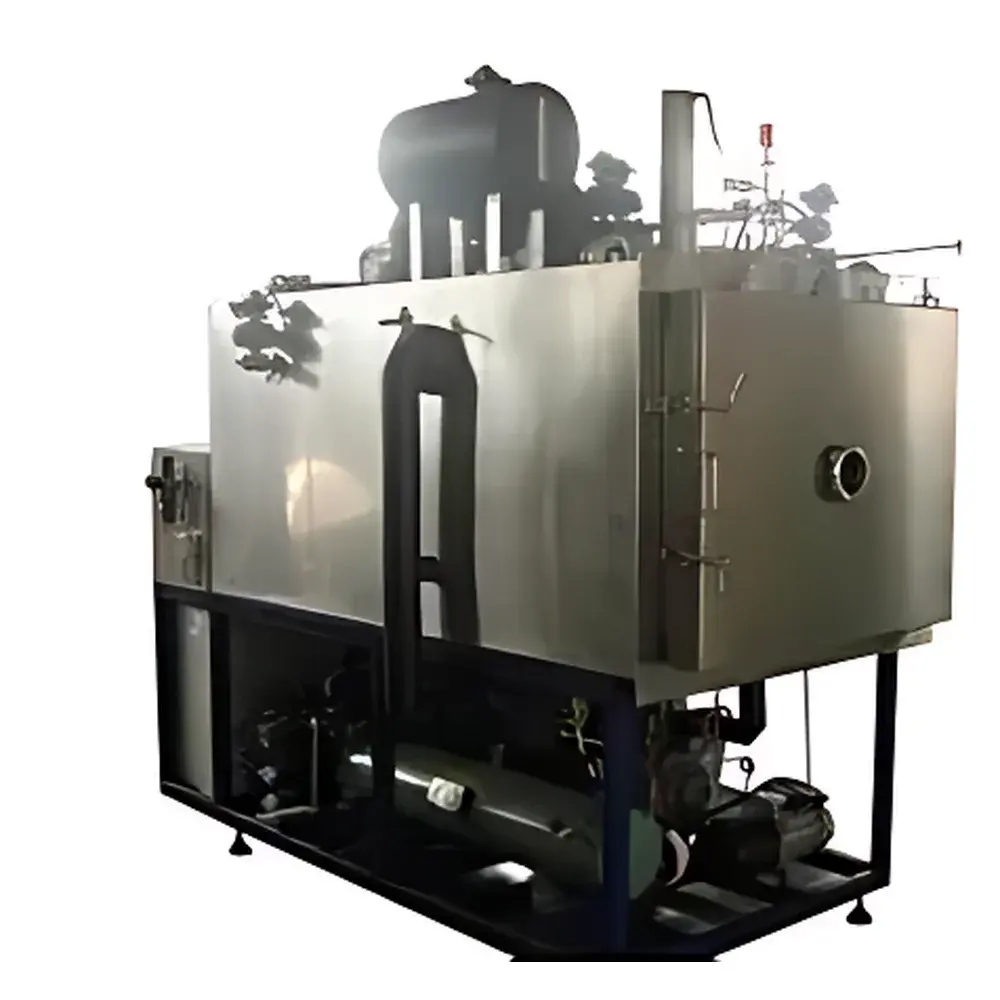
BIOCOOL LYO-1SE Production-Scale Freeze Dryer
| Brand | BIOCOOL |
|---|---|
| Origin | Beijing, China |
| Model | LYO-1SE |
| Instrument Type | Shelf-Type Freeze Dryer |
| Application | Production-Scale Lyophilization |
| Freeze-Drying Area | 1 m² |
| Ultimate Vacuum | <5 Pa |
| Condensate Capacity (24 h) | 20 L/24 h |
| Cold Trap Temperature | <−70 °C |
| Shelf Temperature Range | −55 °C to +110 °C |
| Shelf Configuration | 4+1 Heated Shelves |
| Vacuum Regulation System | Yes |
| Programmable Control System | Yes |
| End-Point Detection | Yes |
| Backfill Control (Pulse Mode) | Three-Speed (Slow/Medium/Fast) |
| Data Acquisition Frequency | 50 ms |
| Recipe Storage Capacity | 2000 Programs |
| Touchscreen Interface | Industrial HMI Panel |
| Remote Monitoring (Optional) | Up to 1.5 km |
| Calibration Function | Temperature & Vacuum |
| Freeze-Dry Curve Logging | Yes |
| Optional Accessories | Eutectic Point Tester, Dry Vacuum Pump, Cascade Compressor Unit, Solvent Trap, Hydraulic Oil Mist Filter |
Overview
The BIOCOOL LYO-1SE is a production-scale shelf-type freeze dryer engineered for reproducible, scalable lyophilization of heat-sensitive pharmaceuticals, biologics, nutraceuticals, and functional food ingredients. It operates on the fundamental principles of sublimation under controlled low-pressure and low-temperature conditions: frozen water in the product matrix transitions directly from solid to vapor phase without passing through liquid, preserving structural integrity, biological activity, and chemical stability. Designed for continuous batch processing in pilot and small-batch manufacturing environments, the LYO-1SE supports GMP-aligned workflows through programmable process control, real-time parameter monitoring, and audit-ready data logging capabilities. Its 1 m² drying area and 20 L/24 h condensate capacity enable consistent processing of up to ~2100 vials (Ø22 mm), making it suitable for early-phase clinical material production, herbal extract stabilization, and high-value additive manufacturing.
Key Features
- Heated shelf system with precise temperature control (−55 °C to +110 °C) and uniform thermal distribution across 4+1 welded stainless-steel shelves — leak-tested per ASME BPE guidelines.
- Integrated vacuum regulation system enabling dynamic pressure control during primary and secondary drying to suppress boil-over, collapse, or foaming in sensitive formulations.
- Automated end-point detection during desorption drying, based on real-time vapor pressure and shelf temperature differentials, ensuring final residual moisture meets USP & Ph. Eur. specifications (typically ≤1–3% w/w).
- Pulse-controlled inert gas backfill (N₂ or argon) with three selectable flow rates — optimized to prevent particle dispersion in lyophilized powders, granules, and fragile amorphous matrices.
- Industrial-grade 10.4″ touchscreen HMI with intuitive navigation; no manual required for routine operation, recipe selection, or alarm acknowledgment.
- Comprehensive process monitoring: vacuum level, shelf temperature, condenser temperature, and chamber pressure sampled at 50 ms intervals and logged with timestamped metadata.
- 2000-user-programmable lyophilization protocols, supporting multi-step ramp-hold cycles, annealing, and variable shelf ramp rates — compatible with DOE-based process optimization.
- Onboard calibration functions for shelf thermocouples and vacuum transducers, traceable to NIST-certified references, supporting long-term measurement integrity per ISO/IEC 17025 requirements.
Sample Compatibility & Compliance
The LYO-1SE accommodates diverse sample formats including glass vials (Ø22 mm, up to 2100 units/batch), serum bottles, trays, and custom containers mounted on heated shelves. It is routinely deployed for lyophilizing monoclonal antibodies, plasmid DNA, probiotic cultures, botanical extracts, enzyme preparations, and nanostructured delivery systems. While the LYO-1SE is classified as an economic-grade unit (non-CIP/SIP capable), its architecture complies with core mechanical and electrical safety standards (IEC 61010-1, GB 4793.1). For regulated environments, optional validation packages support IQ/OQ documentation aligned with FDA 21 CFR Part 11 (when paired with PC-based data acquisition software), EU Annex 15, and WHO TRS 986 Annex 6. The system’s vacuum integrity, temperature uniformity (±1.5 °C across shelf surface), and pressure stability (<±0.2 Pa over 1 h) are verifiable via third-party qualification protocols.
Software & Data Management
The embedded control firmware provides full-cycle automation — from pre-freezing and primary drying to secondary drying, endpoint verification, and inert gas backfill. All process data (shelf temp, chamber pressure, condenser temp, elapsed time) are stored internally with millisecond resolution and exportable via USB to CSV or Excel-compatible formats. Optional PC-based remote monitoring software enables real-time supervision and historical trend analysis up to 1.5 km via Ethernet or RS485. When configured with the optional process data recording module, the system generates ALCOA+ compliant records: attributable, legible, contemporaneous, original, accurate, complete, consistent, enduring, and available — meeting GLP/GMP data integrity expectations. Firmware updates and recipe synchronization are performed securely via encrypted USB transfer.
Applications
- Pharmaceutical development: Lyophilization of clinical trial batches of vaccines, peptides, and unstable small molecules.
- Traditional Chinese medicine (TCM) processing: Stabilization of volatile active compounds (e.g., ginsenosides, alkaloids) without thermal degradation.
- Nutraceutical manufacturing: Preservation of probiotics, enzymes, and polyphenol-rich plant extracts while retaining viability and antioxidant capacity.
- Food science research: Production of lightweight, rehydratable functional ingredients (e.g., encapsulated omega-3 oils, anthocyanin powders).
- Material science: Preparation of porous scaffolds for tissue engineering and aerogel precursors via controlled ice nucleation.
- Diagnostic reagent formulation: Stabilization of lyophilized PCR master mixes, ELISA conjugates, and lateral flow assay components.
FAQ
What is the difference between the LYO-1SE and standard GMP-compliant freeze dryers?
The LYO-1SE is an economic-grade model: it lacks Clean-in-Place (CIP) and Steam-in-Place (SIP) functionality, and its materials-of-construction and documentation package are not pre-qualified for full FDA/EMA regulatory submission. However, its core thermal and vacuum performance remains identical to higher-tier models.
Can the LYO-1SE be validated for use in regulated environments?
Yes — with optional IQ/OQ documentation support, calibrated sensors, and ALCOA+-compliant data logging (via PC software), the system can be qualified for GLP labs and early-phase GMP manufacturing where full validation lifecycle management is not mandated.
Is the cold trap temperature measured under load or no-load conditions?
The stated <−70 °C specification refers to no-load performance. Under typical 20 L/24 h condensation load, the cold trap stabilizes at approximately −65 °C, sufficient to capture water vapor and common organic solvents (e.g., tert-butanol, ethanol) when used with optional solvent traps.
Does the system support automatic recipe transfer between instruments?
Yes — recipes are stored in a vendor-neutral XML-based format and can be imported/exported across LYO-series units via USB drive, facilitating process scale-up from lab to pilot scale.
What maintenance intervals are recommended for the compressor and vacuum pump?
The hermetic scroll compressor requires oil inspection every 2000 operating hours; the dual-stage oil-lubricated vacuum pump should undergo oil change every 500 hours or quarterly — whichever occurs first — using ISO VG 100 mineral oil specified by the OEM.



