
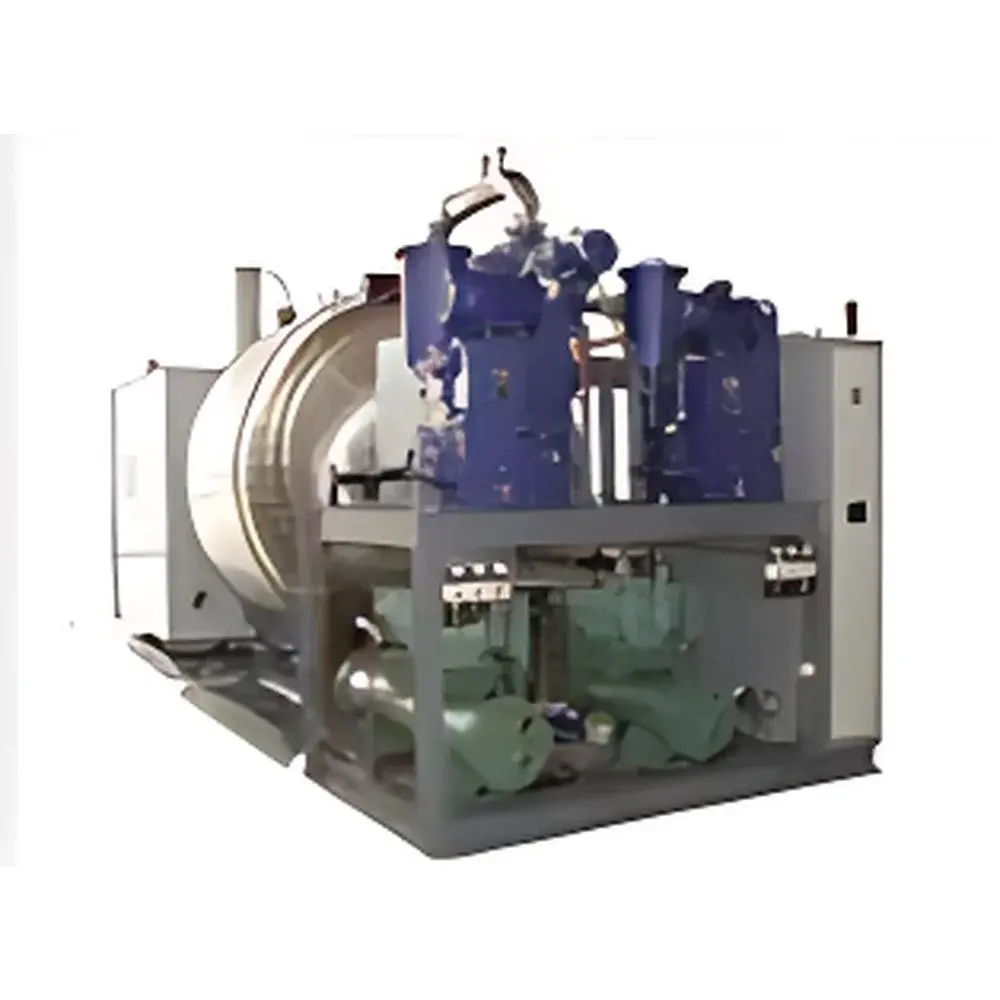
BioCool LYO-20SE Production-Scale Freeze Dryer
| Brand | BioCool |
|---|---|
| Origin | Beijing, China |
| Manufacturer Type | Authorized Distributor |
| Product Category | Domestic |
| Model | LYO-20SE |
| Instrument Type | Shelf-Type Freeze Dryer |
| Application Scope | Production-Scale |
| Lyophilization Area | 20 m² |
| Ultimate Vacuum | <4 Pa |
| Condensate Capacity (24 h) | 400 kg/24 h |
| Cold Trap Temperature | <−75 °C |
Overview
The BioCool LYO-20SE is a production-scale shelf-type freeze dryer engineered for robust, repeatable lyophilization of heat-sensitive biopharmaceuticals, herbal extracts, functional food ingredients, and advanced materials. It operates on the fundamental principles of sublimation under controlled low-pressure and low-temperature conditions: frozen water in the product matrix transitions directly from solid to vapor phase without passing through liquid—preserving structural integrity, biological activity, and chemical stability. Designed for continuous batch processing in pilot and small-to-medium manufacturing environments, the LYO-20SE integrates industrial-grade thermal management, precision vacuum regulation, and programmable process control to meet the reproducibility demands of regulated development workflows. Its architecture supports GMP-aligned operation when paired with optional validation packages and documented IQ/OQ protocols—though the base configuration is classified as economic-grade and excludes CIP (Clean-in-Place) and SIP (Sterilize-in-Place) functionality per regulatory design intent.
Key Features
- Shelf pre-freezing capability enables uniform nucleation and controlled ice crystal formation prior to primary drying.
- Programmable multi-stage drying cycles with automated endpoint detection based on pressure rise test (PRT) during desorption phase—ensuring consistent residual moisture content below target specifications (e.g., ≤1.0% w/w).
- Vacuum modulation system dynamically adjusts chamber pressure during both primary and secondary drying to suppress boil-over, minimize collapse in amorphous matrices, and optimize mass transfer efficiency.
- Pulse backfill system offers three selectable gas introduction rates (slow/medium/fast) using nitrogen or other inert gases—critical for preserving fragile particulate morphology and preventing powder dispersion during vial repressurization.
- Welded stainless-steel shelf construction ensures zero leakage, high thermal conductivity, and long-term mechanical reliability under repeated thermal cycling.
- Industrial 10.4-inch HMI touchscreen interface with intuitive navigation; no manual required for routine operation or cycle initiation.
- Real-time monitoring at 50 ms sampling interval for shelf temperature, chamber pressure, condenser temperature, and refrigerant discharge temperature.
- Onboard storage for up to 2000 user-defined or factory-standard lyo protocols—including full parameter logging (time-stamped setpoints and actuals).
Sample Compatibility & Compliance
The LYO-20SE accommodates standard pharmaceutical vials (Φ22 mm), trays, and custom containers across its 20 m² active shelf area. It supports lyophilization of aqueous solutions, suspensions, emulsions, and nanoparticle dispersions—common in monoclonal antibody formulations, probiotic powders, enzyme preparations, and botanical concentrates. While not certified for sterile manufacturing out-of-the-box, the system complies with general safety standards including IEC 61000-6-2 (EMC immunity) and IEC 61000-6-3 (EMC emission). Optional calibration certificates for shelf temperature (±0.5 °C) and vacuum transducers (±1% FS) are available for GLP-compliant documentation. For FDA-regulated applications, integration with 21 CFR Part 11–compliant PC-based data acquisition software (sold separately) enables audit-trail generation, electronic signatures, and secure user access controls.
Software & Data Management
The embedded controller logs all critical process variables with timestamping and stores raw data locally on internal flash memory. Export options include USB-stick download in CSV format for offline analysis in MATLAB, JMP, or Excel. Optional PC remote monitoring extends operational visibility up to 1.5 km via Ethernet or RS485 communication—supporting real-time alarm notification and limited parameter override. The system includes built-in calibration routines for shelf sensors and Pirani/capacitance vacuum gauges, traceable to NIST-certified references upon request. Freeze-drying curve visualization (shelf temp vs. time, pressure vs. time) is accessible directly on the HMI for rapid cycle assessment and troubleshooting.
Applications
- Biopharmaceutical development: Stabilization of vaccines, recombinant proteins, and oligonucleotides.
- Traditional Chinese Medicine (TCM) processing: Preservation of volatile oils, glycosides, and polysaccharide complexes.
- Functional food manufacturing: Encapsulation of probiotics, vitamins, and phytochemicals without thermal degradation.
- Nanomaterial synthesis: Drying of metal-organic frameworks (MOFs), liposomal carriers, and silica aerogels.
- Diagnostic reagent preparation: Lyophilized enzyme conjugates and lateral flow assay components.
- Feed additive formulation: Thermolabile enzymes and microbial cultures for animal nutrition.
FAQ
What is the difference between the LYO-20SE and standard-grade BioCool freeze dryers?
The LYO-20SE is an economic-grade model optimized for cost-effective production scaling. It lacks CIP/SIP systems, advanced validation support, and certain redundancy features found in GMP-ready configurations—but retains identical core performance metrics (vacuum, cooling capacity, shelf uniformity).
Can the LYO-20SE be validated for regulatory submission?
Yes—when equipped with optional calibrated sensors, electronic record modules, and executed with documented IQ/OQ protocols, it serves as a qualified platform for Phase I–II clinical material production and non-sterile API drying.
Is organic solvent compatibility possible?
With the optional cold trap solvent collector and compatible refrigeration upgrade (cascaded compressor), the system can safely condense acetone, ethanol, and ethyl acetate vapors during lyophilization of solvent-based formulations.
What maintenance intervals are recommended?
Vacuum pump oil change every 500 operating hours; condenser coil inspection quarterly; shelf surface cleaning after each batch using IPA and lint-free wipes; annual calibration verification for all critical sensors.
Does the system support automatic recipe transfer between units?
Yes—via USB import/export of .lyo files containing full cycle definitions, including ramp rates, hold times, vacuum setpoints, and backfill parameters.



