
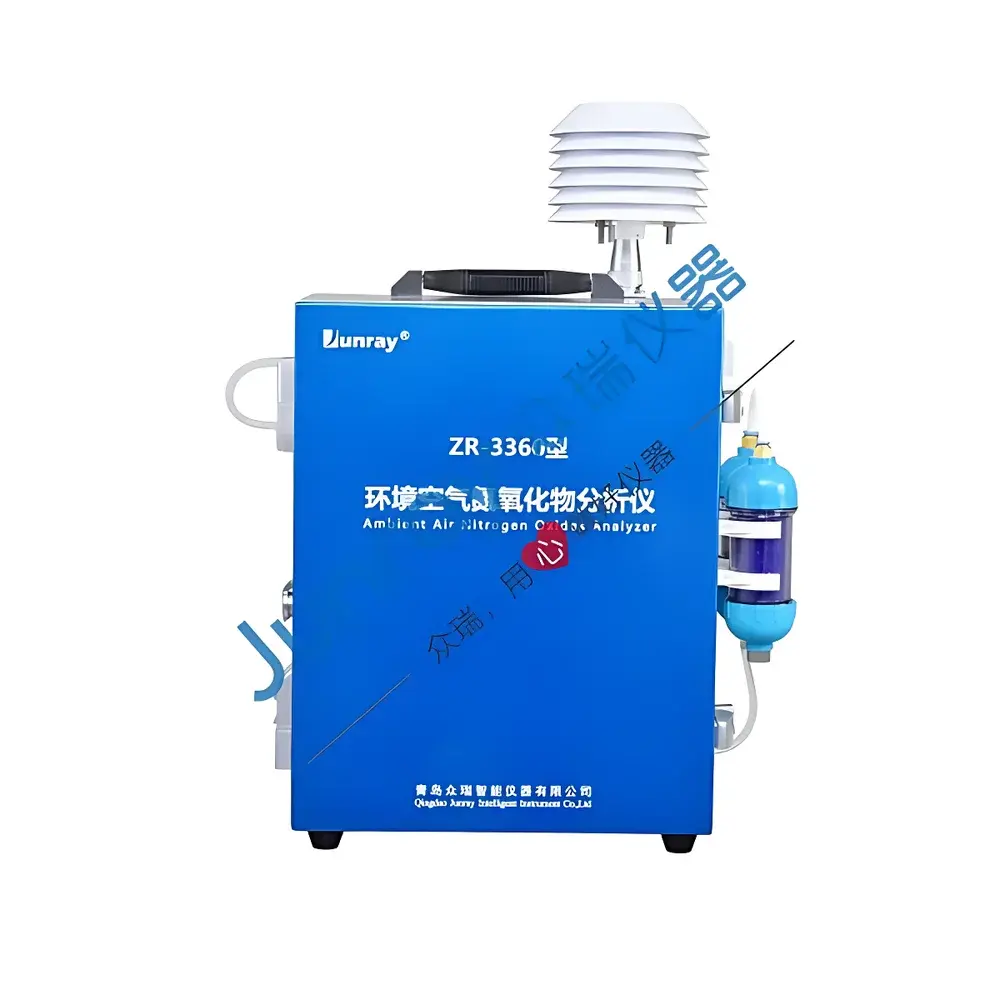
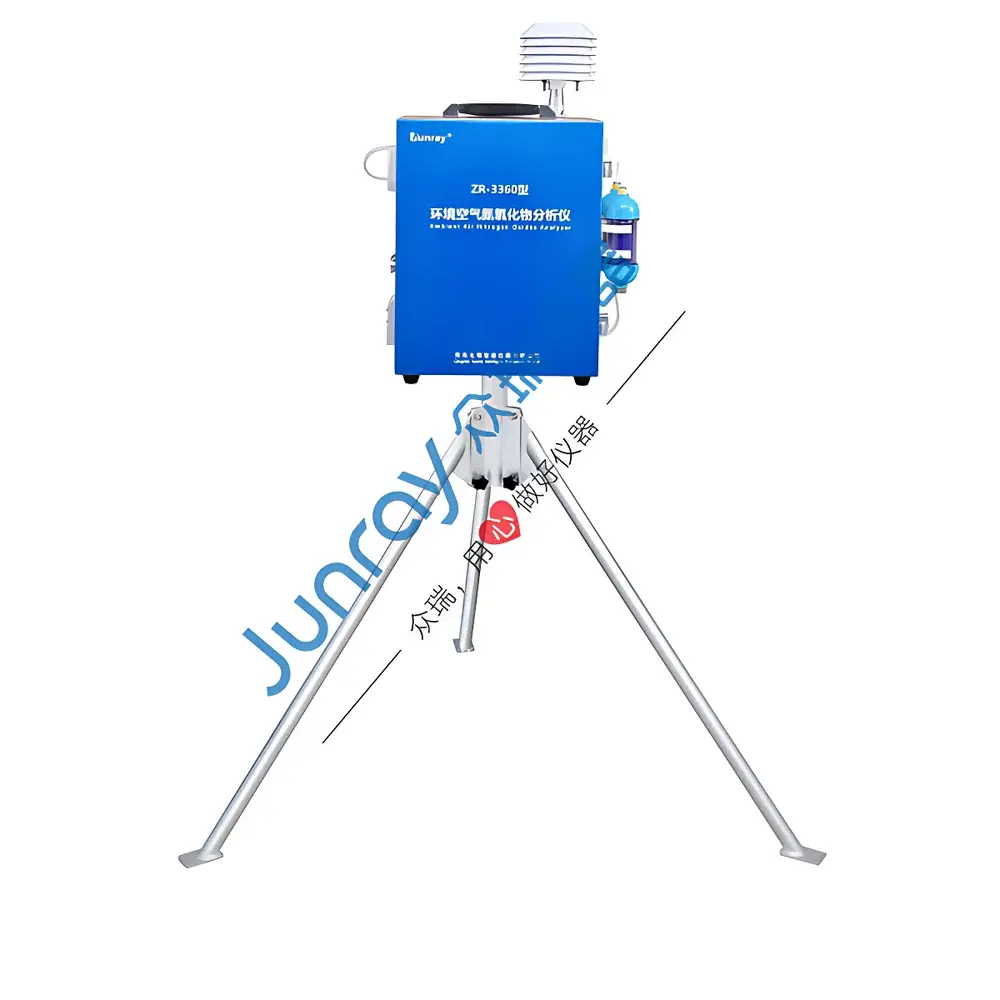
Junray ZR-3360 Environmental Air Nitrogen Oxides (NO/NO₂) Analyzer
| Brand | Junray |
|---|---|
| Origin | Shandong, China |
| Manufacturer Type | Direct Manufacturer |
| Country of Origin | China |
| Model | ZR-3360 |
| Price Range | USD 7,000–14,000 |
| Measurement Principle | Salt-Ethylendiamine Dihydrochloride (NED) Spectrophotometric Method (HJ 479–2009 / GB 8969–1988) |
| Display | 5.0-inch capacitive touchscreen |
| Environmental Rating | IP65-equivalent (rain-, dust-, ESD-, and impact-resistant) |
| Temperature & Pressure Compensation | Yes |
| Sampling Cycle | Adjustable from 5 to 20 minutes |
| Auto-Cleaning | Integrated tubing purge system |
| Low-Reagent Alert | Yes |
| Power Supply | Internal high-capacity Li-ion battery (≥12 h continuous operation) |
| Connectivity | Embedded 4G LTE module, USB 2.0 port, optional Bluetooth thermal printer, optional GPS geotagging module |
Overview
The Junray ZR-3360 Environmental Air Nitrogen Oxides (NO/NO₂) Analyzer is a field-deployable, regulatory-compliant instrument engineered for accurate, real-time quantification of nitrogen monoxide (NO) and nitrogen dioxide (NO₂) in ambient air. It implements the standardized salt-ethylendiamine dihydrochloride (NED) spectrophotometric method—fully aligned with China’s national standard HJ 479–2009 (“Determination of Nitrogen Oxides in Ambient Air—NED Spectrophotometric Method”) and GB 8969–1988 (“Determination of Nitrogen Oxides in Ambient Air—NED Colorimetric Method”). Unlike chemiluminescence or electrochemical analyzers, the ZR-3360 relies on controlled gas-phase absorption and liquid-phase derivatization: ambient air is drawn through a selective scrubber and reaction coil where NO₂ is absorbed into an acidic NED reagent solution, forming a stable pink azo dye; simultaneously, NO is catalytically converted to NO₂ upstream via a molybdenum converter before absorption. The resulting absorbance at 540 nm is measured using a precision optical path and calibrated photodiode detector, enabling trace-level quantification with high specificity and minimal interferences from ozone, SO₂, or VOCs.
Key Features
- 5.0-inch industrial-grade capacitive touchscreen interface with intuitive menu navigation and real-time concentration trend visualization
- Ruggedized enclosure meeting IP65-equivalent mechanical and environmental protection: fully operational under rain, snow, high-dust, and severe haze conditions
- Integrated temperature and barometric pressure compensation algorithms—ensuring measurement stability across wide ambient ranges (−20 °C to +50 °C, 70–106 kPa)
- Programmable sampling cycle (5–20 min), supporting both high-frequency monitoring and extended battery-life operation
- Automated fluidic management: self-purging sample lines, reagent-level monitoring, and audible/visual low-reagent alerts to prevent data gaps
- Onboard rechargeable lithium-ion battery (≥12 h runtime at typical duty cycle), eliminating dependency on grid power during mobile or remote deployments
Sample Compatibility & Compliance
The ZR-3360 is validated for direct analysis of unfiltered ambient air samples without pre-concentration or dilution. Its chemical detection scheme ensures robust performance in complex urban, roadside, industrial boundary, and background monitoring scenarios. The analyzer conforms to the metrological and procedural requirements of HJ 479–2009, including defined sampling flow rate (0.2–0.5 L/min), reagent blank control protocols, calibration frequency (daily zero/span verification recommended), and linearity verification over 0–500 µg/m³ (NO₂-equivalent). While not certified to EU EN 14211 or US EPA EQOA specifications out-of-the-box, its methodology is technically equivalent to reference-grade wet-chemistry methods accepted under ISO 10477 and WHO air quality guidelines. Data integrity supports GLP-aligned recordkeeping when used with audit-trail-enabled software configurations.
Software & Data Management
Data acquisition and instrument control are managed via embedded firmware with dual-mode logging: local storage (≥30 days of 5-min averaged records on internal flash memory) and remote transmission via integrated 4G LTE modem. All transmitted datasets include timestamp, GPS coordinates (if optional module installed), ambient T/P values, reagent status, and diagnostic flags. USB 2.0 port enables secure offline data export in CSV format compliant with Excel and common environmental databases (e.g., EPANET-compatible time-series ingestion). Firmware updates and configuration backups are supported over USB or OTA (Over-The-Air) via authenticated HTTPS endpoints. No cloud subscription is required—users retain full ownership and control of raw and processed datasets.
Applications
- Ambient air quality monitoring networks (AQN) operated by municipal and provincial environmental protection bureaus
- Mobile source emission studies—including roadside, tunnel, and port-area NOx profiling
- Industrial fence-line monitoring for compliance with local emission limits (e.g., DB11/1195–2015)
- Academic and research campaigns requiring speciated NO/NO₂ data with trace-level sensitivity and field durability
- Calibration verification and cross-validation against chemiluminescence analyzers in multi-instrument intercomparison studies
FAQ
What regulatory standards does the ZR-3360 comply with?
It is designed and validated per HJ 479–2009 and GB 8969–1988—the definitive Chinese national standards for ambient NOx measurement using the NED spectrophotometric method.
Does the analyzer require external power for continuous operation?
No—it operates autonomously on its internal Li-ion battery for ≥12 hours; AC adapter is optional for station-based deployments.
Can the ZR-3360 distinguish between NO and NO₂ concentrations?
Yes—via sequential measurement modes: direct NO₂ absorption and total NOx (NO + NO₂) after catalytic conversion, enabling calculation of NO concentration by difference.
Is remote firmware update supported?
Yes—secure OTA updates are available via HTTPS after authentication; USB-based updates are also supported for air-gapped environments.
What maintenance intervals are recommended?
Reagent replacement every 7–14 days depending on sampling frequency and ambient concentration; annual optical path cleaning and converter efficiency verification recommended.
Related Products







