
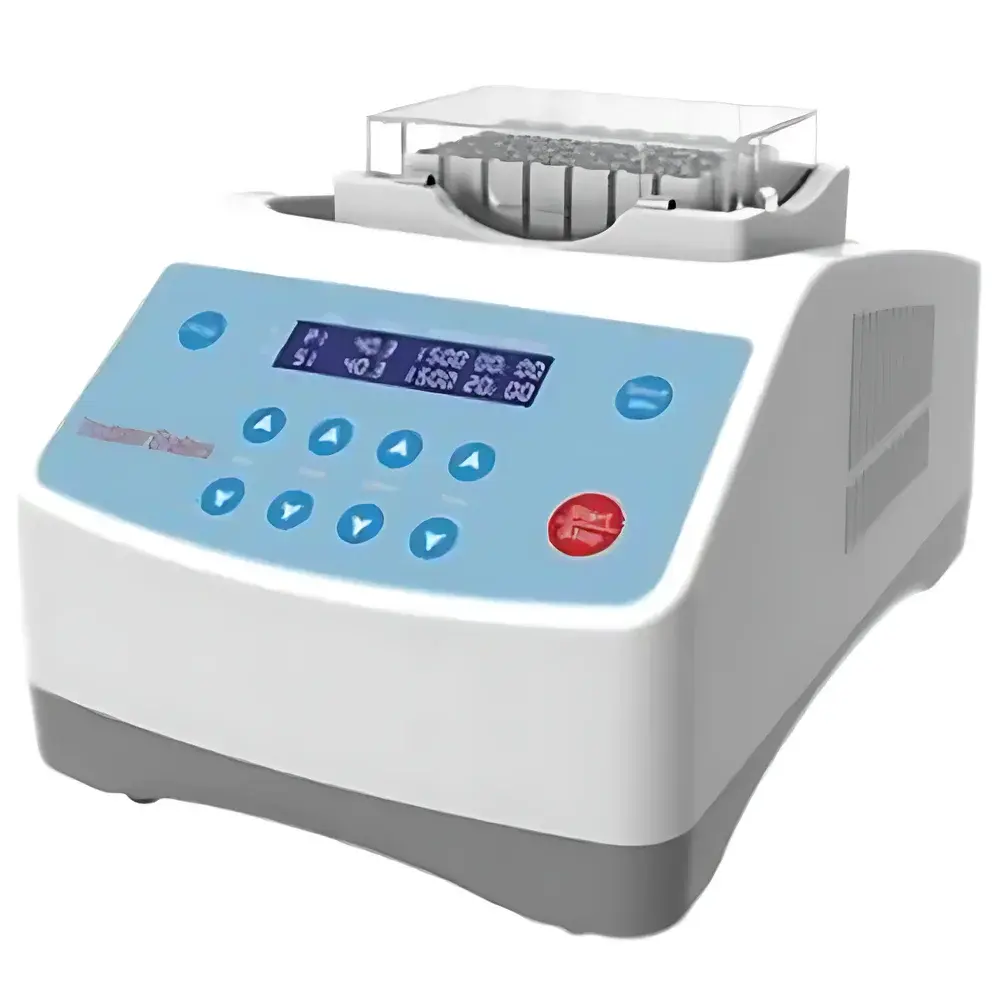
ZiQi MD-20 Refrigerated Dry Block Heater
| Brand | ZiQi |
|---|---|
| Origin | Shanghai, China |
| Manufacturer Type | Direct Manufacturer |
| Product Category | Domestic |
| Model | MD-20 (Refrigerated) |
| Temperature Range | −10 °C to 100 °C |
| Temperature Accuracy | ±0.1 °C |
| Heating Time | ≤15 min (from 25 °C to 100 °C) |
| Cooling Time | ≤15 min (from 20 °C to −5 °C) |
| Dimensions | 300 × 220 × 170 mm |
| Net Weight | 4.5 kg |
| Temperature Uniformity | ≤±0.3 °C |
| Temperature Stability | ≤±0.3 °C |
| Display Resolution | 0.1 °C |
| Timer Range | 1 min to 99 h 59 min |
| Max Power Consumption | 150 W |
| Compatible Modules | A–M (96-well PCR plates, 0.2–50 mL tube formats) |
Overview
The ZiQi MD-20 Refrigerated Dry Block Heater is a precision-engineered thermal management instrument designed for laboratories requiring bidirectional temperature control—from sub-ambient cooling to precise heating—without the operational constraints of liquid baths. Unlike conventional water baths, this dry block system eliminates contamination risks, evaporation losses, and maintenance overhead associated with fluid media. It operates on Peltier-based thermoelectric cooling combined with resistive heating elements, enabling rapid, stable, and programmable thermal regulation across a wide range of sample vessels. The device is optimized for applications demanding strict thermal consistency over extended durations, including enzyme reaction incubation, nucleic acid denaturation, serum coagulation assays, and pre-analytical sample conditioning in clinical and molecular biology workflows.
Key Features
- Microprocessor-controlled dual-mode thermal regulation with independent heating and cooling pathways, delivering fast thermal response: ≤15 min heating (25 °C → 100 °C) and ≤20 min cooling (20 °C → −10 °C).
- High-resolution LCD interface supporting simultaneous dual-parameter programming—temperature setpoint and countdown timer—with real-time display of actual block temperature and remaining time.
- Integrated temperature calibration offset function allows user-adjustable compensation to maintain traceable accuracy per ISO/IEC 17025 laboratory requirements.
- Dual safety architecture: hardware-based overtemperature cutoff (mechanical thermal fuse) and software-monitored fault detection with audible alarm activation upon sensor deviation or power anomaly.
- Compact footprint (300 × 220 × 170 mm) and lightweight design (4.5 kg) enable flexible benchtop integration—even in space-constrained biosafety cabinets or automated workstations.
- Modular aluminum heating block system with 13 interchangeable configurations (A–M), accommodating standard tube formats from 0.2 mL PCR strips to 50 mL conical tubes and 96-well microplates—each engineered for optimal thermal coupling and autoclavable compatibility.
Sample Compatibility & Compliance
The MD-20 supports universal sample vessel compatibility via its standardized modular inserts, validated for use with polypropylene, polyethylene, and glass tubes meeting ASTM D5229/D5230 thermal stability specifications. All modules undergo thermal uniformity mapping per ISO 13843:2021 Annex B, confirming ≤±0.3 °C spatial variation across active zones at steady state. The unit complies with IEC 61010-1:2010 safety standards for laboratory electrical equipment and meets EMC Class B emission limits (EN 61326-1). While not certified for GMP production environments, its audit-ready features—including timestamped temperature logs, calibration history tracking, and error-code reporting—support GLP-aligned documentation practices in regulated research settings.
Software & Data Management
The MD-20 operates as a standalone instrument with embedded firmware; no external PC or proprietary software is required for routine operation. However, optional RS-232 serial output (available upon request) enables integration into LIMS or ELN platforms for automated data capture. All temperature and timer events are logged internally with timestamps, supporting retrospective analysis of thermal exposure profiles. Firmware supports user-defined calibration offsets stored in non-volatile memory, ensuring continuity across maintenance cycles. Audit trail functionality—though not 21 CFR Part 11-compliant out-of-the-box—can be enhanced through third-party middleware solutions for laboratories requiring electronic record integrity under FDA or EMA guidelines.
Applications
- Molecular biology: DNA denaturation (95 °C), restriction digestion (37 °C), and cold-soak steps (−10 °C to 4 °C) for RNase inhibition.
- Clinical diagnostics: Serum clotting assays (37 °C incubation), plasma separation stabilization, and cold-chain sample holding prior to centrifugation.
- Pharmaceutical QC: Dissolution test sample conditioning, excipient thermal stability screening, and accelerated stability study setups.
- Industrial microbiology: Enzyme activity profiling across temperature gradients and microbial growth phase synchronization.
- Educational labs: Safe, low-maintenance alternative to water baths for undergraduate thermodynamics and biochemistry experiments.
FAQ
Does the MD-20 support continuous operation at −10 °C in ambient environments above 30 °C?
Yes, provided adequate ventilation is maintained around the rear heat sink; sustained sub-ambient operation requires ambient temperatures ≤28 °C for optimal cooling efficiency.
Can the instrument be calibrated externally using NIST-traceable reference probes?
Yes—the unit accepts manual calibration offset input based on comparison against certified reference thermometers per ISO/IEC 17025 Section 6.5.
Are module replacements available as spare parts, and do they require recalibration?
All 13 module types (A–M) are orderable individually; no recalibration is needed after replacement due to factory-matched thermal interface tolerances.
Is the timer function capable of cycling between multiple temperature setpoints?
No—the MD-20 implements single-stage temperature + timer control; multi-step protocols require manual intervention or external sequencing controllers.
What maintenance is recommended to ensure long-term thermal accuracy?
Annual verification of temperature uniformity and stability using a calibrated thermal imaging camera or multi-point probe array is advised; cleaning of the aluminum block surface with isopropyl alcohol prevents thermal resistance buildup.



