
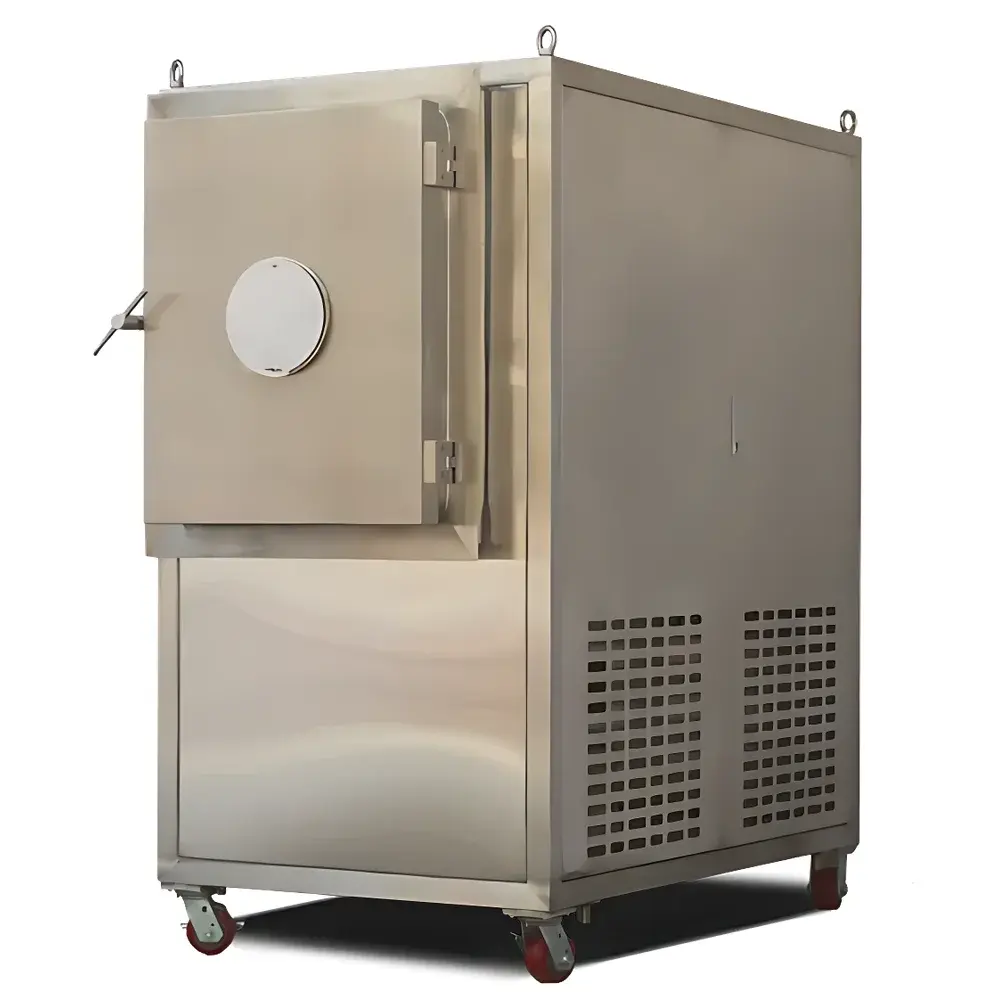
BioCooll BIOCOOL-T Series “IceCore” Freeze Dryer
| Brand | BioCooll |
|---|---|
| Origin | Beijing, China |
| Manufacturer Type | Authorized Distributor |
| Country of Origin | China |
| Model | BIOCOOL-T |
| Instrument Type | Stoppering Freeze Dryer |
| Application Scale | Pilot-Scale |
| Shelf Area | 1 m² |
| Ultimate Vacuum | ≤1 Pa |
| Condensate Capacity (24 h) | 15 L |
| Cold Trap Temperature | < −110 °C (operational), down to −165 °C (enhanced capture mode) |
| Dimensions (W×D×H) | 860 × 1700 × 1950 mm |
Overview
The BioCooll BIOCOOL-T Series “IceCore” Freeze Dryer is an engineered pilot-scale lyophilization system designed for demanding applications in pharmaceutical development, biologics processing, and advanced material science—where low thermal transition temperatures (e.g., Te, Tm, Tc, Tg1) necessitate precise sub-ambient freezing, ultra-low condenser performance, and high-vacuum stability. Unlike conventional freeze dryers optimized for bulk commodity products, the IceCore platform integrates cryogenic engineering with process intelligence to support lyophilization of thermally sensitive formulations—including monoclonal antibodies, mRNA-LNPs, peptide conjugates, and nanostructured ceramics—that require shelf temperatures below −80 °C and cold trap operation as low as −165 °C. Its core architecture follows the primary principles of lyophilization: controlled freezing (to establish a stable crystalline or amorphous matrix), primary drying (sublimation under high vacuum), and secondary drying (desorption under elevated temperature and regulated pressure). The system complies with fundamental design expectations for GMP-aligned pilot equipment per ISO 22042 and ASTM F2375-22 guidelines for lyophilizer qualification.
Key Features
- Ultra-low temperature capability: Shelf pre-freezing to < −80 °C; cold trap base temperature < −110 °C, extendable to −165 °C via enhanced refrigeration circuitry for high-efficiency water vapor capture.
- High-integrity vacuum environment: Dual-stage vacuum system featuring internationally certified oil-lubricated rotary vane pump (high-speed, low-noise, ≥12 m³/h nominal pumping speed) and chamber/cold trap ultimate vacuum ≤1 Pa.
- Structural thermal management: Chamber insulated with proprietary multi-layer vacuum-insulated panels (VIPs), total insulation thickness >100 mm, minimizing heat ingress during long-duration primary drying.
- Integrated stoppering mechanism: Motor-driven hydraulic stopper assembly mounted at machine base—fully accessible after full shelf lift—enabling consistent, repeatable rubber stopper compression on 2–30 mL vials without manual intervention.
- Intelligent process control: Programmable logic controller (PLC) coupled with industrial-grade touchscreen HMI (IEC 61131-3 compliant); no external documentation required for routine operation due to context-sensitive interface navigation.
- Advanced drying logic: Real-time sublimation endpoint detection algorithm; automated desorption endpoint verification via integrated residual moisture inference (based on pressure rise test and shelf temperature differentials).
- Safety-critical interlocks: Comprehensive protection suite including compressor high/low-pressure cutouts, shelf overtemperature shutdown, vacuum breach response, drain valve–vacuum system mutual lockout, and current overload monitoring.
Sample Compatibility & Compliance
The BIOCOOL-T accommodates standard ISO 13485-compatible stainless-steel trays (up to 1 m² loading area) and nested vial configurations (10–1000 units per batch depending on size). It supports lyophilization of aqueous, buffer-based, and organic co-solvent formulations—provided compatibility with stainless-steel wetted parts (AISI 316L) and elastomeric seals (EPDM/FKM) is confirmed. The system meets mechanical safety requirements per EN 61000-6-2/6-4 (EMC) and EN 61010-1 (electrical safety). While not supplied as a fully validated GMP production unit, its architecture enables IQ/OQ execution per FDA Guidance for Industry: Lyophilization Process Validation (2023) and supports 21 CFR Part 11-compliant data integrity when configured with PC database logging and electronic signature modules.
Software & Data Management
Data acquisition operates at 50 ms sampling resolution for shelf temperature, product thermocouple (optional), chamber pressure, and condenser temperature. All parameters are timestamped and stored across three redundant media: internal flash memory (retains ≥90 days of continuous operation logs), removable USB 3.0 drive (FAT32/exFAT formatted), and optional SQL-based PC server (with TLS-encrypted remote access up to 1.5 km via Ethernet/WiFi). The embedded software includes 2000 programmable recipe slots (user-defined or factory presets), real-time curve overlay visualization, co-crystallization point (Tg’/Tc) analysis from offline/online resistance thermometry, and full calibration traceability for temperature sensors (PT100 Class A) and capacitance manometers (±0.25% FS accuracy). Audit trails record all parameter modifications, user logins, alarm events, and cycle start/stop actions.
Applications
- Early-phase clinical trial material manufacturing (Phase I–II) requiring batch consistency under strict thermal history control.
- Stabilization of labile biologics—especially those exhibiting collapse temperatures (Tc) below −45 °C—via deep freezing and slow-ramp primary drying.
- Development of sterile powder formulations for inhalation, ocular delivery, or implantable depots where residual moisture must remain <0.5% w/w.
- Freeze-drying of conductive polymers, MOFs, and aerogel precursors where structural porosity preservation depends on controlled ice nucleation and vapor flow dynamics.
- Process characterization studies supporting Design Space definition per ICH Q5C and Q8(R2), including DoE-based shelf temperature/vacuum mapping.
FAQ
What is the lowest achievable shelf temperature during pre-freezing?
The BIOCOOL-T achieves ≤ −80 °C on all shelves simultaneously, verified per ASTM E2251-22 using calibrated NIST-traceable PT100 probes.
Does the system support inert gas backfilling post-drying?
Yes—integrated mass flow controller enables programmable nitrogen or argon backfill at selectable rates (slow/medium/fast pulse modes) to prevent particle dispersion in fragile cakes.
Is remote monitoring limited to local network access?
No—web-based SCADA interface supports secure HTTPS access from any authenticated device within a firewall-configured LAN/WAN, including mobile browsers.
Can the cold trap reach −165 °C continuously during primary drying?
The −165 °C rating reflects peak capture capacity under low-load conditions; sustained operation at that temperature requires active load management and is recommended only for high-volatility solvents or ultra-low eutectic systems.
How is calibration traceability maintained over time?
Built-in two-point temperature calibration (−80 °C and +20 °C) and zero/span vacuum calibration routines are user-executable; all results are digitally signed and appended to cycle reports.



