
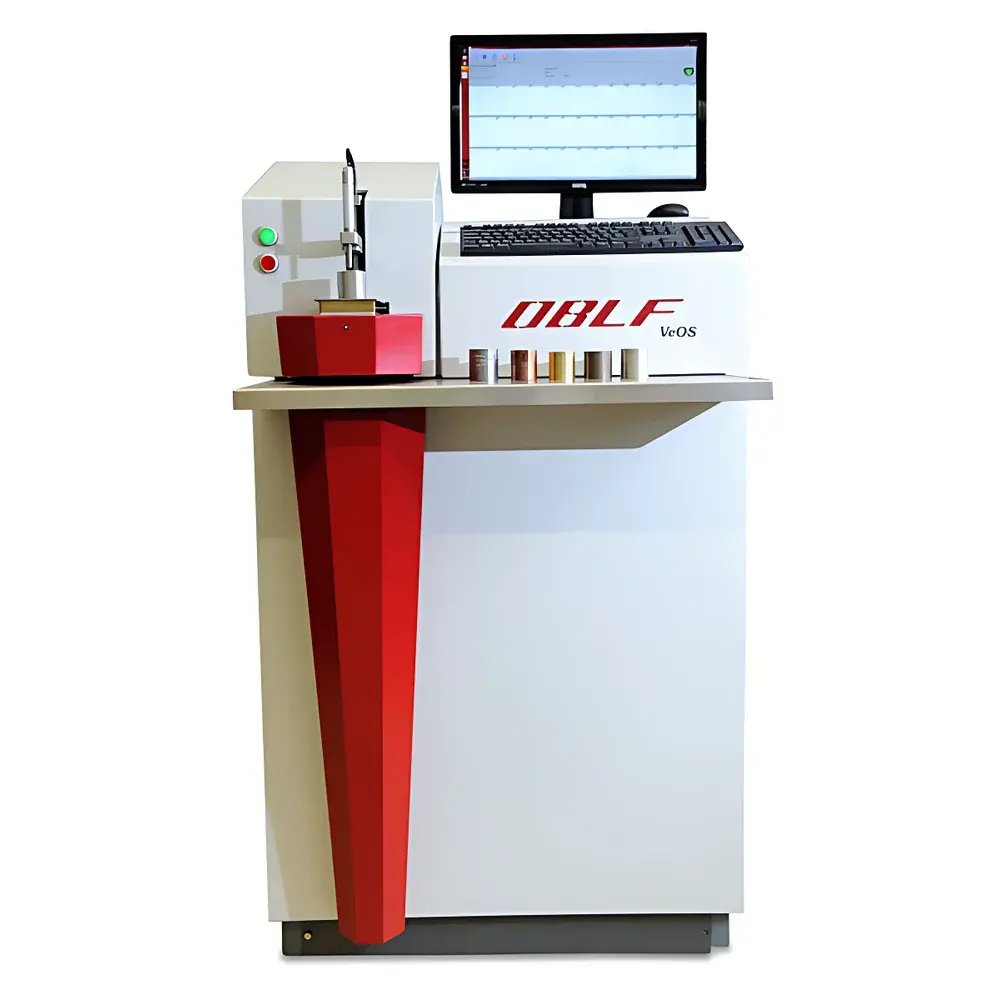
OBLF VeOS Full-Spectrum Direct-Reading Optical Emission Spectrometer
| Brand | OBLF |
|---|---|
| Origin | Germany |
| Model | OBLF VeOS |
| Instrument Type | Floor-Standing |
| Excitation Method | Spark |
| Detector Type | Charge-Coupled Device (CCD) |
| Focal Length | 500 mm |
| Grating Groove Density | 2700 lines/mm |
| Wavelength Range | 120–800 nm |
| Number of Detection Channels | 128 |
Overview
The OBLF VeOS is a high-performance, floor-standing full-spectrum direct-reading optical emission spectrometer (OES) engineered for precise elemental analysis of metallic materials in demanding industrial and laboratory environments. Based on spark source atomic emission spectroscopy, the instrument excites solid metal samples using a controlled high-energy spark discharge in an argon-purged or vacuum environment, generating characteristic atomic line emissions across the ultraviolet to near-infrared spectrum (120–800 nm). Its core optical architecture features a Paschen–Runge mounting with a 500 mm focal length concave grating and 2700 lines/mm groove density, enabling high spectral resolution and efficient light dispersion. Unlike sequential spectrometers, the VeOS captures the entire spectrum simultaneously via a high-sensitivity, thermoelectrically cooled CCD detector—specifically developed for OES applications—delivering >100× higher quantum efficiency than conventional photomultiplier tube (PMT)-based systems across the full wavelength range. This design ensures superior signal-to-noise ratio, low detection limits, and robust multi-element quantification without mechanical channel reconfiguration.
Key Features
- Full-spectrum acquisition using a custom-designed, back-illuminated CCD detector with deep-UV sensitivity down to 120 nm—enabling reliable nitrogen and ultra-low carbon (<0.001 wt%) determination in steels and alloys.
- Thermostatically controlled vacuum optical chamber: maintains stable internal pressure and temperature (±0.1 °C), eliminating air absorption (especially critical below 190 nm) and drift due to ambient humidity or thermal fluctuation.
- Open-style spark stand with motorized sample clamp and adjustable electrode positioning—accommodates irregular geometries, large billets, small castings, and machined coupons without fixture modification.
- Multi-matrix capability: single calibration supports Fe-, Al-, Cu-, Ni-, Zn-, Ti-, and Mg-based alloys; no hardware reconfiguration required when switching between base materials.
- Dust-resistant enclosure and sealed optical path meet IP54-rated environmental protection standards—validated for continuous operation in foundry floors, rolling mills, and QC labs with elevated particulate levels.
- Robust spark source with digital ignition control, real-time current/voltage monitoring, and adaptive energy delivery—optimized for reproducible ablation across varying surface conditions and conductivity.
Sample Compatibility & Compliance
The VeOS accepts solid conductive metallic samples up to Ø 40 mm × 50 mm height, including as-cast, hot-rolled, machined, and coated specimens. Non-conductive coatings (e.g., paint, oxide layers) are removed in situ via pre-spark cleaning. The system complies with ISO 11577:2021 (metallic materials — spark emission spectrometry), ASTM E415-22 (standard test method for analysis of carbon and low-alloy steel), and EN 10315 (chemical analysis of steel by OES). Data integrity protocols support GLP/GMP environments, including user access control, electronic signatures, and audit-trail logging per FDA 21 CFR Part 11 requirements when integrated with OBLF’s certified software suite.
Software & Data Management
Controlled by OBLF’s proprietary WinOE software, the VeOS provides intuitive workflow management—from method setup and calibration to routine analysis and statistical reporting. All spectral data (raw intensity, background-corrected net intensities, peak profiles) are stored in vendor-neutral HDF5 format. Software features include automatic inter-element interference correction, matrix-matched standardization, drift compensation using internal reference lines, and customizable report templates compliant with ISO/IEC 17025 documentation requirements. Remote diagnostics, firmware updates, and spectral library sharing are supported via secure TLS-encrypted network connections.
Applications
- Quality assurance of incoming raw materials (scrap, ingots, master alloys) in steelmaking and non-ferrous production.
- Final product certification for automotive, aerospace, and energy-sector components requiring traceability to EN 10204 3.1/3.2 certificates.
- Low-level nitrogen analysis in stainless steels, superalloys, and nitrided tool steels.
- Carbon equivalency (CEV) and alloy grade identification (e.g., ASTM A36 vs. A572) in structural fabrication QA/QC.
- Research-grade quantitative mapping of microsegregation in cast structures using line-scan mode and spatial intensity profiling.
FAQ
Does the VeOS require external vacuum pumps during operation?
No—the optical chamber is sealed and maintained under permanent high vacuum using a getter-based pumping system; no continuous mechanical pumping is needed.
Can the instrument analyze coated or galvanized steel samples?
Yes—pre-spark cleaning removes thin surface layers (up to ~5 µm); thicker coatings require mechanical preparation prior to analysis.
Is nitrogen calibration traceable to certified reference materials?
Yes—OBLF provides CRM-based nitrogen calibration sets (e.g., NIST SRM 2165, BCS CRM 304) with uncertainty budgets documented per ISO/IEC 17025.
What maintenance intervals are recommended for daily operation?
Optical chamber vacuum integrity check every 6 months; spark stand cleaning and electrode replacement every 10,000–15,000 sparks; CCD detector lifetime exceeds 10 years under normal use.
How is method transfer handled between multiple VeOS units?
Spectral response normalization and intensity mapping allow cross-instrument calibration transfer using OBLF’s standardized method export/import protocol—validated per ASTM E2923-20 Annex A2.
Related Products




