
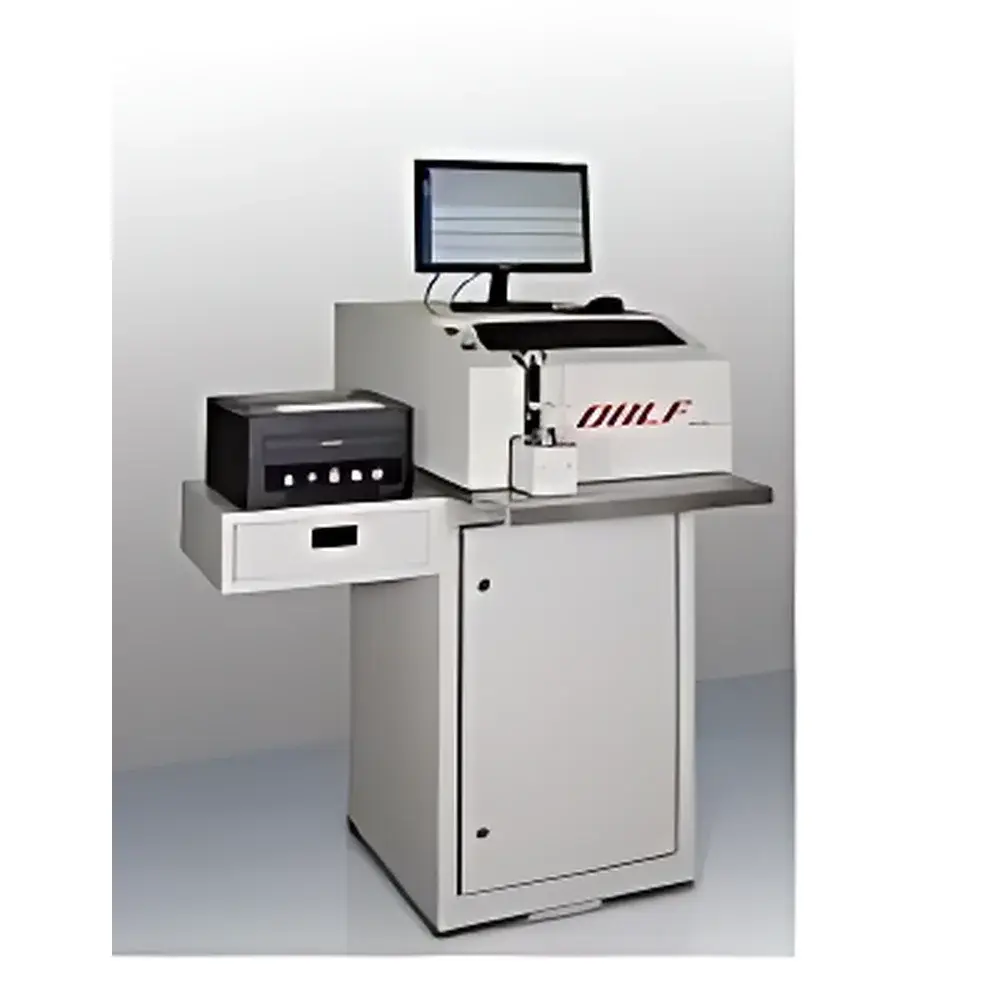
OBLF GS1000-II Direct Reading Spark Optical Emission Spectrometer
| Brand | OBLF |
|---|---|
| Origin | Germany |
| Model | OBLF GS1000 II |
| Instrument Type | Floor-standing |
| Excitation Method | Spark |
| Detector Type | Photomultiplier Tube (PMT) |
| Focal Length | 500 mm |
| Grating Groove Density | 2700 lines/mm |
| Wavelength Range | 120–780 nm |
| Number of Channels | 32 |
Overview
The OBLF GS1000-II is a high-performance, floor-standing spark optical emission spectrometer (OES) engineered for rapid, precise elemental analysis of solid metallic materials in demanding industrial environments—including foundries, metal production facilities, and quality control laboratories. Based on the fundamental principle of spark-induced atomic emission spectroscopy, the instrument generates controlled micro-plasma discharges on the sample surface under argon atmosphere, exciting atoms to emit characteristic wavelengths. These emissions are dispersed via a high-resolution Czerny-Turner optical system with a 500 mm focal length and 2700 lines/mm ruled grating, then detected by an array of photomultiplier tubes (PMTs) optimized for signal-to-noise ratio and long-term stability. Designed for single-matrix applications—primarily ferrous and non-ferrous alloys—the GS1000-II delivers quantitative multi-element results (including nitrogen and interstitial elements such as carbon, sulfur, and phosphorus) within approximately 15 seconds per analysis cycle. Its vacuum-protected optical chamber—operating at <5% pump duty cycle—ensures minimal environmental drift and exceptional spectral reproducibility over extended operational periods.
Key Features
- Gated Discharge Source (GDS) excitation technology: Solid-state, auxiliary-electrode-free spark generator operating at up to 1000 Hz repetition rate, delivering stable, reproducible plasma energy without maintenance-intensive components.
- Vacuum-sealed optical bench: All critical optical elements—including diffraction grating, mirrors, PMT detectors, and integration boards—are housed within a continuously evacuated chamber; vacuum pump activation is fully automated and limited to <5% of total instrument runtime, extending service life and reducing operational overhead.
- Open, self-cleaning spark stand: Patented argon-flushed design with no static gas reservoir; argon flow initiates only during spark discharge, significantly lowering consumable gas usage while accommodating irregularly shaped or oversized samples (e.g., billets, castings, machined parts).
- Direct optical coupling: Spark plasma light is focused through a quartz lens directly into the vacuum chamber, eliminating air-path absorption losses—particularly critical in the deep UV range (120–190 nm) where key elemental lines (e.g., N I 149.26 nm, C I 193.09 nm, P I 178.28 nm) reside.
- Rugged mechanical architecture: Weighing 300 kg with dimensions of 600 × 1050 × 1210 mm (W × D × H), the instrument features vibration-damped base construction and thermally stabilized optics, enabling reliable operation across ambient temperatures from 12 °C to 35 °C.
Sample Compatibility & Compliance
The GS1000-II supports flat, cylindrical, and irregular metallic specimens up to 40 mm in height and 40 mm in diameter, with optional adapters for smaller wires or thin sheets. Surface preparation follows standard metallurgical practices (grinding or milling to remove oxide layers). The system complies with ISO/IEC 17025 requirements for testing laboratories and supports audit-ready documentation workflows aligned with GLP and GMP frameworks. While not inherently 21 CFR Part 11 compliant out-of-the-box, its Windows-based control software (compatible with Windows Vista and later versions) allows integration with validated LIMS environments through configurable user access controls, electronic signatures, and full audit trail logging when deployed with appropriate IT governance protocols.
Software & Data Management
Control and data acquisition are managed via OBLF’s proprietary WinSpark software, providing intuitive method setup, calibration management, interference correction algorithms (e.g., line overlap compensation), and statistical process control (SPC) tools. Raw intensity values, net intensities, and certified reference material (CRM)-based calibration curves are stored in structured binary format with timestamped metadata. Export options include CSV, XML, and PDF reports compliant with internal QA templates. Software updates are distributed via secure OBLF update portal; version history and configuration change logs are retained for traceability. No cloud connectivity is embedded—data residency remains fully on-premise unless integrated via customer-defined network policies.
Applications
- Real-time melt shop analysis for steel, stainless steel, aluminum, copper, and nickel-based alloys.
- Verification of alloy grade conformity against ASTM E415, E1086, E1479, ISO 6871, and EN 10088 specifications.
- Trace element quantification (e.g., B, Sn, As, Pb) in high-purity specialty steels.
- Nitrogen determination in austenitic and duplex stainless steels per ASTM A763.
- Quality gate screening prior to heat treatment or forging to prevent costly rework.
- Supplier material verification and incoming inspection in automotive and aerospace Tier-1 supply chains.
FAQ
What is the typical detection limit for nitrogen using the GS1000-II?
Detection limits for nitrogen are matrix-dependent; in low-alloy steel, typical values range between 10–30 ppm (3σ), contingent upon CRM calibration density and spark parameter optimization.
Can the instrument be upgraded to support additional elements or matrices?
Yes—hardware channel capacity is fixed at 32 PMTs, but spectral coverage (120–780 nm) permits reconfiguration for new elements within this range via software recalibration and optional optical realignment by certified OBLF service engineers.
Is routine maintenance required for the vacuum system?
No scheduled maintenance is required for the vacuum pump or chamber under normal operation; the low-duty-cycle design (<5% runtime) ensures >10,000 hours mean time between failures (MTBF) for the pumping system.
How does the GDS source improve analytical precision compared to conventional spark sources?
GDS enables precise temporal gating of discharge energy, minimizing thermal diffusion into the sample and stabilizing plasma temperature—resulting in improved shot-to-shot intensity reproducibility (RSD < 0.5% for major elements in homogeneous standards).
Does the system support automated sample changers or robotics integration?
The GS1000-II features digital I/O ports and Ethernet-based remote command protocol (TCP/IP), enabling seamless integration with third-party autosamplers and factory automation systems via OEM-defined interface specifications.
Related Products




