
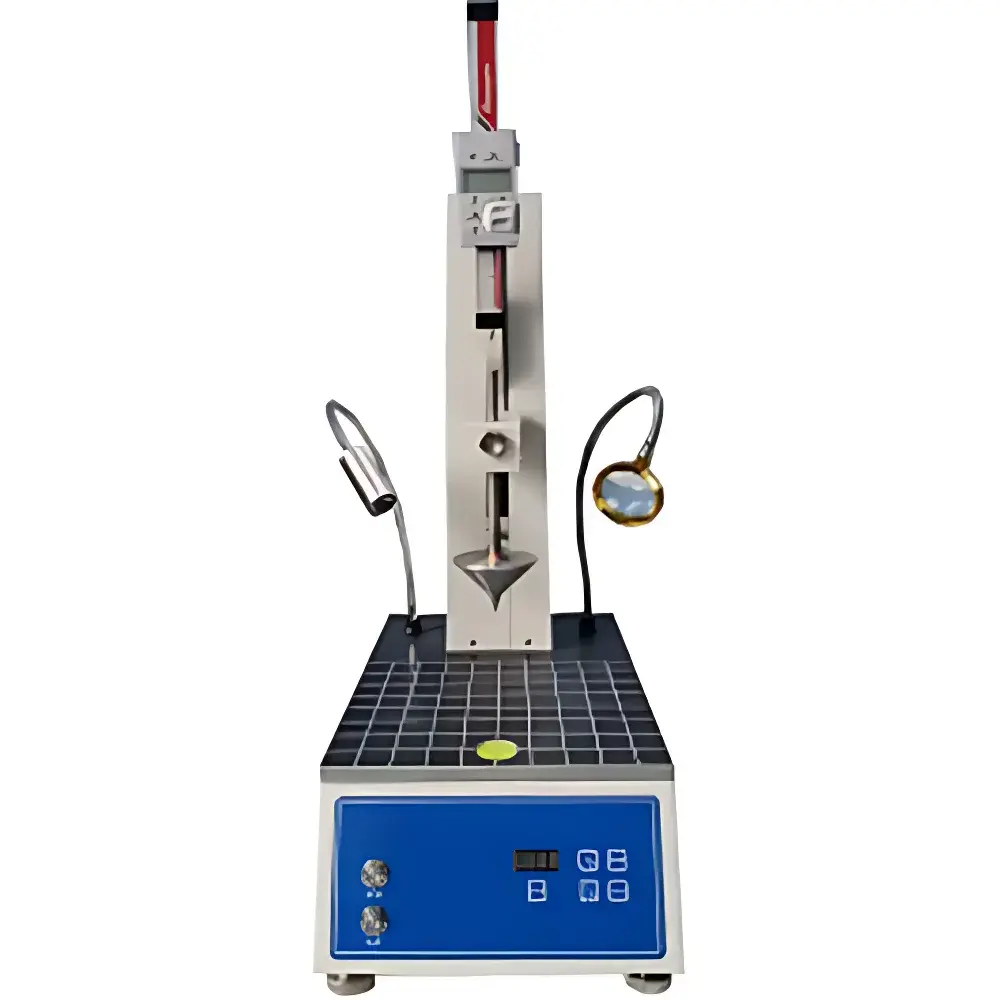
MITONG SYP-0983 Pharmaceutical Penetrometer
| Brand | MITONG (Shanghai Mitong Instrument Co., Ltd.) |
|---|---|
| Origin | Shanghai, China |
| Model | SYP-0983 |
| Penetration Measurement Range | 0–700 dmm |
| Temperature Control Range | 0–65 °C |
| Temperature Control Accuracy | ±0.1 °C |
| Penetration Resolution | 0.01 mm |
| Maximum Penetration Depth | ±1 dmm |
| Standard Cone (No. 1) | (102.5 ± 0.05) g |
| Cone Rod Mass | (47.5 ± 0.05) g |
| Timing Options | 5, 8, 10, 12, 30, 60 s (±0.1 s accuracy) |
| Power Supply | AC 220 V ±10 %, 50 Hz, ≤300 W |
| Dimensions (L×W×H) | 280 × 350 × 700 mm |
Overview
The MITONG SYP-0983 Pharmaceutical Penetrometer is a precision mechanical instrument engineered for standardized cone penetration testing of semi-solid pharmaceutical formulations in compliance with the Chinese Pharmacopoeia (ChP) 2025 Edition, Volume IV, General Chapter 0983 “Penetration Test” and GB/T 269–2022 “Petroleum Products—Penetration Test Method”. While widely adopted in petroleum and lubricant testing, this instrument has been specifically adapted and validated for pharmaceutical applications—including ointments, eye ointments, and their base materials (e.g., petrolatum, wool fat, beeswax)—where controlled consistency, spreadability, and structural integrity directly impact dosing accuracy, patient compliance, and stability during storage.
Operation follows the fundamental principle of gravity-driven cone penetration: a standardized No. 1 cone assembly (total mass 150.0 ± 0.1 g), released from rest at 25.0 °C, penetrates the sample surface under its own weight for a user-selectable duration (5–60 s). The depth of penetration—measured in tenths of a millimeter (dmm, decimillimeters)—quantifies material resistance to deformation and correlates empirically with rheological properties such as yield stress and apparent viscosity under low-shear conditions. The instrument employs a high-resolution digital displacement transducer (0.01 mm resolution) and dual-stage mechanical height adjustment to ensure repeatable cone alignment and vertical drop geometry—critical for inter-laboratory reproducibility in QC environments.
Key Features
- Dual-mode height adjustment: coarse and fine micrometer screws enable precise, backlash-free positioning of the cone tip relative to the sample surface—minimizing operator-induced variability in initial contact.
- Six programmable timing modes (5, 8, 10, 12, 30, 60 s) with ±0.1 s timing accuracy, supporting both pharmacopoeial (5 s) and extended rheological profiling protocols.
- Integrated cold-light LED illumination and magnifying lens facilitate visual verification of cone-sample contact and surface homogeneity prior to test initiation.
- Compliant No. 1 cone assembly: cone mass (102.5 ± 0.05) g and rod mass (47.5 ± 0.05) g meet ChP 2020/2025 specifications; optional No. 2 and No. 3 cones available for higher-viscosity or non-pharmaceutical matrices.
- Robust cast-aluminum frame and vibration-damped base ensure measurement stability during release and penetration phases—reducing noise in low-penetration samples (e.g., stiff ointments).
- Front-panel digital display shows real-time penetration depth in dmm units; no external software required for basic operation—ideal for GMP-aligned manual QC workflows.
Sample Compatibility & Compliance
The SYP-0983 is validated for use with semi-solid dosage forms requiring batch-release testing per ChP 0983, including hydrophilic and hydrophobic ointment bases, emulsion-type creams, and sterile ophthalmic preparations. Sample cups conform to ChP-specified dimensions (flat-bottom cylindrical, 55 mm diameter × 35 mm height), ensuring consistent thermal equilibration and surface area-to-volume ratio. Optional temperature-controlled water baths (10–50 °C range) support testing across physiologically relevant conditions or accelerated stability studies.
Instrument design supports GLP and GMP documentation requirements: all critical parameters (cone mass, timing, temperature) are traceable to national metrological standards. While the device itself does not generate electronic audit trails, its mechanical simplicity and deterministic operation reduce validation burden compared to fully automated systems. It aligns with ISO/IEC 17025 clause 6.4.10 (equipment suitability) when used within defined operating ranges and calibrated per internal SOPs referencing JJG 1075–2012 (Calibration Specification for Penetrometers).
Software & Data Management
The SYP-0983 operates as a standalone benchtop instrument with no embedded firmware or network connectivity. All measurements are displayed numerically on the front-panel LCD and may be manually recorded into laboratory notebooks or LIMS-compatible spreadsheets. For laboratories requiring electronic data capture, optional RS-232 or USB-to-serial adapters (sold separately) allow integration with custom Python- or LabVIEW-based acquisition scripts. No proprietary software is bundled; raw output is ASCII-formatted numeric values (e.g., “42.35”) representing penetration depth in dmm. This architecture avoids FDA 21 CFR Part 11 compliance complexities associated with electronic records—making it suitable for facilities maintaining paper-based or hybrid QC documentation systems.
Applications
- Batch release testing of topical ointments and creams per ChP 0983 and USP <1724> Rheological Properties of Semisolid Dosage Forms.
- Stability-indicating monitoring of base material consistency across shelf life (e.g., oxidation-induced hardening of petrolatum).
- Formulation development screening: comparative assessment of thickener efficacy (e.g., carbomers vs. microcrystalline wax) under identical thermal and temporal conditions.
- Raw material qualification of excipients such as white soft paraffin, lanolin anhydrous, and synthetic wax blends.
- Supporting compendial compliance for ANDA submissions where penetration depth serves as a surrogate for spreadability and bioavailability-relevant rheology.
FAQ
What pharmacopoeial standards does the SYP-0983 comply with?
It is designed and verified for full conformance with ChP 2025 Edition, Volume IV, General Chapter 0983, and GB/T 269–2022. Its cone geometry and mass meet ChP 2020/2025 specifications for No. 1 cone assemblies.
Can the instrument be used for non-pharmaceutical samples?
Yes—when equipped with optional No. 2 or No. 3 cones and appropriate sample cups, it meets ASTM D5–22 and ISO 2281 for petroleum greases and bituminous materials.
Is temperature control integrated or external?
The base unit includes ambient-temperature operation only. A separate thermostatically controlled water bath (optional accessory, 10–50 °C range) is required for tests at non-ambient temperatures.
How often should calibration be performed?
Per ISO/IEC 17025, calibration of penetration depth measurement (using certified gauge blocks) and timing verification should occur before each shift or daily in high-throughput QC labs; cone mass verification is recommended quarterly or after mechanical impact.
Does the instrument support 21 CFR Part 11 compliance?
No—it generates no electronic records. Data entry remains manual or via third-party acquisition tools; thus, it falls outside the scope of Part 11 unless interfaced with compliant software and access controls.






