
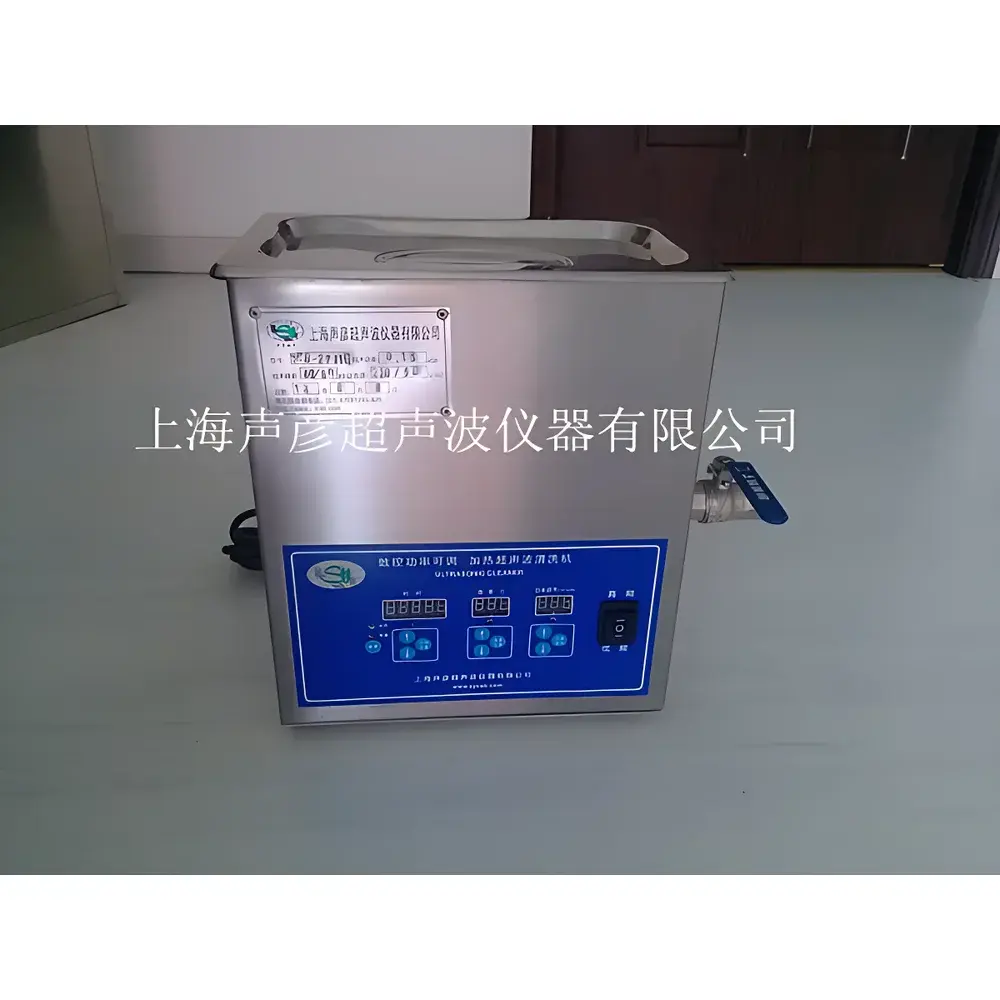
Shengyan Ultrasonic Cleaner SCQ-2211D
| Brand | Shengyan Ultrasonic (SYCS) |
|---|---|
| Origin | Shanghai, China |
| Model | SCQ-2211D |
| Capacity | 4 L |
| Ultrasonic Frequency | 40 kHz (dual-frequency selectable: 20/40 kHz, 25/40 kHz, or 28/40 kHz) |
| Ultrasonic Power | 150 W |
| Power Adjustment | Not adjustable |
| Heating Function | None |
| Temperature Control | None |
| Timer Range | 1–600 min (digital display, countdown) |
| Sound-Dampening Lid | Included |
| Drain Valve | Manual |
| Tank Dimensions (L×W×H) | 230 × 140 × 150 mm |
| Construction | Stainless steel inner and outer tank |
| Power Supply | 220 V / 50 Hz |
| Application Type | General-purpose laboratory ultrasonic cleaner |
Overview
The Shengyan Ultrasonic Cleaner SCQ-2211D is a benchtop, general-purpose ultrasonic cleaning system engineered for reproducible, non-destructive removal of particulate, organic, and ionic contaminants from delicate laboratory components—including glassware, metal parts, surgical instruments, electronic assemblies, and precision optics. It operates on the principle of acoustic cavitation: high-frequency sound waves (40 kHz, with optional dual-frequency modes at 20/40 kHz, 25/40 kHz, or 28/40 kHz) generate microscopic vacuum bubbles in the cleaning solution; their rapid collapse produces localized shockwaves and microstreaming that dislodge adherent soils without mechanical abrasion. Unlike single-frequency units, the SCQ-2211D’s programmable frequency selection enables optimization across diverse sample geometries and contaminant types—low frequencies enhance particle detachment from robust surfaces, while higher frequencies improve cleaning efficacy on fine features and heat-sensitive substrates. Designed for ISO-compliant laboratory environments, it meets baseline mechanical and electrical safety requirements per IEC 61010-1 and conforms to standard operating protocols for pre-analytical sample preparation in QC, R&D, and clinical support labs.
Key Features
- Dual-frequency operation (40 kHz primary; selectable secondary frequency: 20 kHz, 25 kHz, or 28 kHz) for adaptive cleaning performance across varied sample types and contamination profiles
- 150 W nominal ultrasonic power delivered via piezoelectric transducers bonded to the stainless steel tank base—engineered for stable output and long-term duty cycle reliability
- 4 L capacity stainless steel tank (230 × 140 × 150 mm internal dimensions) with seamless welds and passivated surface finish to resist corrosion and facilitate cleaning validation
- Digital timer with 1–600 minute adjustable range and real-time countdown display—supports unattended operation and repeatable process documentation
- Integrated sound-dampening lid to reduce ambient noise levels below 75 dB(A) during operation, improving workplace ergonomics and compliance with occupational health guidelines
- Removable stainless steel mesh basket and manual drain valve for efficient solution exchange and residue management between cleaning cycles
- Full stainless steel construction (inner tank and outer chassis) ensures structural integrity, chemical resistance, and compatibility with aqueous and mild solvent-based cleaning media
Sample Compatibility & Compliance
The SCQ-2211D accommodates a broad spectrum of laboratory items: volumetric flasks, pipette tips, crucibles, filter holders, microcentrifuge tubes, watch glasses, and small-scale reaction vessels. Its frequency-flexible architecture supports cleaning validation studies under ASTM D2603 (Standard Test Method for Sonic Shear Stability of Lubricating Oils) and ISO 13485-aligned device reprocessing workflows. While not certified for sterilization (i.e., does not meet ISO 17664 or AAMI ST79 requirements), it serves as a validated pre-sterilization step in GLP/GMP environments when paired with documented cleaning agents and rinse protocols. The absence of heating or temperature control limits its use to ambient-temperature aqueous or low-boiling-point solvent applications—making it suitable for thermolabile samples where thermal degradation must be avoided.
Software & Data Management
The SCQ-2211D operates via embedded firmware with no external software dependency. All operational parameters—including selected frequency mode and elapsed time—are displayed on a LED interface with tactile push-button controls. While the unit lacks USB/Ethernet connectivity or audit-trail functionality, its digital timer provides traceable run-duration records essential for SOP adherence in regulated settings. For laboratories requiring 21 CFR Part 11 compliance, integration with standalone electronic lab notebooks (ELNs) or LIMS systems is achievable through manual entry of batch-specific cleaning logs (e.g., date/time, frequency setting, duration, operator ID). Calibration verification can be performed using aluminum foil erosion tests per ASTM E1754 or hydrophone-based intensity mapping—procedures supported by Shengyan’s technical documentation.
Applications
- Routine decontamination of analytical glassware prior to HPLC, GC, or ICP-MS analysis to minimize carryover and background interference
- Preparation of electron microscopy specimens by removing carbonaceous residues from TEM grids and SEM stubs
- Cleaning of reusable microfluidic chips and lab-on-a-chip devices without compromising channel integrity
- Removal of flux residues from printed circuit boards (PCBs) during electronics prototyping and failure analysis
- Supporting ISO 14644-1 cleanroom maintenance through validated cleaning of tools and fixtures used in Class 5–8 environments
- QC/QA workflows in pharmaceutical manufacturing for cleaning verification of contact surfaces per PDA Technical Report No. 29
FAQ
Is the SCQ-2211D suitable for cleaning delicate optical lenses or coated substrates?
Yes—when operated at 40 kHz with low-surface-tension, non-ionic detergents and short durations (≤5 min), it effectively removes submicron particles without damaging anti-reflective or hydrophobic coatings.
Does this unit support continuous operation over multiple cycles?
It is rated for intermittent duty: maximum 30 minutes ON followed by 10 minutes OFF to prevent transducer overheating; extended unattended runs require thermal monitoring per local safety policy.
Can cleaning parameters be recorded for audit purposes?
Timer values and frequency selection are manually logged; for automated data capture, integration with external timers or ELN systems is recommended.
What cleaning solutions are compatible with the stainless steel tank?
Aqueous alkaline, neutral, or mildly acidic formulations (pH 4–10); avoid halogenated solvents, strong oxidizers (e.g., >5% HNO₃), or chlorinated cleaners to preserve tank passivation.
Is installation training provided with purchase?
Yes—Shengyan’s field application engineers conduct on-site commissioning, including safety briefing, operational demonstration, and basic troubleshooting guidance aligned with ISO/IEC 17025 competency requirements.



