
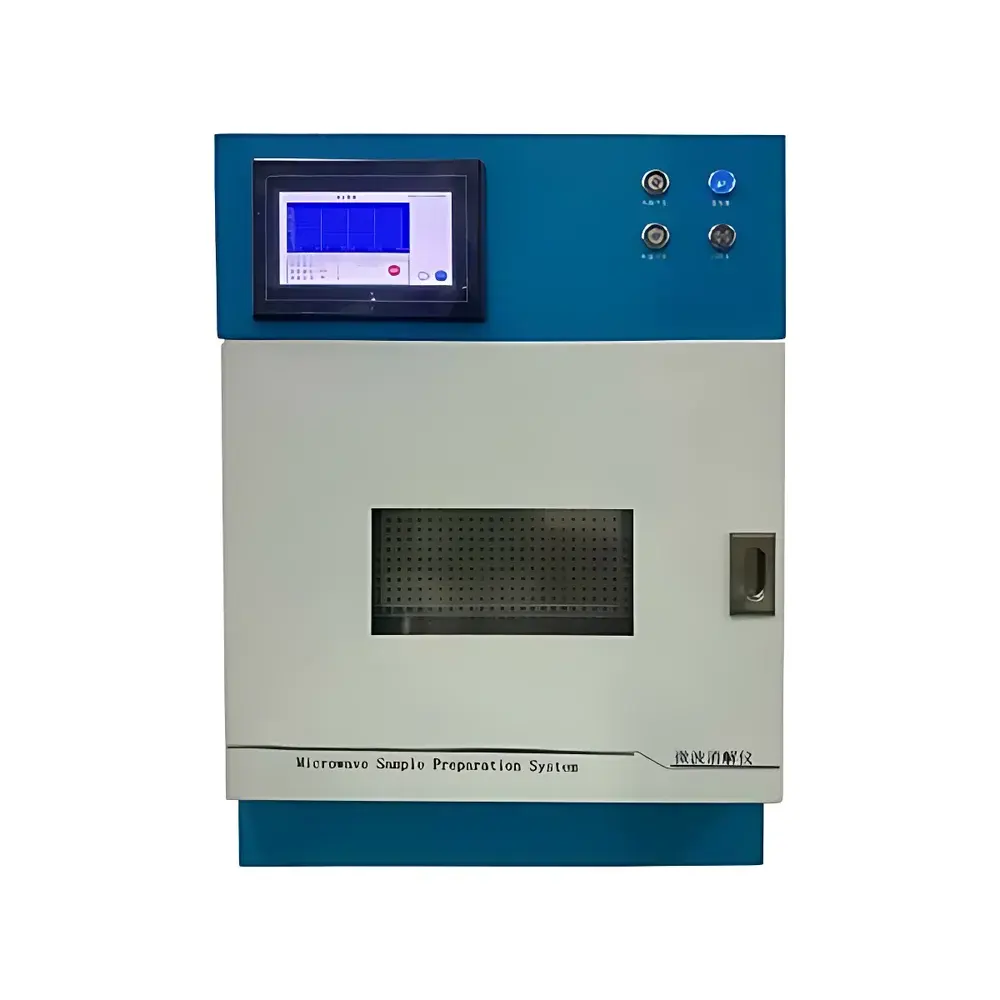
Chuanna CNWB-6 High-Throughput Microwave Digestion System
| Brand | Chuanna Instrument |
|---|---|
| Origin | Zhejiang, China |
| Model | CNWB-6 |
| Sample Capacity | 6 positions |
| Max Temperature | 300 °C |
| Temp Uniformity | ±0.5 °C |
| Max Pressure | 0–6 MPa |
| Microwave Frequency | 2450 MHz |
| Power Output | 0–1600 W (continuously variable, non-pulsed, auto-frequency modulation) |
| Cavity Volume | 52 L |
| Cavity Material | 316 stainless steel with 6-layer PTFE coating |
| Cooling | High-capacity acid-resistant centrifugal blower (≥5 m³/min), integrated forced-air cavity cooling |
| Control Interface | 8-inch TFT-LCD touchscreen (800×480) with real-time temperature/pressure curve display |
| Temperature Sensing | Contact-type Pt100 sensor |
| Pressure Sensing | Non-contact pressure transducer |
| Pressure Accuracy | ±0.01 MPa |
| Safety Features | Auto-shutoff on over-pressure, dual-stage rupture disc, self-locking shock-absorbing blast door, microwave leakage <5 mW/cm² (per GB 4706.21 & IEC 60335-2-90) |
Overview
The Chuanna CNWB-6 High-Throughput Microwave Digestion System is an engineered solution for rapid, reproducible, and safe open-vessel or closed-vessel sample preparation in environmental, geological, food safety, and regulatory testing laboratories. It operates on the principle of dielectric heating—where microwave energy (2450 MHz) couples directly with polar molecules (e.g., HNO₃, HCl, HF) in sealed digestion vessels—inducing rapid molecular friction and uniform thermal energy distribution throughout the sample matrix. Unlike conventional hot-block or open-vessel digestion, this system achieves complete mineralization of refractory metals (e.g., Pb, Cd, As, Cr, Ni, Hg) at temperatures up to 300 °C and pressures up to 6 MPa (870 psi), significantly reducing digestion time from hours to minutes while minimizing analyte loss, contamination, and reagent blank contributions. Its 52 L monolithic 316 stainless steel cavity—coated with six layers of high-purity PTFE—ensures long-term resistance to aggressive acid vapors (including aqua regia and hydrofluoric acid mixtures) and maintains electromagnetic field homogeneity across all six reaction positions.
Key Features
- Non-pulsed, auto-frequency-modulated microwave generation ensures stable power delivery (0–1600 W), minimizes magnetron thermal stress, and extends source lifetime beyond 5,000 hours.
- Self-locking, shock-absorbing blast door with dual mechanical interlocks meets IEC 61000-4-3 immunity requirements and limits microwave leakage to <5 mW/cm²—verified per GB 4706.21 and EN 60335-2-90.
- Dual independent control loops: contact-based Pt100 temperature sensing (±0.5 °C accuracy) and non-contact pressure transduction (±0.01 MPa resolution) enable real-time, synchronized monitoring of both parameters with automatic microwave cutoff upon threshold violation.
- Integrated high-flow acid-resistant ventilation (≥5 m³/min) and cavity-level forced-air cooling maintain thermal stability during extended multi-step methods and prevent condensate accumulation on vessel lids.
- 6-position rotor accommodates standard 75 mL TFM-lined PEEK outer vessels—rated for continuous operation at 300 °C and 1500 psi—with optional configurations supporting ASTM D5191, EPA Method 3052, ISO 11466, and USP <231> compliant workflows.
Sample Compatibility & Compliance
The CNWB-6 supports a broad range of solid and semi-solid matrices, including soils, sediments, biological tissues, polymers, catalysts, and food composites. Its pressure-rated vessels are validated for use with HNO₃/H₂O₂, HNO₃/HF, and HNO₃/HCl/HF mixtures under ISO/IEC 17025-accredited digestion protocols. All safety-critical components—including rupture discs, door latches, and pressure sensors—are traceable to NIST-calibrated references. The system’s operational log records timestamped temperature/pressure profiles, user ID, method name, and alarm events—supporting audit readiness for GLP, GMP, and FDA 21 CFR Part 11 compliance when paired with secure networked data export (CSV/Excel).
Software & Data Management
The embedded 8-inch TFT-LCD interface runs a deterministic real-time OS with no third-party dependencies. Users define multi-segment digestion programs (ramp-hold-cool) with independent setpoints for power, temperature, pressure, and duration. All process data—including raw sensor values, derivative curves (dT/dt, dP/dt), and event flags—are stored locally in non-volatile memory and exportable via USB 2.0. No cloud connectivity or proprietary software installation is required; exported datasets conform to ASTM E1382-22 metadata standards for traceability. Optional RS-232 or Ethernet modules enable integration into LIMS environments using Modbus RTU/TCP.
Applications
- Regulatory heavy metal analysis (Pb, Cd, As, Cr(VI), Hg) in soil per EPA SW-846 Method 3052 and EN 13656.
- Trace element quantification in plant tissue and animal feed via ICP-MS/OES post-digestion.
- Leachate testing of electronic waste (WEEE) and RoHS-compliant materials under EN 62321-3-2.
- Preparation of certified reference material (CRM) homogenates for proficiency testing schemes (e.g., FAPAS, IRMM).
- Routine QA/QC in contract testing labs requiring documented chain-of-custody for digestion records.
FAQ
What safety certifications does the CNWB-6 meet?
It complies with GB 4706.21 (China), IEC 60335-2-90 (international household appliance safety), and electromagnetic compatibility requirements per GB/T 17626.3 (IEC 61000-4-3). Rupture disc performance is validated per ASME BPVC Section VIII Div. 1.
Can the system be used for HF-containing digestions?
Yes—vessels feature TFM (perfluoroalkoxy) inner liners and PEEK outer bodies, both chemically inert to hydrofluoric acid at ≤200 °C and ≤4 MPa. Always follow ISO 11466 Annex B handling guidelines.
Is method validation support available?
Chuanna provides application notes aligned with EPA 3052, ISO 11466, and ASTM D5191, including spike recovery data, blank levels, and precision studies across 10+ matrix types.
How is calibration maintained?
Temperature sensors are factory-traceable to NIST SRM 1750; pressure transducers are calibrated annually using dead-weight testers. A built-in diagnostic mode verifies sensor linearity and response latency before each run.
What maintenance intervals are recommended?
Cavity coating inspection every 200 cycles; door gasket replacement every 12 months or 1,000 cycles; blower filter cleaning after each 50 digestion batches; full cavity decontamination with 5% HNO₃ vapor weekly in high-throughput labs.



