
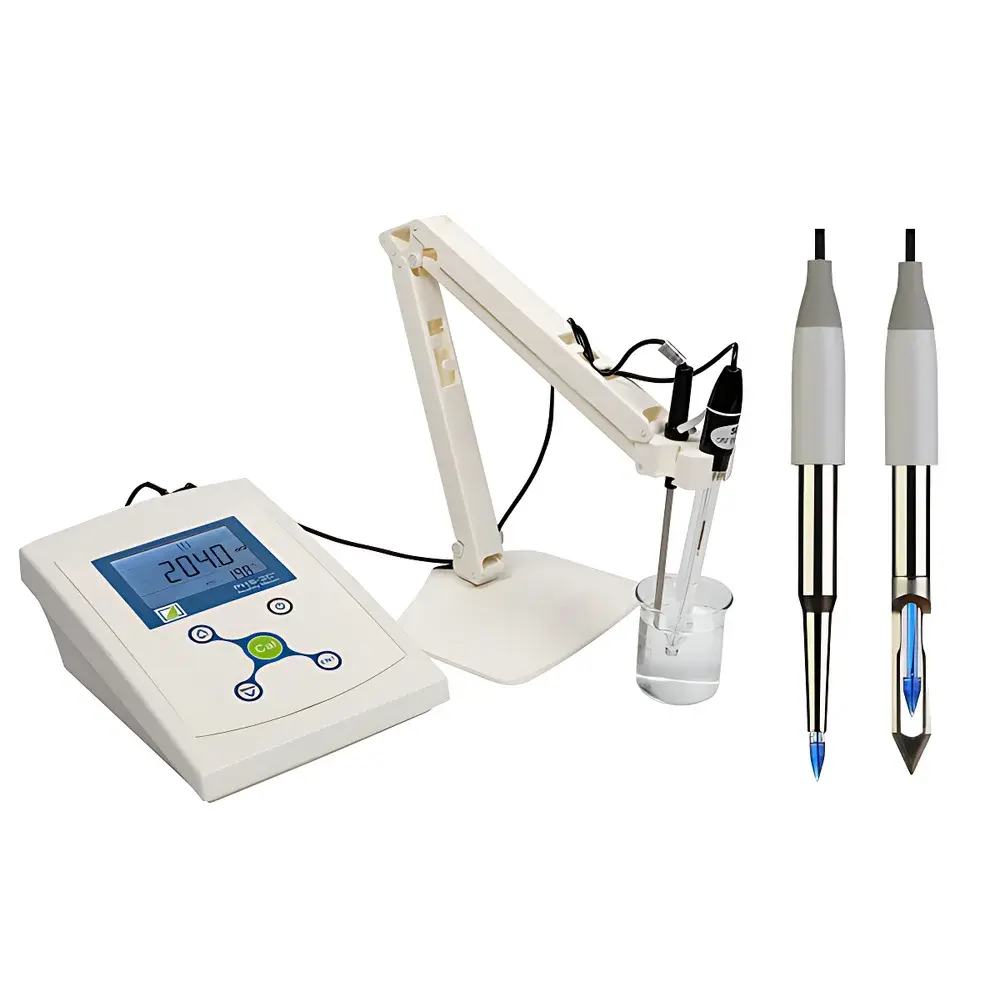
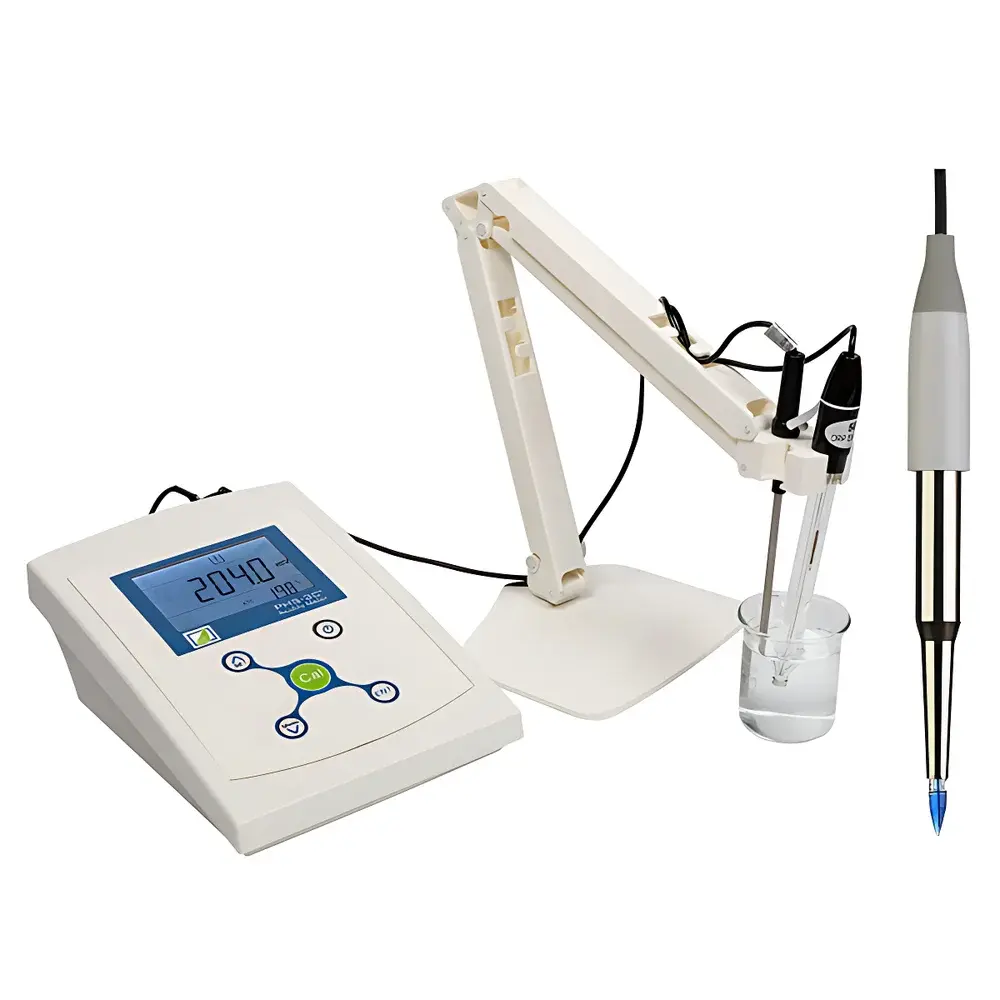
FangZhou PHS-3C+ Benchtop Food pH Meter
| Brand | FangZhou |
|---|---|
| Origin | Sichuan, China |
| Model | PHS-3C+ |
| Instrument Type | Benchtop pH Meter |
| Parameter Types | pH, mV, ORP, Temperature |
| Measurement Accuracy | ±0.01 pH |
| pH Range | (–5.00 to 20.00) pH |
| Resolution | 0.01 pH / 0.1 mV |
| Temperature Compensation | Automatic (ATC) and Manual |
| Calibration Standards | NIST-traceable buffers |
| Input Impedance | ≥1 × 10¹² Ω |
| Power Supply | DC 9 V, 300 mA (center-positive) |
Overview
The FangZhou PHS-3C+ Benchtop Food pH Meter is a high-precision electrochemical instrument engineered for routine and regulatory-compliant pH, mV, ORP, and temperature measurements in food processing, quality control laboratories, dairy facilities, beverage production lines, and academic food science research. It operates on the potentiometric principle—measuring the potential difference between a pH-sensitive glass electrode and a stable reference electrode—converted into pH units via the Nernst equation. Designed specifically for food matrix applications, the PHS-3C+ incorporates robust electrical isolation, high-input-impedance circuitry (>1 × 10¹² Ω), and low-noise analog signal conditioning to ensure stable readings in conductive or viscous samples such as sauces, fermented products, fruit pulps, and dairy emulsions. Its extended pH range (–5.00 to 20.00) supports both highly acidic (e.g., vinegar, citrus juices) and strongly alkaline (e.g., sodium hydroxide-treated foods, processed cheeses) applications—critical for HACCP validation and shelf-life studies.
Key Features
- Microprocessor-controlled architecture with programmable measurement routines and touch-sensitive keypad interface
- Large backlit LCD display (128 × 64 pixels) with dual-parameter real-time readout (e.g., pH + temperature) and diagnostic indicators (electrode status, stability flag, calibration alert)
- 0.01 pH resolution with user-selectable decimal places; 0.1 mV resolution for precise ion activity estimation via direct or indirect potentiometric methods
- Automatic Temperature Compensation (ATC) with integrated Pt1000 or thermistor probe support; manual compensation also available within –5.0 °C to 135.0 °C
- Multi-buffer calibration suite supporting four standard sets (NIST, Merck, MT Europe, China GB)—12 preloaded buffer values enabling up to five-point calibration with auto-buffer recognition
- Electrode health diagnostics including impedance monitoring, response time assessment, and slope/offset validation—displayed numerically and graphically during calibration
- RS232 serial interface compliant with standard ASCII protocol for data logging, GLP-compliant report export, and integration with LIMS or QC software platforms
Sample Compatibility & Compliance
The PHS-3C+ is validated for use with standard combination pH electrodes (e.g., Ag/AgCl double-junction, food-grade epoxy bodies, conical tips) and temperature probes meeting IEC 60751 Class B tolerances. Its input impedance and guard-ring shielding minimize drift in low-ionic-strength samples (e.g., purified water rinses, distilled extracts) and reduce junction potential errors in high-fat or protein-rich matrices. The instrument complies with ISO/IEC 17025:2017 requirements for measurement uncertainty evaluation and supports audit-ready documentation per FDA 21 CFR Part 11 when paired with compliant data acquisition software. All firmware and calibration routines are traceable to NIST-certified reference materials, and the device meets CE marking requirements under the Low Voltage Directive (2014/35/EU) and EMC Directive (2014/30/EU).
Software & Data Management
Raw measurement data—including timestamp, electrode ID, calibration history, temperature, and operator code—can be exported via RS232 to PC-based applications such as FangZhou’s optional LabLink Pro or third-party platforms like LabArchives or Empower. Each data packet includes checksum verification and embedded metadata required for GLP/GMP environments. Internal memory retains up to 500 measurement records with full traceability. Firmware updates are delivered via UART bootloader, preserving calibration coefficients and user configurations. Audit trail functionality logs all critical events: power-on/off cycles, calibration attempts (success/failure), parameter changes, and electrode replacement entries.
Applications
- QC testing of raw ingredients (e.g., meat pH pre-rigor, milk acidity titration endpoint verification)
- In-process monitoring during fermentation (yogurt, kimchi, sourdough), thermal processing (canning, retorting), and enzymatic hydrolysis
- Regulatory compliance for USDA-FSIS, EFSA, and Codex Alimentarius pH thresholds in ready-to-eat foods and acidified products
- Stability studies evaluating pH drift over storage time under accelerated conditions
- Method development and validation per AOAC Official Method 981.12 (pH of Foods) and ISO 2918:2021 (Determination of pH in foodstuffs)
FAQ
What calibration standards are supported by the PHS-3C+?
The meter supports four internationally recognized buffer series: NIST (USA), Merck (Germany), MT Europe (EU), and China GB standards—totaling 12 predefined points across pH 1.68 to 12.45.
Does the instrument meet FDA 21 CFR Part 11 requirements?
While the standalone hardware does not include electronic signatures or role-based access control, its RS232 output and structured data format enable full Part 11 compliance when integrated with validated third-party data management systems.
Can the PHS-3C+ measure non-aqueous or semi-solid food samples?
Yes—when used with appropriate food-grade electrodes (e.g., open-junction, gel-filled, or flow-through cells) and proper sample homogenization protocols, it delivers reproducible results in mashed fruits, cheese curds, and batter systems.
What is the warranty coverage for the main unit?
FangZhou provides a three-year limited warranty on the instrument electronics and a six-month replacement guarantee for manufacturing defects in the main unit.
Is ATC compatible with all temperature probe types?
The PHS-3C+ accepts Pt1000 RTDs and 10 kΩ NTC thermistors with linearization tables preloaded for common food-grade sensor models; custom coefficients can be entered manually.
Related Products





