
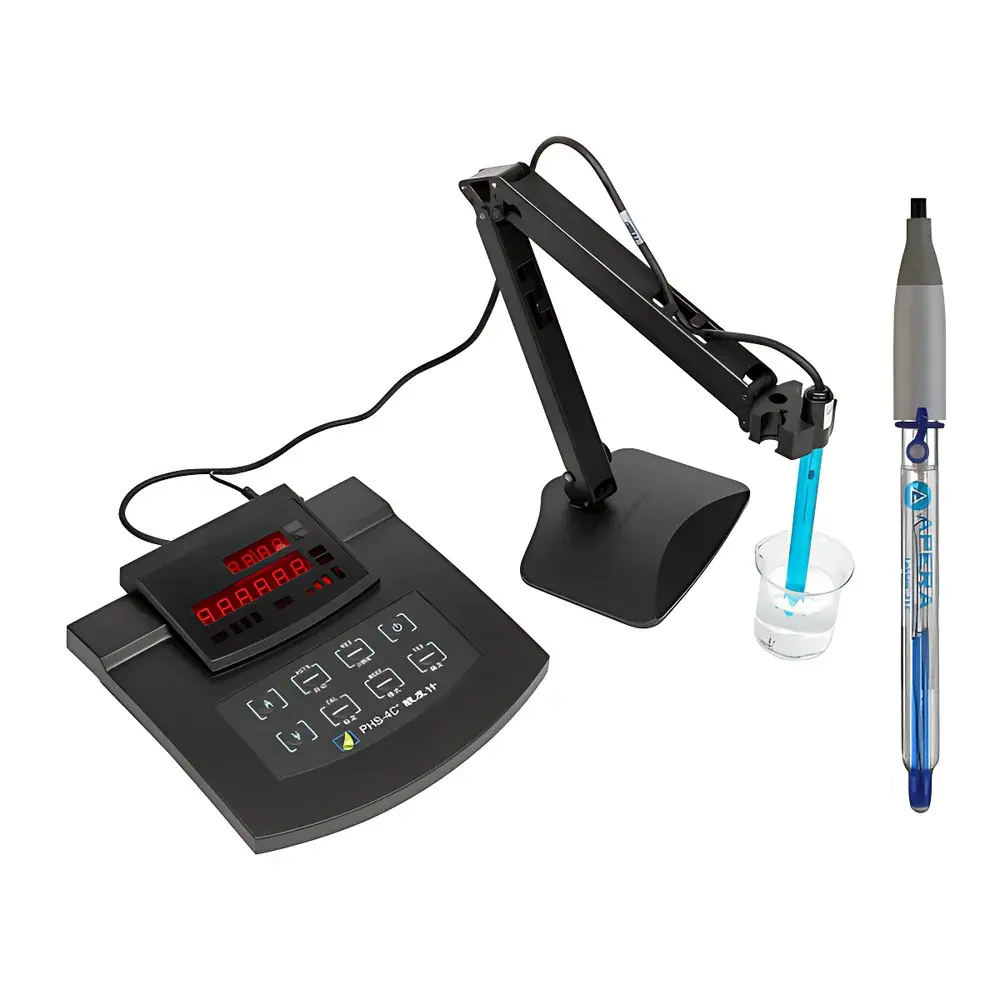
FangZhou PHS-4C+ Gypsum Powder pH Meter
| Brand | FangZhou |
|---|---|
| Origin | Sichuan, China |
| Model | PHS-4C+ |
| Instrument Type | Benchtop pH Meter |
| Parameter Types | Multi-parameter (pH, mV, ORP, Temperature) |
| Measurement Accuracy | ±0.002 pH |
| pH Range | 0.000–14.000 |
| Resolution | 0.001/0.01/0.1 pH (adjustable) |
| mV/ORP Range | −1999.9 to +1999.9 mV |
| mV Resolution | 0.1/1 mV (adjustable) |
| Temperature Range | −5.0 to 105.0 °C |
| Temp. Resolution | 0.1 °C |
| Temp. Accuracy | ±0.3 °C ±1 digit |
| Input Impedance | ≥3×10¹² Ω |
| Calibration Points | 1–3 point auto-identification with NIST-traceable standard buffers |
| Temperature Compensation | Automatic (ATC) or manual |
| Interface | BNC electrode port, Pt1000/NTC temperature sensor port, RS232 communication port |
| Power Supply | DC 9 V, 300 mA (center-positive) |
Overview
The FangZhou PHS-4C+ Gypsum Powder pH Meter is a high-precision benchtop electrochemical analyzer engineered for rigorous quality control in construction materials, gypsum manufacturing, and industrial process laboratories. Designed specifically to address the unique buffering behavior and low-conductivity challenges of gypsum slurries and powdered formulations, this instrument employs a high-input-impedance potentiometric measurement architecture compliant with ISO 3696 (Grade 3 water), ASTM E70, and IUPAC recommendations for pH metrology. Its microprocessor-controlled circuitry ensures stable potential acquisition from high-resistance samples—critical when measuring saturated gypsum suspensions where junction potentials and liquid junction drift may otherwise compromise accuracy. The device operates on the fundamental principle of hydrogen-ion activity detection via glass electrode potential difference relative to a stable reference system, with integrated temperature compensation algorithms that conform to the Nernst equation’s theoretical slope (−59.16 mV/pH at 25 °C), dynamically adjusted across the full −5.0 to 105.0 °C operating range.
Key Features
- Triple-resolution pH display (0.001 / 0.01 / 0.1 pH) with user-selectable mode for optimal readability in diverse operational contexts
- Auto-temperature compensation (ATC) using Pt1000 or NTC sensors, coupled with manual override capability for non-standard thermal environments
- Intelligent calibration engine supporting 1-, 2-, or 3-point calibration with automatic buffer recognition of NIST-traceable standards (e.g., pH 4.00, 6.86, 9.18 at 25 °C)
- Real-time electrode health monitoring with visual status indicator—detecting response time decay, asymmetry potential shifts, and high-impedance failure modes
- RS232 serial interface enabling GLP-compliant data export to LIMS or Excel-based QA databases; supports timestamped calibration logs and measurement history
- Ruggedized chassis with IP54-rated enclosure, chemical-resistant housing, and reinforced BNC electrode port designed for repeated exposure to alkaline gypsum dust and humid industrial settings
- Non-volatile memory retaining up to 500 measurement records and full calibration profiles through power interruption
Sample Compatibility & Compliance
The PHS-4C+ is validated for direct immersion measurement of semi-aqueous gypsum pastes, dry powder slurries (≥30% w/w solids), and saturated calcium sulfate dihydrate solutions. Its extended input impedance (>3×10¹² Ω) mitigates polarization errors common in low-conductivity matrices (<200 µS/cm). The instrument meets ISO/IEC 17025 technical requirements for pH measurement uncertainty estimation and supports audit-ready documentation per FDA 21 CFR Part 11 when paired with compliant data acquisition software. All calibration protocols align with Chinese JJG 119–2018 and international ISO 7870–2:2017 guidelines for routine pH meter verification in industrial QA labs.
Software & Data Management
Raw data output via RS232 follows ASCII-based SCPI command structure, permitting integration with third-party laboratory software (e.g., LabVIEW, MATLAB, or custom Python scripts). Each transmitted record includes UTC timestamp, measured pH/mV/ORP value, temperature reading, electrode ID (if encoded), and calibration validity flag. Internal memory stores calibration coefficients, date/time stamps, and operator ID fields—enabling traceability required under GMP Annex 11 and ISO 9001:2015 clause 8.5.2. Firmware supports firmware-upgradable calibration algorithms without hardware modification.
Applications
- Quality assurance of hemihydrate and dihydrate gypsum raw materials prior to calcination
- In-process pH monitoring during slurry preparation for plasterboard and molding applications
- Stability testing of set retarders and accelerators in gypsum-based admixtures
- Environmental compliance testing of gypsum waste leachates per TCLP (US EPA Method 1311)
- Research-grade characterization of hydration kinetics in calcium sulfate systems
- Verification of neutralization endpoints in acid-wash procedures for recycled gypsum feedstock
FAQ
Does the PHS-4C+ support ion-selective electrode (ISE) measurements?
Yes—when equipped with the optional ISE adapter module and compatible solid-state or liquid-membrane electrodes, it performs direct concentration measurement of Ca²⁺, SO₄²⁻, or Cl⁻ in gypsum-related matrices.
What is the recommended maintenance interval for the pH electrode in gypsum applications?
For continuous use in abrasive slurries, clean the sensing bulb and reference junction daily with deionized water and mild detergent; perform full recalibration before each shift and verify slope recovery weekly.
Can the instrument store calibration data for multiple electrode types?
Yes—up to four independent electrode profiles can be saved, each with unique offset/slope parameters, temperature coefficients, and usage history.
Is the RS232 interface compatible with modern Windows/macOS systems?
Yes, via standard USB-to-RS232 adapters; drivers and basic terminal software are provided with the instrument.
How does the PHS-4C+ handle measurement drift during prolonged gypsum slurry analysis?
It implements adaptive endpoint detection with configurable stability thresholds (±0.002 pH over 10 sec), suppressing false stabilization in slowly equilibrating heterogeneous suspensions.





