
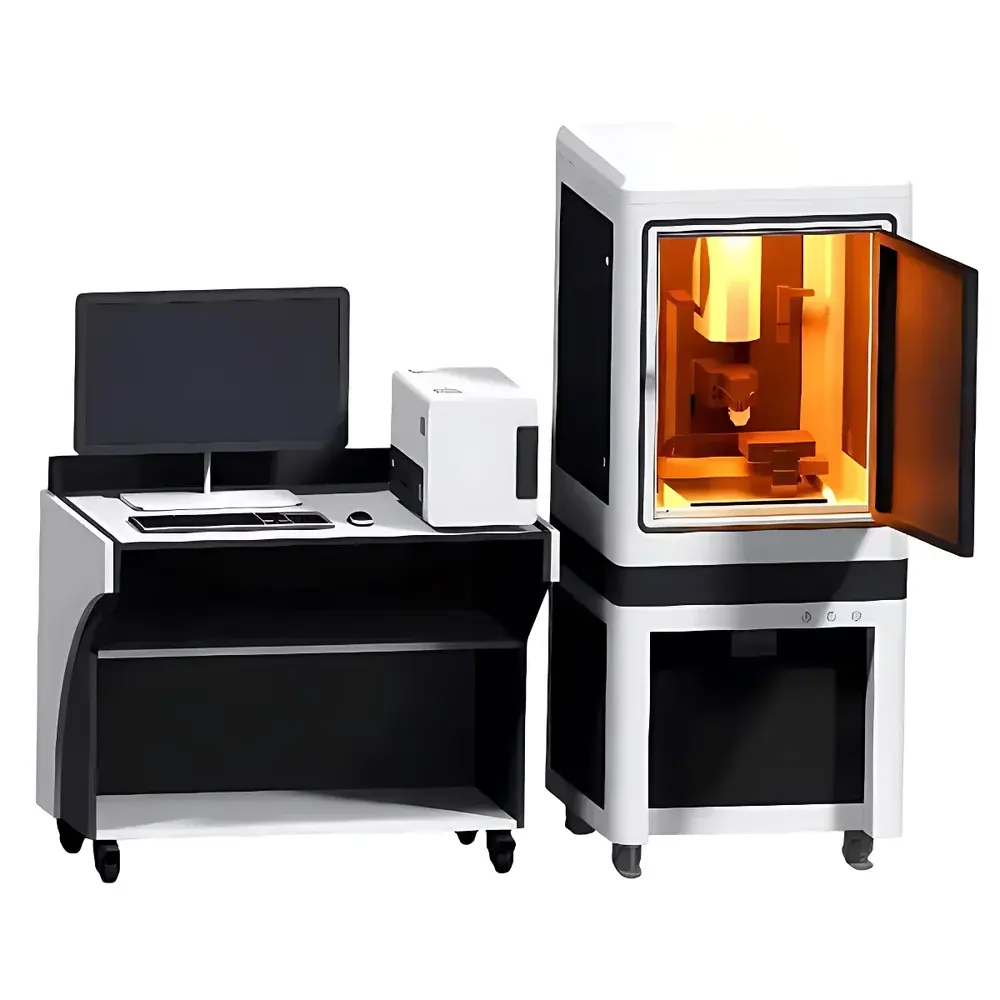
MinTech MT-PSAM/IMMS100 Perovskite Self-Assembled Monolayers Multidimensional Intelligent Measurement System
| Brand | MinTech |
|---|---|
| Origin | Jilin, China |
| Manufacturer Type | Manufacturer |
| Regional Category | Domestic (China) |
| Model | MT-PSAM/IMMS100 |
| Pricing | Upon Request |
Overview
The MinTech MT-PSAM/IMMS100 is a purpose-built, automated electrochemical characterization platform engineered for in situ, multidimensional analysis of perovskite-compatible self-assembled monolayers (SAMs) on transparent conductive substrates such as ITO or FTO. It operates on the principle of scanning electrochemical cell microscopy coupled with thin-layer cyclic voltammetry (SECCM-TLCV), enabling localized, non-destructive interrogation of surface-confined redox-active SAMs under ambient or controlled atmospheres. Unlike conventional solution-phase electrochemical methods—which report ensemble-averaged behavior of unbound molecules—the MT-PSAM/IMMS100 directly probes the functional integrity, interfacial energetics, and lateral homogeneity of *assembled* monolayers in device-relevant configurations. Its core architecture integrates four-axis programmable motion control (X/Y/Z/U), modular probe options spanning micrometer to millimeter resolution, and synchronized electrochemical waveform generation (CV, LSV, DPV) to extract quantitative parameters including HOMO/LUMO alignment (via redox peak potentials), charge transfer kinetics (via scan-rate-dependent peak separation and Randles–Sevcik analysis), surface coverage (Γ, mol·cm⁻²), and spatial distribution uniformity across cm²-scale substrates.
Key Features
- Multi-resolution probe compatibility: Interchangeable single-channel mm-scale probes, 5-channel mm-scale array probes, and high-resolution μm-scale single-channel probes—enabling seamless transition between high-throughput screening and localized mechanistic studies.
- Four-axis automated sample handling: Precision X/Y/Z/U stage with programmable positioning accuracy ≤±1.5 µm, supporting unattended sequential measurement across ≥24 samples per batch without manual intervention.
- Integrated thin-layer electrochemical modalities: Simultaneous acquisition of cyclic voltammetry (CV), linear sweep voltammetry (LSV), and differential pulse voltammetry (DPV) with configurable scan rates (0.01–10 V·s⁻¹), pulse amplitudes (1–100 mV), and sampling intervals (≥10 kHz).
- Onboard environmental monitoring: Real-time logging of ambient temperature (±0.2 °C), relative humidity (±2% RH), and illumination conditions (dark/white LED, adjustable intensity); optional glovebox integration for inert-atmosphere operation (N₂ or Ar, <0.1 ppm O₂/H₂O).
- Modular DEMS coupling interface: Standardized vacuum-tight port and electrical feedthroughs for direct integration with differential electrochemical mass spectrometry systems to identify volatile degradation products (e.g., CH₃NH₂, HI, I₂) during operational stress testing.
Sample Compatibility & Compliance
The MT-PSAM/IMMS100 is validated for use with SAMs deposited on planar conductive oxides (ITO, FTO, NiOₓ), metal films (Au, Ag), and emerging alternatives (e.g., doped metal oxides, graphene oxide composites). Substrate dimensions up to 150 × 150 mm are accommodated. All electrochemical protocols adhere to ASTM E2798-21 (Standard Guide for Electrochemical Measurements on Conducting Polymer Films) and ISO 13885-2:2020 (Electrochemical sensors — Part 2: Performance requirements). Data acquisition complies with ALCOA+ principles; audit trails, user access logs, and electronic signatures are supported via optional 21 CFR Part 11-compliant software modules for GLP/GMP-regulated environments.
Software & Data Management
The proprietary IMMS Analyze Suite provides end-to-end workflow automation—from instrument control and real-time signal visualization to batch-processed parameter extraction. Key modules include: (1) Surface Coverage Mapper, which computes Γ from integrated charge using substrate area normalization and double-layer correction; (2) Kinetic Rate Analyzer, applying Marcus–Hush theory to derive heterogeneous electron transfer rate constants (k⁰) from peak shift analysis; (3) Uniformity Quantifier, generating heatmaps of ΔEₚ and Γ with statistical metrics (CV%, skewness, kurtosis) per 100 × 100 µm region; and (4) DEMS Correlation Engine, time-synchronizing mass spectrometric ion currents with electrochemical transients. Raw data are stored in HDF5 format with embedded metadata (timestamp, probe ID, atmospheric log, calibration history) for full traceability.
Applications
- Interface engineering validation for perovskite photovoltaics: Quantifying SAM-induced work function shifts and hole extraction efficiency on ITO anodes.
- Molecular stability benchmarking: Accelerated aging studies under simulated operational bias + illumination, correlating electrochemical decay kinetics with mass-spec-identified decomposition pathways.
- High-throughput SAM library screening: Parallel evaluation of >50 candidate molecules for surface coverage density and charge recombination suppression.
- Fabrication process control: In-line monitoring of SAM deposition uniformity across large-area substrates prior to perovskite layer coating.
- Fundamental charge transport modeling: Providing experimental k⁰ and Γ inputs for drift-diffusion simulations of interfacial carrier dynamics.
FAQ
What electrochemical techniques does the MT-PSAM/IMMS100 support?
CV, LSV, and DPV—with fully configurable waveform parameters, including scan rate, pulse width, and sampling frequency.
Can the system operate in inert atmosphere?
Yes; optional integration with standard gloveboxes or custom vacuum/N₂ purge enclosures is available upon request.
Is the software compliant with regulatory data integrity standards?
The base software supports audit trails and user-level permissions; 21 CFR Part 11 compliance is available as a validated add-on module.
How is spatial resolution defined for the μm-scale probe?
Lateral resolution is determined by meniscus confinement diameter (~2–5 µm at 50% meniscus height), verified via AFM-correlated SECCM imaging on patterned gold surfaces.
Does the system support third-party mass spectrometers?
Yes; the DEMS interface uses standardized Swagelok fittings and analog/digital I/O for synchronization with commercial quadrupole and TOF mass spectrometers.





