
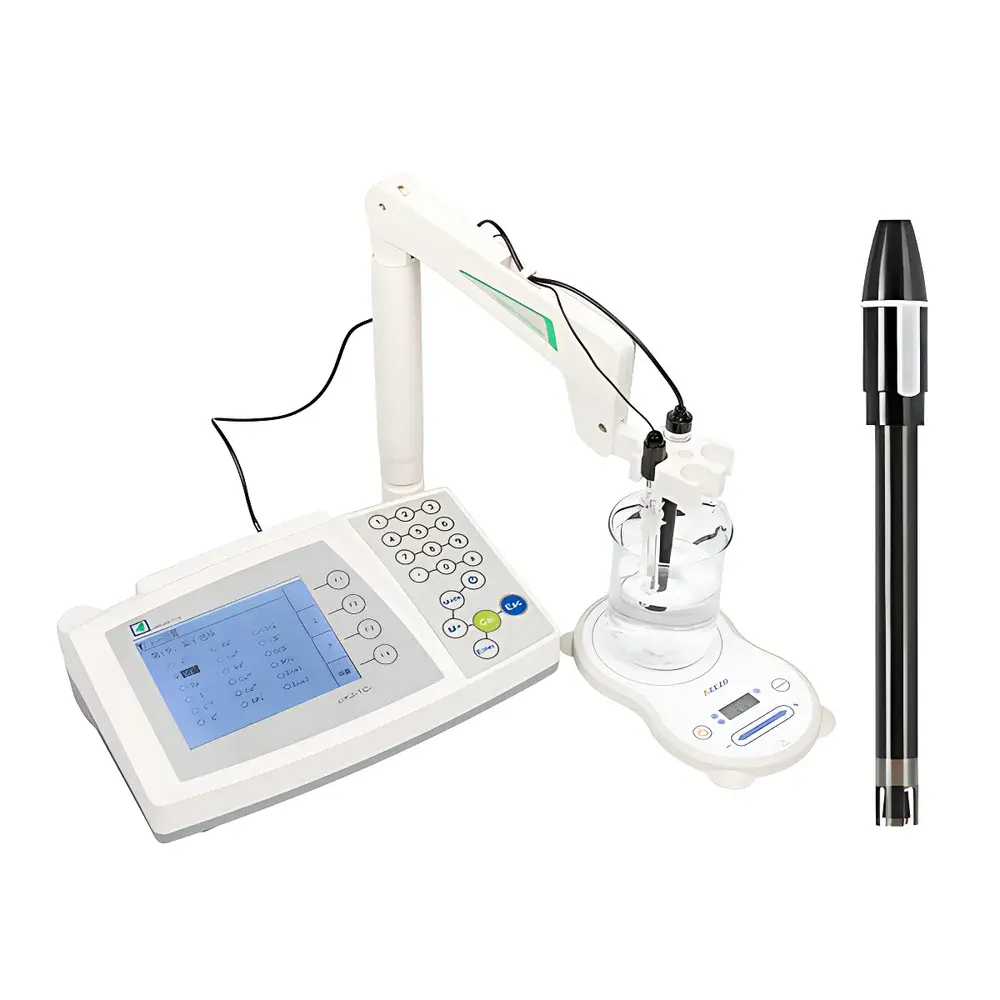
FangZhou PXJ-1C+ Ammonium Ion Meter
| Brand | FangZhou |
|---|---|
| Origin | Sichuan, China |
| Manufacturer Type | Authorized Distributor |
| Product Category | Domestic |
| Model | PXJ-1C+ Ammonium Ion Meter |
| Instrument Type | Benchtop |
| Ion Measurement Range | 0–99,999 ppm |
| Detection Limit | 9,999 ppm |
| Response Time | 3 s |
| Measurement Accuracy | ±0.5% FS ±1 digit |
| Temperature Range | −20.0–135.0 °C |
| Resolution | 0.001 pH / 0.01 mV / 0.1 °C |
| Input Impedance | ≥3 × 10¹² Ω |
| Data Storage Capacity | 4,096 sets |
| GLP Compliance | Yes |
| Calibration Points | 2–9 points (ion), up to 5 points (pH) |
| Temperature Compensation | Automatic (ATC) or Manual |
| Communication Interfaces | USB, RS-232, 0–20 mV analog output |
| Power Supply | DC 9 V, 500 mA (center-positive) |
Overview
The FangZhou PXJ-1C+ Ammonium Ion Meter is a high-precision benchtop ion concentration analyzer engineered for reliable quantification of ammonium (NH₄⁺) and 16 pre-programmed ions—including fluoride, chloride, bromide, nitrate, sodium, and ammonia—in aqueous environmental, industrial, and laboratory samples. Based on potentiometric measurement using ion-selective electrodes (ISEs), the instrument operates under the Nernst equation principle, delivering stable, reproducible readings across wide dynamic ranges. Its dual-mode architecture supports both direct ion activity measurement (pX) and concentration-based reporting (ppm, mmol/L, etc.), with automatic unit conversion and built-in temperature compensation to ensure thermodynamic consistency. Designed for compliance-critical workflows, the PXJ-1C+ meets GLP documentation requirements through time-stamped data logging, user-accessible audit trails, and configurable calibration records—making it suitable for municipal water testing labs, wastewater treatment facilities, and academic research environments where trace-level ammonium monitoring is essential for regulatory reporting (e.g., EPA Method 350.1, ISO 7888, or ASTM D1426).
Key Features
- Benchtop form factor with backlit LCD display and intuitive menu-driven navigation for rapid method setup and real-time parameter review.
- Multi-parameter capability: simultaneous measurement of NH₄⁺ concentration, pH, mV, ORP, and temperature—all referenced to a single sample aliquot.
- High-resolution detection: 0.001 pH resolution, 0.01 mV resolution, and 0.1 °C temperature resolution with ±0.2 °C accuracy over −20.0–135.0 °C range.
- Advanced calibration flexibility: up to 9-point ion calibration with automatic standard curve generation; 5-point pH calibration with auto-recognition of 18 certified buffer solutions.
- Robust input impedance (>3 × 10¹² Ω) ensures minimal loading error when interfacing with high-impedance ISEs and pH electrodes.
- GLP-compliant data management: 4,096 memory slots with timestamp (date + clock), user ID tagging, and editable entry notes—exportable via USB or RS-232.
- Integrated ATC (Automatic Temperature Compensation) with manual override; supports both electrode-integrated and external Pt100/NTC temperature sensors.
- Dual-output connectivity: analog (0–20 mV) for PLC integration and digital (USB/RS-232) for PC-based analysis using FangZhou pH-Link software.
Sample Compatibility & Compliance
The PXJ-1C+ is validated for use with standard ammonium-selective electrodes (e.g., gas-sensing or solid-state ISEs) and compatible with a broad spectrum of aqueous matrices—including raw surface water, treated drinking water, effluent streams, soil leachates, and nutrient solutions. It accommodates variable ionic strength via manual or automatic ionic strength adjustment (ISA) during calibration. The instrument conforms to fundamental metrological standards aligned with ISO/IEC 17025 technical competence requirements for testing laboratories. Its firmware implements electronic signature support, calibration lockout, and change-log functionality—facilitating alignment with FDA 21 CFR Part 11 expectations for electronic records in regulated settings. All factory calibrations are traceable to NIST-certified reference materials.
Software & Data Management
FangZhou pH-Link software provides secure bidirectional communication between the PXJ-1C+ and Windows-based workstations. Users can perform remote instrument configuration, batch calibration validation, statistical analysis (mean, SD, RSD), trend plotting, and PDF/CSV report generation. Raw datasets retain full metadata—including electrode ID, calibration history, ambient temperature, operator code, and measurement duration—to satisfy audit readiness requirements. Data encryption and role-based access control (via password-protected user profiles) are implemented at the application layer. The software supports export formats compliant with LIMS ingestion protocols and includes templates aligned with ISO 5725 repeatability/reproducibility reporting guidelines.
Applications
- Regulatory compliance monitoring of ammonium in municipal wastewater discharge per national environmental standards (e.g., China’s GB 3838-2002, EU WFD Annex V).
- Process control in nitrogen removal bioreactors, where sub-ppm NH₄⁺ tracking informs nitrification/denitrification efficiency.
- Quality assurance of fertilizer solutions and hydroponic nutrient reservoirs.
- Educational laboratories conducting ion equilibrium experiments, including common-ion effect studies and activity coefficient derivations.
- Field-deployable verification of portable ISE measurements in conjunction with fixed-site instrumentation.
FAQ
Does the PXJ-1C+ support custom ion calibration for non-predefined analytes?
Yes—two user-definable ion channels allow programming of slope, intercept, and unit conversion factors for proprietary or emerging ISEs.
Is temperature compensation mandatory during ion measurement?
No—it can be disabled manually, but omission invalidates Nernstian response assumptions; ATC is strongly recommended for quantitative accuracy.
What electrode interfaces does the instrument accept?
It features universal BNC and DIN connectors, plus an optional adapter module for proprietary electrode housings (e.g., Thermo Orion, Metrohm, or Hach).
Can calibration data be exported independently of sample measurements?
Yes—pH and ion calibration logs are stored separately and retrievable via pH-Link with full parameter metadata.
How is traceability maintained for GLP audits?
Each measurement record contains embedded timestamps, operator ID, electrode serial number, calibration validity status, and environmental conditions—fully exportable without modification.







