
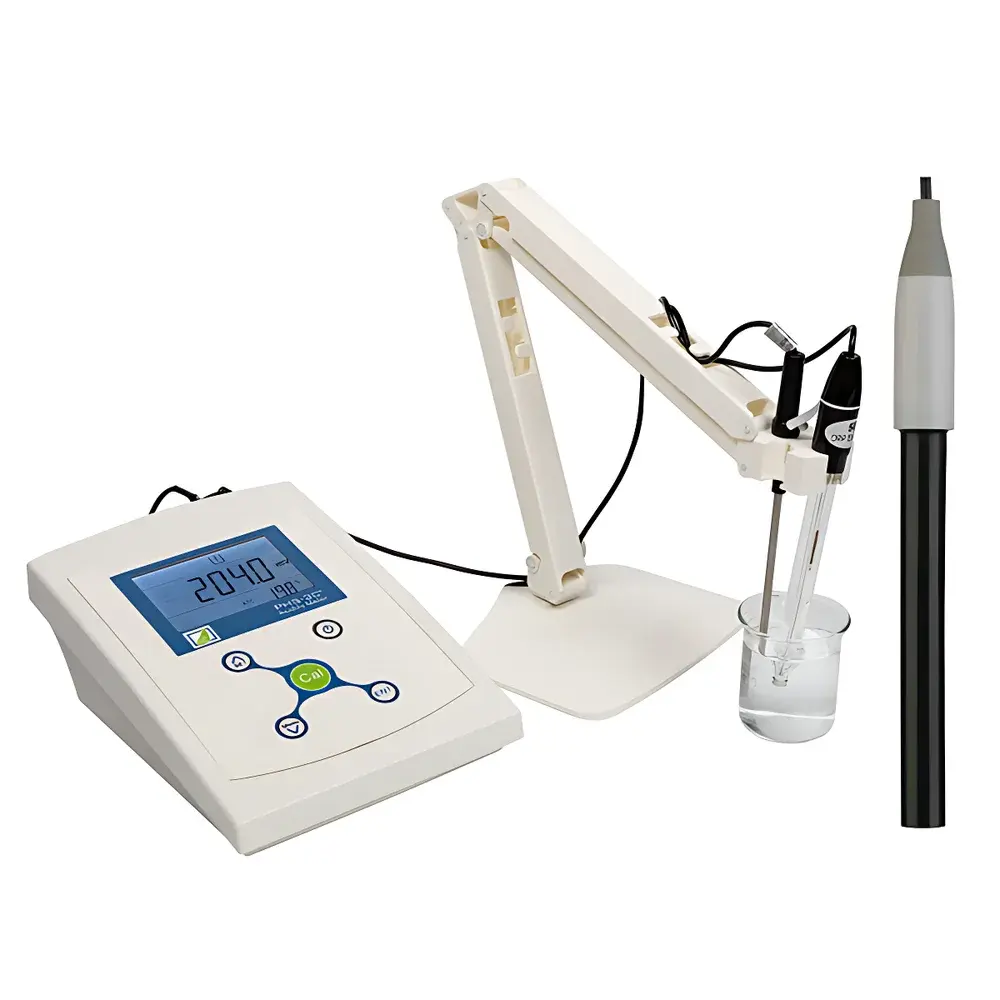
FangZhou PHS-3C+ Benchtop pH Meter for Culture Media Analysis
| Brand | FangZhou |
|---|---|
| Origin | Sichuan, China |
| Model | PHS-3C+ |
| Instrument Type | Benchtop |
| Parameter Types | pH, mV, ORP, Temperature |
| Measurement Accuracy | ±0.01 pH |
| pH Range | (−5.00 to 20.00) pH |
| Resolution | 0.01 pH / 0.1 mV |
| Temperature Compensation | Automatic (ATC) and Manual |
| Calibration Standards | NIST-traceable buffers |
| Input Impedance | ≥1 × 10¹² Ω |
| Power Supply | DC 9 V, 300 mA (center-positive) |
Overview
The FangZhou PHS-3C+ Benchtop pH Meter is an ISO 9001-certified electrochemical instrument engineered for precise, reproducible pH measurement in microbiological culture media preparation, pharmaceutical quality control, food safety testing, and academic research laboratories. It operates on the potentiometric principle—measuring the electromotive force (EMF) generated across a glass pH electrode and reference electrode pair immersed in aqueous solution—enabling high-fidelity quantification of hydrogen ion activity under variable ionic strength and temperature conditions. Designed specifically for demanding applications such as sterilized broth formulation, agar-based medium validation, and fermentation process monitoring, the PHS-3C+ meets essential metrological requirements for GLP-compliant environments and aligns with foundational standards including ASTM E70, ISO 3696 (Grade 3 water), and USP pH measurements. Its extended pH range (−5.00 to 20.00) supports both highly acidic and strongly alkaline culture formulations—critical for mycological, anaerobic, or extremophile media development.
Key Features
- Microprocessor-controlled architecture with programmable measurement protocols and capacitive touch-key interface for glove-compatible operation
- Backlit, high-contrast LCD display (128 × 64 pixels) showing real-time pH/mV/ORP/temperature values, electrode status, calibration progress, and diagnostic flags
- 0.01 pH resolution with adjustable decimal precision; 0.1 mV resolution for indirect ion concentration determination via standard addition or calibration curve methods
- Automatic Temperature Compensation (ATC) using integrated Pt1000 or external thermistor probes, plus manual offset capability across −5.0 °C to 135.0 °C
- Multi-point calibration support: up to five points with auto-buffer recognition from four preconfigured sets (NIST, Merck, MT Europe, Chinese GB standards)—totaling 12 certified buffer options
- Comprehensive electrode diagnostics: slope calculation (%), asymmetry potential display, response time indicator, and stable-signal hold function with visual equilibrium confirmation
- Robust input impedance (>1 × 10¹² Ω) minimizes loading errors during high-resistance measurements, particularly with double-junction or low-conductivity media electrodes
Sample Compatibility & Compliance
The PHS-3C+ is validated for use with standard combination pH electrodes (e.g., Ag/AgCl reference, low-pH-resistant glass membranes) and compatible temperature sensors meeting IEC 60751 Class B tolerances. It accommodates viscous, particulate-laden, or protein-rich culture media—including tryptic soy broth (TSB), Sabouraud dextrose agar (SDA), and thioglycollate medium—without signal drift or junction clogging when paired with appropriate flow-through or sleeve-type electrodes. The instrument complies with electromagnetic compatibility (EMC) per IEC 61326-1 and electrical safety per IEC 61010-1. While not FDA 21 CFR Part 11–enabled out-of-the-box, its RS232 serial output supports integration into validated LIMS or ELN systems where audit trails and electronic signatures are implemented at the host software layer.
Software & Data Management
Data export is facilitated via RS232 serial interface (9600 bps, no parity, 1 stop bit) to PCs or printers. FangZhou provides optional terminal-emulation software for real-time logging, CSV export, and basic statistical analysis (mean, SD, min/max). All calibration events—including date/time stamp, buffer IDs, measured mV values, calculated slope, and offset—are stored in non-volatile memory with capacity for ≥100 entries. The device maintains full traceability for QA/QC documentation and internal audit readiness, supporting laboratory adherence to ISO/IEC 17025 clause 7.7 (equipment records) and CLSI EP21-A guidelines for pH meter verification.
Applications
- Pre-sterilization and post-autoclave pH verification of microbial growth media per ISO 11133 and EU Pharmacopoeia 2.2.3
- Monitoring pH stability during long-term incubation studies in environmental microbiology and bioremediation assays
- Quality assurance of enzymatic reagents, lyophilized standards, and diagnostic kits requiring strict pH specification
- Teaching laboratories conducting fundamental electrochemistry experiments on buffer capacity, electrode kinetics, and liquid junction potentials
- Raw material screening for acidulants (e.g., citric, lactic, acetic acids) used in food-grade culture media manufacturing
FAQ
What calibration standards are supported?
The PHS-3C+ recognizes 12 NIST-traceable buffer solutions across four regional sets: NIST (USA), Merck (Germany), MT Europe (UK), and Chinese national standards (GB). Calibration is fully automated with one-touch recognition.
Does the meter support GLP-compliant data recording?
Yes—calibration history, measurement timestamps, operator ID fields (via manual entry), and electrode diagnostics are retained locally. Full GLP compliance requires integration with validated third-party software for electronic signatures and audit trail generation.
Can it measure ORP in anaerobic culture systems?
Yes. With a platinum ORP electrode and appropriate redox buffer verification (e.g., Zobell’s solution), the instrument delivers ±0.05% FS accuracy in the −1999.9 to +1999.9 mV range, suitable for monitoring reducing environments in strict anaerobe media.
Is temperature compensation mandatory for culture media pH readings?
While manual compensation is available, ATC is strongly recommended—especially for media heated above 40 °C or cooled below 15 °C—to correct for the inherent temperature dependence of glass electrode response per the Nernst equation.
What is the warranty coverage?
The instrument carries a three-year limited warranty on the main unit; defective units within six months of purchase are eligible for direct replacement under FangZhou’s quality assurance policy.





