
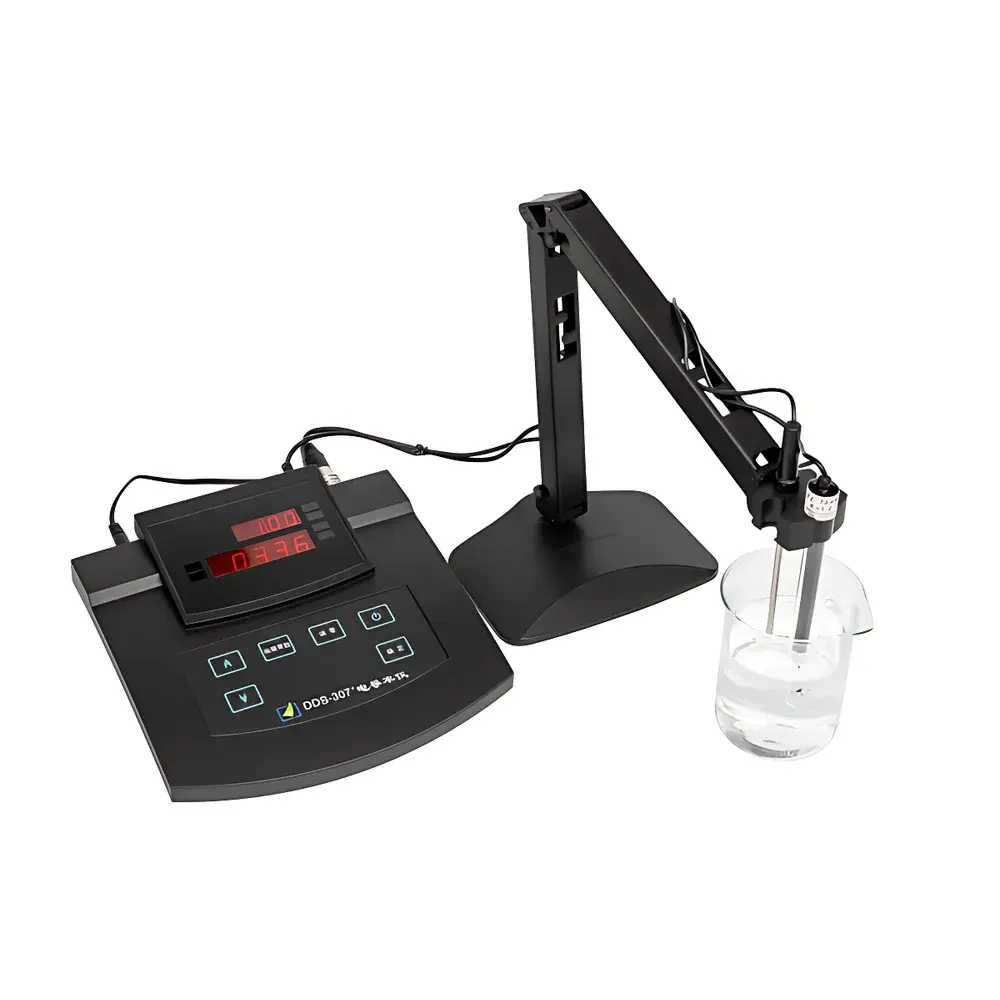
FangZhou DDS-307+ Benchtop Conductivity Meter
| Brand | FangZhou |
|---|---|
| Origin | Sichuan, China |
| Manufacturer Type | Authorized Distributor |
| Product Origin | Domestic (China) |
| Model | DDS-307+ |
| Measurement Parameters | Conductivity only |
| Form Factor | Benchtop |
| Intended Use | Laboratory |
| Conductivity Range | 0.000–200.0 μS/cm and 0.200–200.0 mS/cm (7 auto-ranging spans) |
| TDS Range | Not supported |
| Resistivity Range | Not supported |
| Salinity Range | Not supported |
| Temperature Range | −5.0 to +105.0 °C |
| Accuracy | ±1.0% of Full Scale (FS) |
| Minimum Resolution | 0.001 μS/cm |
| Temperature Compensation | Automatic (ATC) or Manual, 2.0%/°C coefficient |
| Electrode Compatibility | DJS-0.01, DJS-0.1, DJS-1.0, DJS-10.0 cells |
| Interface | BNC electrode port, Pt1000 temperature sensor input, RS232 serial output |
| Temperature Resolution | 0.1 °C |
| Temp. Accuracy | ±0.3 °C ±1 digit |
| Instrument Class | 1.0 grade per GB/T 6682 & JJG 376 |
Overview
The FangZhou DDS-307+ is a precision benchtop conductivity meter engineered for routine laboratory applications requiring reliable, repeatable measurement of aqueous ionic conductivity across seven decades of dynamic range—from ultrapure water (0.000 μS/cm) to concentrated saline solutions (200.0 mS/cm). Based on the fundamental principle of two-electrode AC conductance measurement, the instrument applies a low-voltage, frequency-modulated excitation signal to minimize polarization effects and electrode fouling—ensuring stable readings in both low-conductivity and high-ionic-strength matrices. Its microprocessor-controlled architecture integrates high-resolution analog-to-digital conversion (16-bit ADC), automatic temperature compensation (ATC) using Pt1000-compatible sensors, and intelligent auto-ranging logic that selects optimal measurement span without user intervention. Designed to meet the operational rigor of QC labs, environmental testing facilities, and university teaching laboratories, the DDS-307+ complies with national metrological verification regulation JJG 376–2007 and conforms to general requirements of GB/T 6682–2008 for water quality analysis instrumentation.
Key Features
- Seven-step auto-ranging conductivity measurement spanning 0.000 μS/cm to 200.0 mS/cm, with seamless transitions between ranges
- Programmable temperature compensation with selectable linear coefficient (default 2.0%/°C), supporting both automatic (ATC) and manual modes across −5.0 to +105.0 °C
- Compatibility with standardized DJS-type conductivity cells (0.01, 0.1, 1.0, and 10.0 cm−1 cell constants), including optional flow-through configurations for continuous monitoring or ultrapure water analysis
- Benchtop enclosure with chemical-resistant housing and IP54-rated front panel, suitable for humid or splash-prone lab environments
- RS232 serial interface enabling data logging, remote control, and integration with LIMS or custom acquisition software under standard ASCII protocol
- Calibration verification via dual-point (low/high) conductivity standards; supports user-defined calibration constants for traceable metrology workflows
Sample Compatibility & Compliance
The DDS-307+ is validated for use with aqueous samples only—including deionized water, boiler feedwater, wastewater effluents, pharmaceutical rinse solutions, and process brines. It is not intended for non-aqueous solvents, viscous media, or suspensions. The instrument satisfies functional requirements outlined in ISO 7888 (water quality — determination of electrical conductivity), ASTM D1125 (standard test method for electrical conductivity and resistivity of water), and supports GLP-compliant documentation when paired with RS232-connected PC-based logging tools. While not certified to FDA 21 CFR Part 11 out-of-the-box, its deterministic calibration history, audit-ready parameter storage (including date/time stamps), and non-volatile memory retention align with foundational data integrity expectations for regulated environments.
Software & Data Management
Data output is delivered via ASCII-formatted RS232 serial stream at 9600 baud, 8N1, with configurable transmission triggers (e.g., on measurement stabilization or timed intervals). No proprietary software is bundled; however, the protocol is fully documented and interoperable with industry-standard platforms such as LabVIEW, MATLAB, Python (pySerial), and Excel-based logging utilities. All calibration coefficients, temperature settings, and unit preferences are retained in non-volatile memory—even after power loss. The device stores no raw time-series data internally but provides real-time output suitable for external archival systems compliant with ISO/IEC 17025 documentation requirements.
Applications
- Monitoring conductivity drift in ultrapure water loops (using DJS-0.01 cell + flow cell)
- Verification of cleaning-in-place (CIP) rinse endpoints in food & beverage and biopharma manufacturing
- Field-deployable lab validation of portable meters via reference solution checks
- Teaching core electrochemical principles—including Kohlrausch’s law, cell constant derivation, and temperature dependence modeling
- Environmental compliance testing for surface water, groundwater, and treated effluent per local regulatory thresholds
- Quality control of buffer solutions, reagent grades, and distilled water used in analytical sample preparation
FAQ
Does the DDS-307+ support TDS, resistivity, or salinity calculation?
No. It measures conductivity only. TDS, resistivity, and salinity outputs are not computed or displayed.
Can I use this meter for high-precision ultrapure water measurements below 0.1 μS/cm?
Yes—when equipped with a calibrated DJS-0.01 cm−1 cell and flow-through adapter, it achieves resolution down to 0.001 μS/cm within the 0.000–0.200 μS/cm range.
Is the temperature sensor integrated or external?
The meter accepts external Pt1000-class temperature probes via dedicated BNC input; no built-in thermistor is provided.
What calibration standards are recommended?
Certified KCl solutions traceable to NIST or equivalent national metrology institutes: 1413 μS/cm (at 25 °C) for low-range verification, and 12.88 mS/cm for high-range validation.
How is traceability maintained during calibration?
Users may record calibration date, standard lot number, measured value, and deviation manually or via RS232 log; the instrument itself stores only active cell constant and temperature coefficient settings.




