
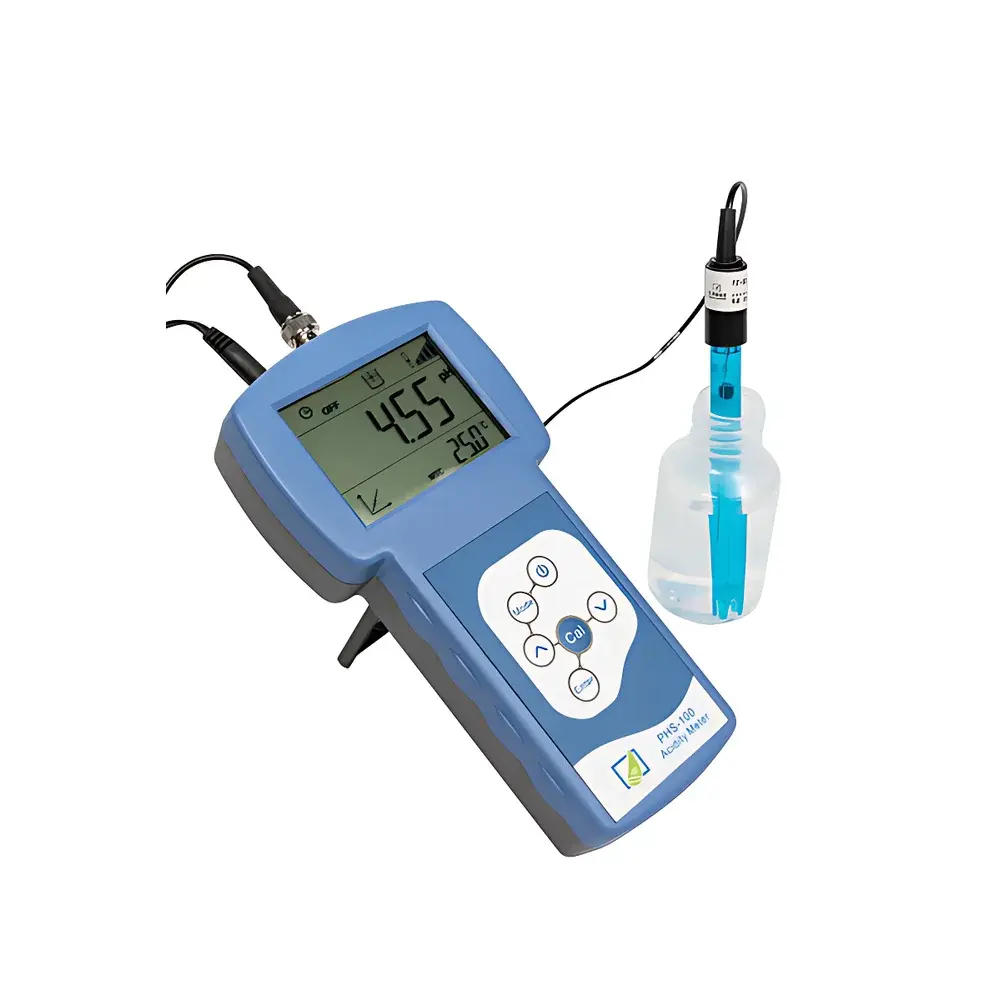
FangZhou PHS-100 Portable pH Meter
| Brand | FangZhou |
|---|---|
| Origin | Sichuan, China |
| Model | PHS-100 |
| Instrument Type | Portable |
| Parameter Types | pH / mV / ORP / Temperature (T) |
| Measurement Accuracy | ±0.002 pH ±1 digit |
| pH Range | (−5.000 to 20.000) pH |
| Resolution | 0.001 / 0.01 pH (adjustable) |
| mV/ORP Range | (−1999.9 to +1999.9) mV |
| mV Resolution | 0.1 / 1 mV (adjustable) |
| Temperature Range | (−5.0 to 105.0) °C |
| Temp. Resolution | 0.1 °C |
| Temp. Accuracy | ±0.3 °C ±1 digit |
| Input Impedance | ≥3 × 10¹² Ω |
| Calibration Points | 1–3 point auto-recognized NIST-traceable buffer calibration |
| Data Storage | 200 measurement records with timestamp |
| Power Supply | 2 × AA alkaline batteries or DC 5 V / 300 mA (center-positive) |
Overview
The FangZhou PHS-100 Portable pH Meter is a high-precision electrochemical instrument engineered for field-deployable and laboratory-grade pH, redox potential (ORP), millivolt (mV), and temperature measurements. Built upon a microprocessor-controlled architecture with programmable logic, it implements potentiometric measurement principles compliant with ISO 3696, ASTM D1293, and USP standards for aqueous solution analysis. Its extended pH range of −5.000 to 20.000 accommodates highly acidic, neutral, and strongly alkaline samples—including industrial process streams, geological leachates, and aggressive cleaning solutions—where conventional meters fail. The instrument employs high-input-impedance (>3 × 10¹² Ω) circuitry to minimize electrode loading errors, ensuring stable readings even with low-ionic-strength or high-resistivity samples such as deionized water, ethanol-water mixtures, or organic solvents.
Key Features
- True dual-resolution capability: selectable 0.001 pH / 0.1 mV or 0.01 pH / 1 mV modes for optimized precision versus dynamic response trade-offs
- Intelligent auto-buffer recognition across NIST-traceable standard solutions (pH 4.00, 6.86, 9.18 at 25 °C) with real-time validation of calibration slope and offset
- Automatic temperature compensation (ATC) with support for both integrated Pt1000 sensors and manual entry; temperature compensation range spans −5.0 °C to 105.0 °C
- Signal balancing algorithm reduces stabilization time by up to 40% compared to conventional analog front-ends, critical for rapid field surveys
- Non-volatile memory retains calibration coefficients and 200 timestamped measurement records—even after power loss—enabling GLP-compliant audit trails
- Dual-power architecture: operates on two AA alkaline cells (typical 200-hour battery life) or external DC 5 V / 300 mA supply (center-positive polarity)
- Ergonomic, IP65-rated housing with tactile touch keys and backlit LCD for readability under variable ambient lighting conditions
Sample Compatibility & Compliance
The PHS-100 is validated for use with standard combination glass electrodes (BNC or DIN connectors), optional electrode adapters for legacy or specialized probes (e.g., double-junction, gel-filled, or solid-state sensors), and ion-selective electrodes (ISEs) when paired with the optional ISE converter module. It meets ISO 9001:2015 quality management system requirements and supports regulatory workflows aligned with FDA 21 CFR Part 11 through secure data export (via USB or RS232 interface on compatible variants) and user-accessible calibration logs. All electrical safety design conforms to IEC 61010-1:2010 for measurement equipment used in laboratory and field environments.
Software & Data Management
While the base unit operates independently, optional PC connectivity enables data transfer via ASCII-formatted CSV files compatible with LIMS platforms, Excel, and statistical analysis tools (e.g., JMP, Minitab). Each stored record includes pH/mV/ORP value, temperature, date/time stamp, electrode ID (if entered manually), and calibration status flag. Audit-ready reports can be generated to document calibration frequency, drift verification, and instrument performance against internal SOPs or ISO/IEC 17025 criteria.
Applications
- Environmental monitoring: soil pore water, acid mine drainage, wastewater effluent, and surface water profiling
- Food & beverage QA/QC: titratable acidity checks, fermentation broth monitoring, and cleaning-in-place (CIP) validation
- Pharmaceutical manufacturing: buffer preparation verification, excipient stability testing, and rinse water qualification per USP
- Academic research: electrochemical kinetics studies, corrosion inhibitor evaluation, and hydrogel swelling behavior analysis
- Industrial process control: semiconductor wet bench chemistry, electroplating bath management, and boiler feedwater treatment
FAQ
What calibration standards are supported?
The PHS-100 recognizes NIST-traceable pH buffers (4.00, 6.86, 9.18 at 25 °C) and supports custom calibration points if manually entered. Calibration slope and asymmetry potential are calculated and displayed post-calibration.
Does the instrument support GLP data integrity requirements?
Yes—calibration history, measurement timestamps, and operator ID fields (user-configurable) are retained in non-volatile memory. Exported data includes metadata required for 21 CFR Part 11 compliance when used with validated software.
Can I measure non-aqueous or low-ionic-strength samples?
With appropriate electrodes (e.g., low-resistance glass membranes, reference junctions with high-flow electrolyte), the PHS-100’s ≥3 × 10¹² Ω input impedance minimizes junction potential errors—but users must apply matrix-matched calibration and consider liquid junction correction per IUPAC recommendations.
Is temperature compensation mandatory during pH measurement?
No—temperature compensation is configurable as automatic (via ATC probe) or manual entry. However, uncorrected measurements deviate from thermodynamic pH values by approximately 0.03 pH units per °C away from 25 °C.
What is the warranty coverage?
The PHS-100 host unit carries a three-year limited warranty against material and workmanship defects. Electrodes and consumables are excluded per industry-standard practice.





