
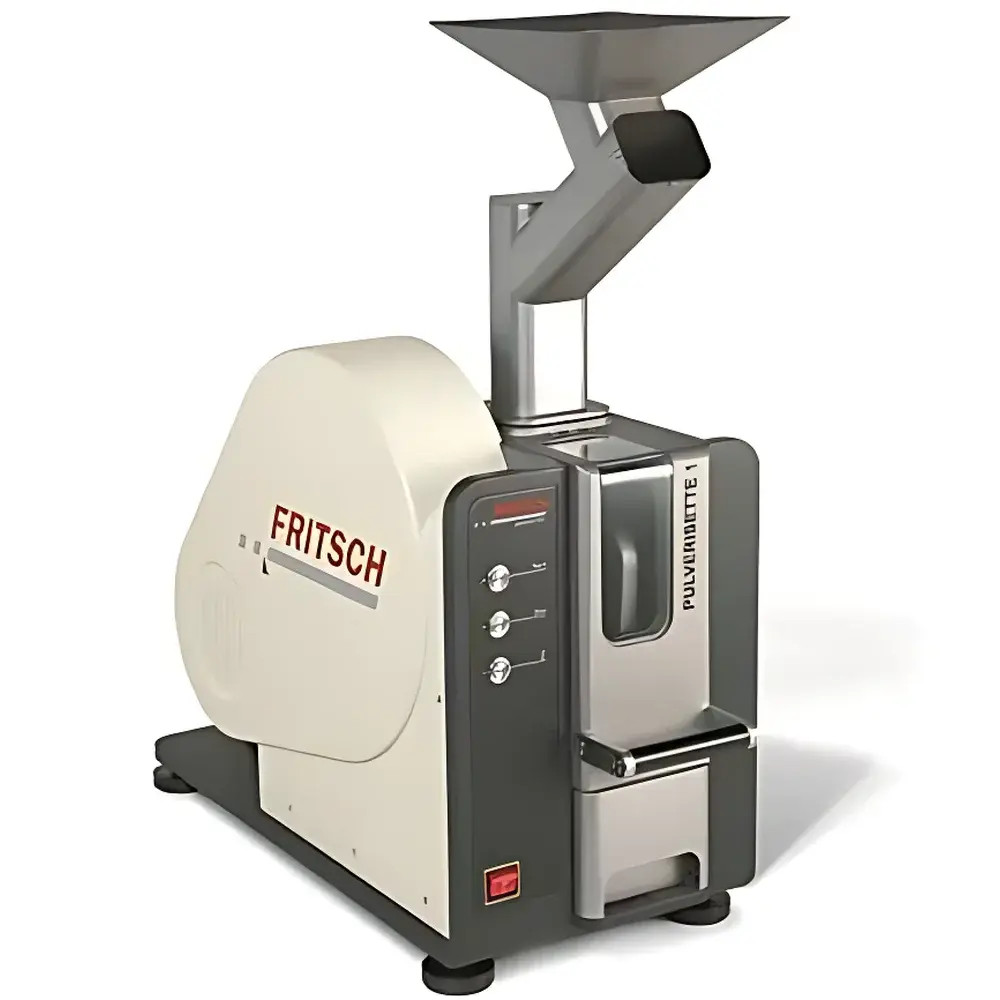
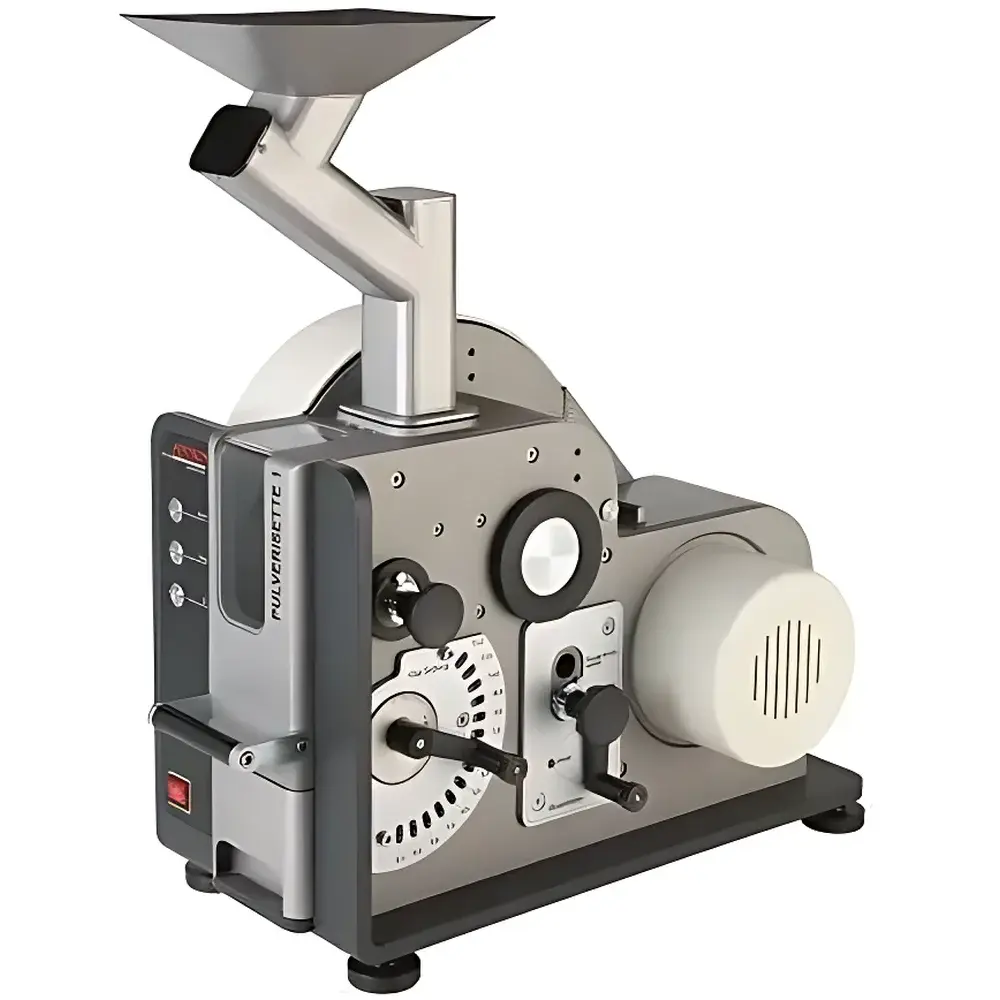
FRITSCH P-1 premium Jaw Crusher
| Brand | FRITSCH |
|---|---|
| Origin | Germany |
| Manufacturer | FRITSCH GmbH |
| Type | Jaw Crusher |
| Model | P-1 premium |
| Sample Type | Hard and brittle materials |
| Max. Feed Size | 95 mm |
| Min. Feed Volume | 20 mL |
| Throughput Capacity | 250 kg/h |
| Final Particle Size | 0.01–0.3 mm |
| Adjustable Gap | 14 precise settings (mm-scale resolution) |
| Motor Power | 3 kW |
| Net Weight | 320 kg |
| Dimensions (W × L × H) | 55 × 90 × 106 cm |
| Grinding Chamber & Drawer Interlock Safety System | Yes |
| Dust Extraction Interface | Integrated, front-panel controlled |
| Available Jaw Materials | Tempered steel, stainless steel, chromium-free steel, manganese steel, tungsten carbide, zirconium oxide, aluminum, polyamide |
| Compliance | CE, ISO 9001, GLP-ready design |
Overview
The FRITSCH P-1 premium Jaw Crusher is a high-performance, laboratory-scale primary crushing instrument engineered for reproducible size reduction of hard, brittle, and medium-hard materials. Based on the classic double-toggle jaw crushing principle—where material is compressed between a fixed and a dynamically oscillating jaw plate—the P-1 premium delivers controlled, consistent particle size distribution with minimal overgrinding or heat generation. Designed and manufactured in Germany to DIN EN ISO 9001 standards, it serves as a critical first-stage sample preparation tool in geochemical laboratories, metallurgical R&D centers, cement and construction materials testing facilities, and academic mineralogy departments. Its robust mechanical architecture ensures long-term dimensional stability under repeated high-load operation, making it suitable for routine use in ISO/IEC 17025-accredited labs where traceability and process repeatability are mandated.
Key Features
- 3 kW high-torque motor enables efficient throughput of up to 250 kg/h while maintaining low vibration and thermal drift during extended operation.
- Monolithic cast-steel frame and precision-machined jaw assembly provide structural rigidity and minimize operational deflection—critical for maintaining gap accuracy across thousands of crushing cycles.
- 14-step micrometer-adjustable jaw gap (with mm-level resolution) allows precise control over output fineness without requiring recalibration; gap setting is mechanically locked and documented for audit trails.
- Bidirectional jaw plates extend service life by up to 100%, reducing consumable costs and downtime associated with replacement scheduling.
- Conical feed hopper with anti-rebound channel geometry prevents material ejection and ensures gravity-fed, uniform loading—even for irregularly shaped or high-density samples (e.g., quartzite, basalt, sintered ceramics).
- Three preconfigured crushing modes (coarse, medium, fine) are selectable via mechanical cam mechanism—no gap adjustment required—enabling rapid method switching while preserving inter-run comparability.
- Interlocked drawer and chamber lid system halts motor activation unless both safety interfaces are fully engaged, meeting EN 61000-6-2 EMC and EN ISO 13857 machine guarding requirements.
- Modular grinding chamber design permits full disassembly in under 8 minutes using standard tools; all wear components are accessible without specialized fixtures.
- Integrated dust extraction port (Ø100 mm) connects directly to central lab vacuum systems or standalone cyclonic extractors; start/stop synchronized with crusher operation via front-panel push-button interface.
- Eight jaw material variants—including tungsten carbide (for ultra-abrasive ores), zirconia (for contamination-sensitive geochemical analysis), and polyamide (for low-metal leaching in environmental soil testing)—support application-specific cross-contamination mitigation strategies.
Sample Compatibility & Compliance
The P-1 premium is validated for use with geological specimens (granite, limestone, iron ore), industrial minerals (feldspar, kaolin), metallurgical slags, ceramic raw materials, coal, and construction aggregates. It complies with ASTM D2974 (Standard Test Methods for Moisture, Ash, and Organic Matter of Peat and Other Organic Soils), ISO 679 (Cement — Test methods), and USP (Disintegration of Tablets), when integrated into validated sample prep workflows. Its closed-chamber configuration and optional HEPA-filtered exhaust path support compliance with OSHA silica exposure limits (29 CFR 1926.1153) and EU Directive 2004/37/EC (carcinogens and mutagens). Full GLP documentation packages—including IQ/OQ protocols, calibration certificates, and maintenance logs—are available upon request.
Software & Data Management
While the P-1 premium operates as a stand-alone mechanical unit, its operational parameters (run time, cycle count, jaw gap setting, material type code) can be manually logged into FRITSCH’s optional LabSolutions™ LIMS integration module (v3.2+). This module supports 21 CFR Part 11-compliant electronic signatures, audit trail generation, and export to CSV or XML for traceability in regulated environments. All mechanical adjustments are physically indexed and labeled—ensuring that parameter settings remain verifiable independent of software dependency.
Applications
- Geochemical assay preparation: Crushing drill core and grab samples to ≤0.3 mm prior to pulverization in planetary ball mills (e.g., FRITSCH PULVERISETTE 5) for XRF or ICP-MS analysis.
- Cement clinker homogenization: Reducing kiln feed samples to uniform granulometry for Blaine surface area testing per EN 196-6.
- Mineral processing R&D: Generating representative feed fractions for downstream flotation or magnetic separation trials.
- Environmental soil screening: Preparing contaminated site samples for TCLP (Toxicity Characteristic Leaching Procedure) extractions under EPA Method 1311.
- Recycled construction material characterization: Size reduction of concrete rubble and asphalt pavement cores for gradation analysis (ASTM C136).
FAQ
What safety certifications does the P-1 premium hold?
It carries CE marking per Machinery Directive 2006/42/EC, electromagnetic compatibility certification per EN 61000-6-2/6-3, and conforms to EN ISO 13857 for safe distances from hazardous zones.
Can the P-1 premium be integrated into an automated sample prep line?
Yes—via optional I/O terminals (24 V DC, relay outputs) for synchronization with upstream feeders or downstream sieving units; full integration requires FRITSCH’s Automation Interface Kit (Order No. 90.001.00).
Is calibration required before first use?
No formal calibration is needed; however, users must perform initial gap verification using certified gauge blocks and document the baseline setting per internal SOPs—recommended annually thereafter.
How often should jaw plates be rotated or replaced?
Under typical usage (≤8 hrs/day, abrasive ores), bidirectional jaw plates require rotation every 200–300 operating hours and replacement after 800–1,200 hours depending on material hardness and feed consistency.
Does FRITSCH supply validation documentation for GMP environments?
Yes—Factory Acceptance Test (FAT) reports, Installation Qualification (IQ), and Operational Qualification (OQ) templates are included with each unit; Performance Qualification (PQ) support is provided by FRITSCH Application Engineers on-site.



