
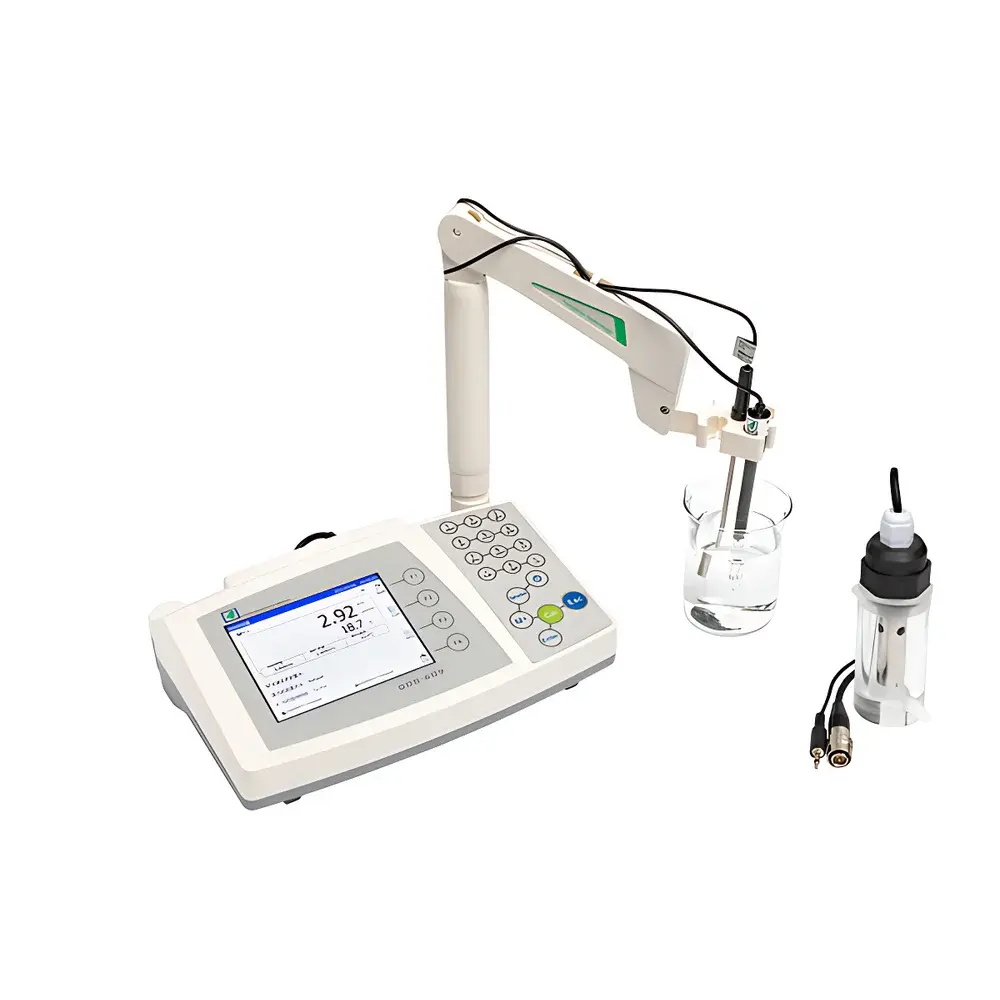
FangZhou DDS-609 Benchtop Wastewater Conductivity Analyzer
| Brand | FangZhou |
|---|---|
| Origin | Sichuan, China |
| Manufacturer Type | Authorized Distributor |
| Product Category | Domestic |
| Model | DDS-609 Wastewater Conductivity Analyzer |
| Price Range | USD 700–1,400 (FOB) |
| Measured Parameters | Conductivity, Resistivity, TDS, Salinity, Conductive Ash, Temperature |
| Portability | Benchtop |
| Application Environment | Laboratory |
| Conductivity Range | (0–2×10⁵) µS/cm |
| TDS Range | (0.00–300.0) g/L (TDS factor = 1.0) |
| Resistivity Range | (5.00–10⁸) Ω·cm |
| Salinity Range | (0.00–80.00) ppt |
| Temperature Range | (−25.0–135.0) °C |
| Accuracy | ±0.5% FS |
| Minimum Conductivity Resolution | 0.0001 µS/cm |
| Temperature Compensation | Automatic (ATC) or Manual (MTC), Linear/Nonlinear, Reference Temp Adjustable (15.0–25.0 °C) |
| Calibration | Up to 4 Chinese standard points, 6 US/EU standard points, 1 custom solution |
| Data Storage | ≥100,000 measurement records |
| Interface | RS-232, USB, 0–20 mV analog output |
| GLP Compliance | Full audit trail, user authentication, method traceability, electronic signature support |
Overview
The FangZhou DDS-609 Benchtop Wastewater Conductivity Analyzer is an ISO 9001-certified, laboratory-grade electrochemical instrument engineered for high-reproducibility measurement of aqueous ionic strength in complex industrial and environmental matrices. It operates on the principle of two-electrode or four-electrode conductometric sensing—applying a known AC voltage across a conductivity cell and measuring the resulting current to compute specific conductance (σ), corrected for cell geometry via adjustable cell constant (DJS). Designed explicitly for wastewater characterization, the DDS-609 integrates dual-mode temperature compensation (linear and non-linear), multi-point calibration traceable to NIST-traceable standards (including ASTM D1125 and ISO 7888), and rigorous adherence to Good Laboratory Practice (GLP) data integrity requirements. Its architecture supports regulatory workflows in environmental monitoring labs, municipal water treatment QA/QC departments, and pharmaceutical manufacturing facilities where conductivity is a critical parameter for purified water systems per USP , EP 2.2.38, and JP 2.05.
Key Features
- 8-range auto-ranging conductivity measurement with dynamic resolution scaling—from 0.0001 µS/cm at ultra-low levels (DJS = 0.01 cm⁻¹) up to 2000 mS/cm for highly concentrated effluents
- Simultaneous real-time calculation and display of five interrelated parameters: conductivity, resistivity, TDS (with user-adjustable coefficient 0.2–1.0), salinity (ppt), and conductive ash (%)
- Comprehensive temperature management: ATC/MTC selection, non-linear compensation algorithms for natural water profiles, and configurable reference temperature (15.0–25.0 °C)
- Regulatory-ready software architecture: Role-based user authentication (1000+ accounts), method versioning, electronic audit trail, and 21 CFR Part 11–compatible data export
- Dedicated water grade modes—including USP Purified Water (PW), Water for Injection (WFI), and SEMI Grade EW-I/EW-II/EW-III—with configurable alarm thresholds and pass/fail flagging
- Expandable electrode ecosystem: Compatible with DJS 0.01, 0.1, 1.0, and 10.0 cm⁻¹ cells; automatic electrode ID recognition and history logging (calibration date, drift, last verification)
Sample Compatibility & Compliance
The DDS-609 is validated for use with raw sewage, primary/secondary effluent, landfill leachate, industrial process streams, and reclaimed water—samples exhibiting high suspended solids, variable pH, and organic fouling potential. Its robust electrode interface accommodates both platinized stainless-steel and graphite conductivity cells, minimizing polarization error in high-conductivity applications. The instrument complies with ISO/IEC 17025:2017 clause 6.4.3 (equipment suitability), meets the performance criteria of ISO 7888:2019 (water quality — determination of electrical conductivity), and supports compliance with EPA Method 120.1 and APHA Standard Methods 2510 B. All firmware and calibration routines are documented per GLP Annex 11 and ICH M7 requirements for analytical instrument qualification.
Software & Data Management
Data integrity is enforced through embedded timestamped storage (≥100,000 records), dual-format export (CSV, Excel-compatible .xls), and three report templates: Simple (raw values only), Standard (method + metadata), and GLP-compliant (full traceability: operator ID, electrode serial, calibration log, ambient conditions). RS-232 and USB interfaces enable direct integration with LIMS and ELN platforms. The instrument’s internal database maintains full revision history for all user-defined methods (up to 1000 stored), including calibration curves, temperature coefficients, and TDS conversion factors. Audit logs record every login, method edit, calibration event, and data deletion—retained for ≥36 months per internal SOPs aligned with FDA expectations.
Applications
- Wastewater treatment plant effluent compliance monitoring against local discharge permits (e.g., China’s GB 8978–1996, EU Urban Wastewater Directive 91/271/EEC)
- Pharmaceutical water system validation per USP , including conductivity mapping of distribution loops and point-of-use testing
- Industrial cooling tower and boiler feedwater control, where conductivity serves as proxy for total dissolved solids and corrosion risk
- Environmental field lab analysis of river, lake, and groundwater samples under ISO 5667-3 protocols
- Educational laboratories requiring pedagogical clarity in electrochemical fundamentals and regulatory measurement practice
FAQ
Does the DDS-609 support non-linear temperature compensation for natural water samples?
Yes—the instrument implements polynomial-based non-linear compensation per ISO 7888, optimized for freshwater, seawater, and brackish matrices.
Can calibration data be exported for external audit review?
All calibration events—including standard IDs, measured values, residuals, and operator signatures—are exportable in GLP format with digital timestamps and cryptographic hash integrity checks.
Is electrode constant adjustment possible during routine operation?
The DJS value is fully user-configurable per measurement method and automatically logged with each calibration cycle.
What is the maximum allowable sample temperature for continuous measurement?
The sensor input circuitry is rated for sustained operation up to 135.0 °C; however, electrode selection must match thermal stability limits (e.g., high-temp graphite cells required above 80 °C).
How does the instrument handle electrode fouling in wastewater applications?
The DDS-609 includes diagnostic routines that monitor electrode impedance and signal noise; users receive alerts when deviation exceeds ±5% of baseline, prompting cleaning or recalibration per SOP 042.
Related Products






