
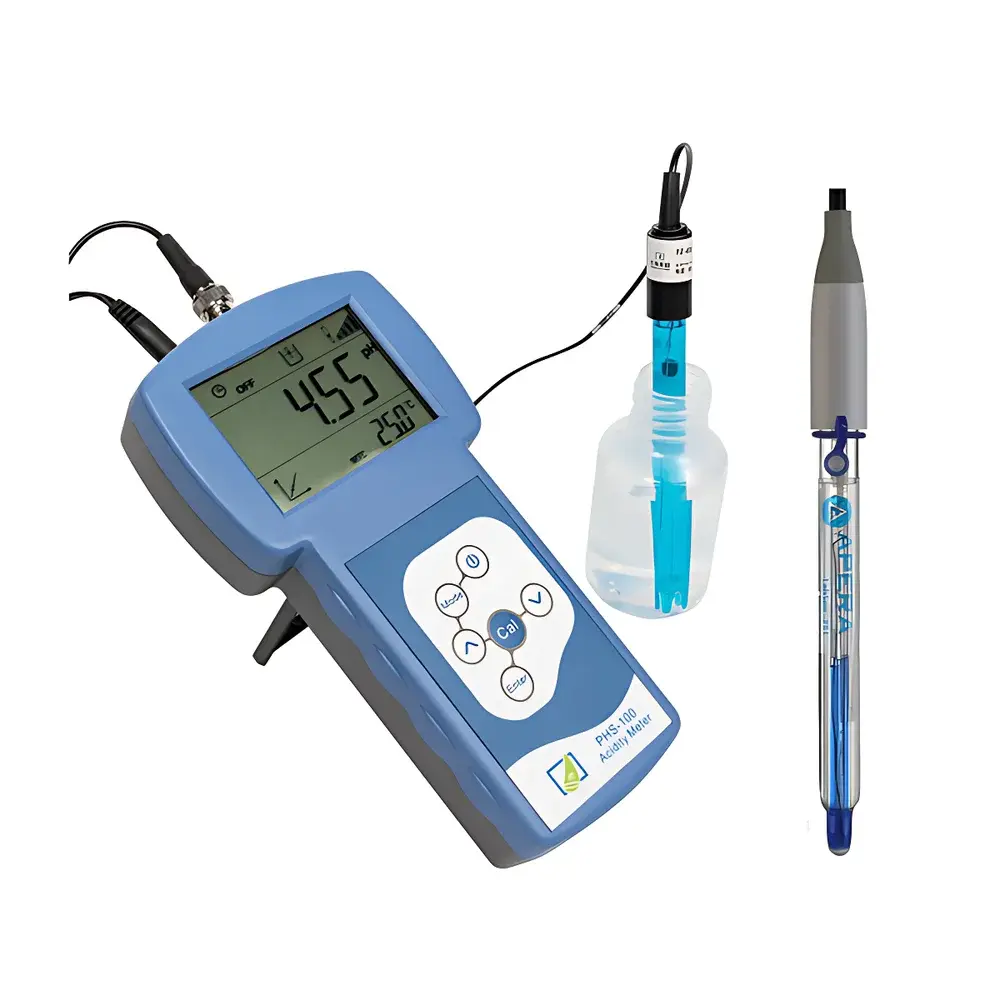
FangZhou PHS-100 Wastewater pH Meter
| Brand | FangZhou |
|---|---|
| Origin | Sichuan, China |
| Manufacturer Type | Authorized Distributor |
| Product Category | Domestic |
| Model | PHS-100 Wastewater pH Meter |
| Instrument Type | Portable |
| Parameter Types | Multi-parameter (pH, mV, ORP, Temperature) |
| Measurement Accuracy | ±0.002 pH ±1 digit |
| pH Range | (−5.000 to 20.000) pH |
| Resolution | 0.001/0.01 pH (adjustable) |
| mV/ORP Range | (−1999.9 to +1999.9) mV |
| mV Resolution | 0.1/1 mV (adjustable) |
| Temperature Range | (−5.0 to 105.0) °C |
| Temp. Resolution | 0.1 °C |
| Temp. Accuracy | ±0.3 °C ±1 digit |
| Input Impedance | ≥3 × 10¹² Ω |
| Calibration | 1–3 point auto-buffer recognition (NIST-traceable standards: pH 4.00, 6.86, 9.18 at 25 °C) |
| Data Storage | 200 measurement records with timestamp |
| Power Supply | 2 × AA alkaline batteries or DC 5 V / 300 mA (center-positive) |
| Auto-Off Delay | Configurable (default 10 min) |
| ATC | Automatic/manual temperature compensation |
| Signal Stabilization | Dynamic equilibrium algorithm for accelerated response |
| Electrode Interface | Standard BNC + dedicated temperature input |
| Optional | Electrode adapter for multiple probe types |
Overview
The FangZhou PHS-100 Wastewater pH Meter is a portable, microprocessor-controlled electrochemical analyzer engineered for high-precision field and laboratory measurement of hydrogen ion activity in complex aqueous matrices—including industrial effluents, municipal wastewater, leachates, and environmental monitoring samples. Operating on the fundamental principle of potentiometric pH measurement, the instrument measures the potential difference between a glass pH sensing electrode and a stable reference electrode immersed in solution, converting it into a calibrated pH value via Nernst equation-based algorithms. Its extended pH range (−5.000 to 20.000) accommodates highly acidic or alkaline waste streams commonly encountered in chemical processing, electroplating, and flue gas desulfurization systems—where conventional meters often fail due to electrode poisoning or junction clogging. The device meets the performance criteria of ISO 3696 (Grade 3 water), ASTM D1293 (Standard Test Method for pH of Water), and supports compliance with regulatory reporting requirements under EPA Method 150.1 and EU Directive 2000/60/EC (Water Framework Directive).
Key Features
- High-resolution dual-mode display: 0.001 pH / 0.01 pH and 0.1 mV / 1 mV resolution—user-selectable to match analytical rigor and operational context.
- Intelligent calibration system with automatic buffer recognition for NIST-traceable standard solutions (pH 4.00, 6.86, 9.18 at 25 °C); supports 1-, 2-, or 3-point calibration with real-time slope and offset diagnostics.
- Advanced signal stabilization algorithm reduces measurement settling time by dynamically balancing electrode polarization effects—critical for viscous or particulate-laden wastewater samples.
- Integrated Automatic Temperature Compensation (ATC) with optional manual override; utilizes Pt1000 or thermistor-based probes (BNC + dedicated temp input) for accurate thermal correction across −5.0 to 105.0 °C.
- Dual power architecture: Operates continuously on two AA alkaline cells (typical 200+ hours) or external DC 5 V / 300 mA supply—enabling uninterrupted use during extended site surveys or mobile lab deployments.
- Robust data governance: Stores 200 timestamped records (pH/mV/ORP/T) with non-volatile memory; retains calibration coefficients and user settings after power loss per IEC 61000-4-2 ESD immunity standards.
Sample Compatibility & Compliance
The PHS-100 is specifically optimized for challenging wastewater matrices characterized by high ionic strength, suspended solids, sulfide content, and organic load. Its high-input-impedance circuitry (≥3 × 10¹² Ω) minimizes loading errors when paired with double-junction or gel-filled reference electrodes—reducing drift in low-conductivity effluents. The instrument complies with CE marking requirements (EMC Directive 2014/30/EU, LVD Directive 2014/35/EU) and supports GLP-compliant workflows through traceable calibration logs and audit-ready storage. While not FDA 21 CFR Part 11–certified out-of-the-box, its deterministic calibration history and immutable record timestamps align with ALCOA+ principles for data integrity in environmental QA/QC laboratories.
Software & Data Management
Data export is performed via manual transcription or optional RS232/USB interface (adapter sold separately). All stored measurements include date/time stamps, electrode ID (if entered), calibration status flags, and ambient temperature—facilitating traceability in regulatory submissions. Firmware supports configurable auto-shutdown (1–60 minutes), preventing inadvertent battery drain during transport. Calibration data—including slope (%), offset (mV), and buffer acceptance thresholds—is retained independently of measurement logs, enabling post-hoc verification of sensor performance trends over time.
Applications
- On-site pH monitoring of primary, secondary, and tertiary wastewater treatment stages.
- Compliance testing for discharge permits (e.g., NPDES, UK Environmental Permitting Regulations).
- Process control in chemical manufacturing, metal finishing, and food/beverage wastewater streams.
- Field assessment of acid mine drainage (AMD) and landfill leachate characterization.
- Calibration verification and inter-laboratory comparison studies using certified reference materials (CRMs).
FAQ
What calibration standards are supported?
The PHS-100 recognizes NIST-traceable pH buffers at 4.00, 6.86, and 9.18 (25 °C) and performs automatic slope calculation. Custom buffer values may be entered manually for non-standard media.
Can the meter measure ion concentrations directly?
Not natively—but with optional ion-selective electrodes (ISEs) and appropriate calibration, it supports quantitative determination of F⁻, Cl⁻, NO₃⁻, NH₄⁺, and other ions per ISO 10304-1 guidelines.
Is temperature compensation mandatory?
No—temperature can be entered manually or disabled for comparative measurements where thermal drift is negligible.
How is data integrity ensured during field use?
All measurements and calibrations are stored with embedded timestamps and checksum-verified memory; no data overwrite occurs unless explicitly initiated by the user.
What maintenance is required for long-term reliability?
Regular electrode cleaning (e.g., dilute HCl for carbonate deposits, enzymatic solution for organic fouling), junction rinsing with deionized water, and periodic verification against CRMs every 30 days in high-use environments.




