
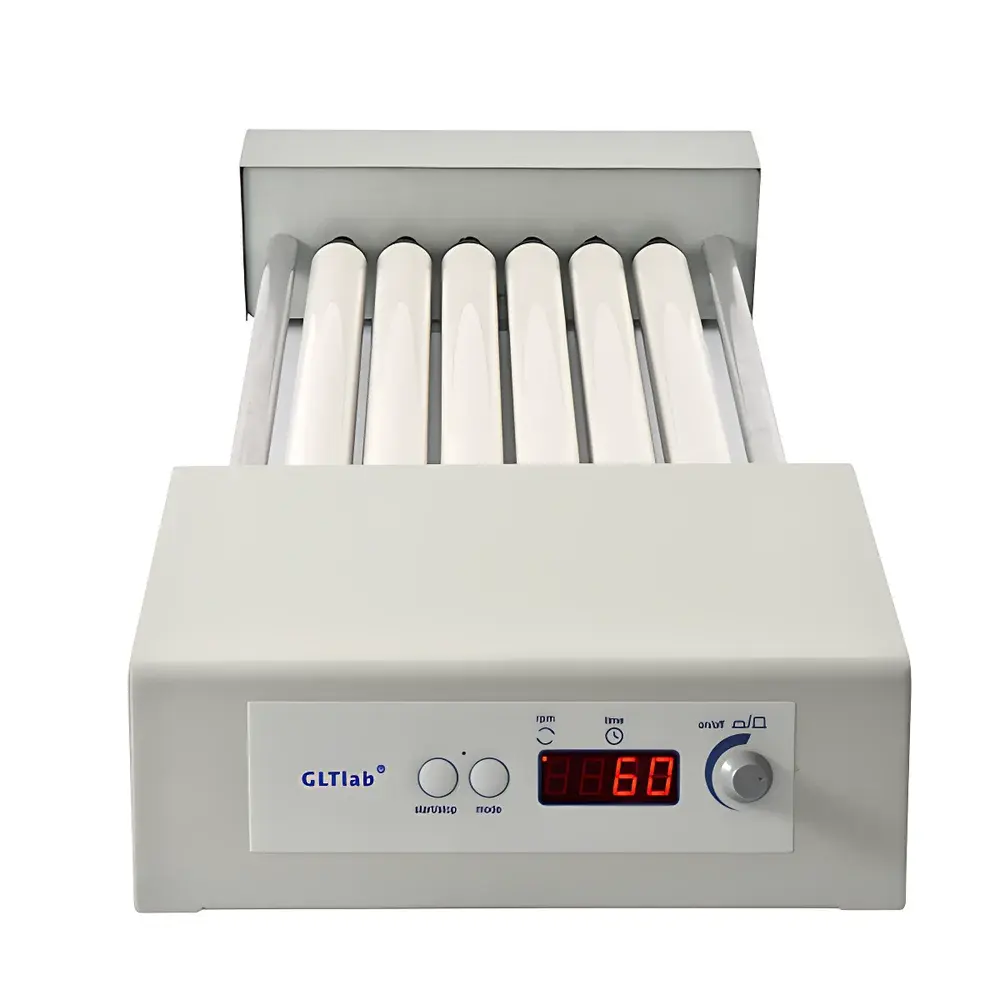
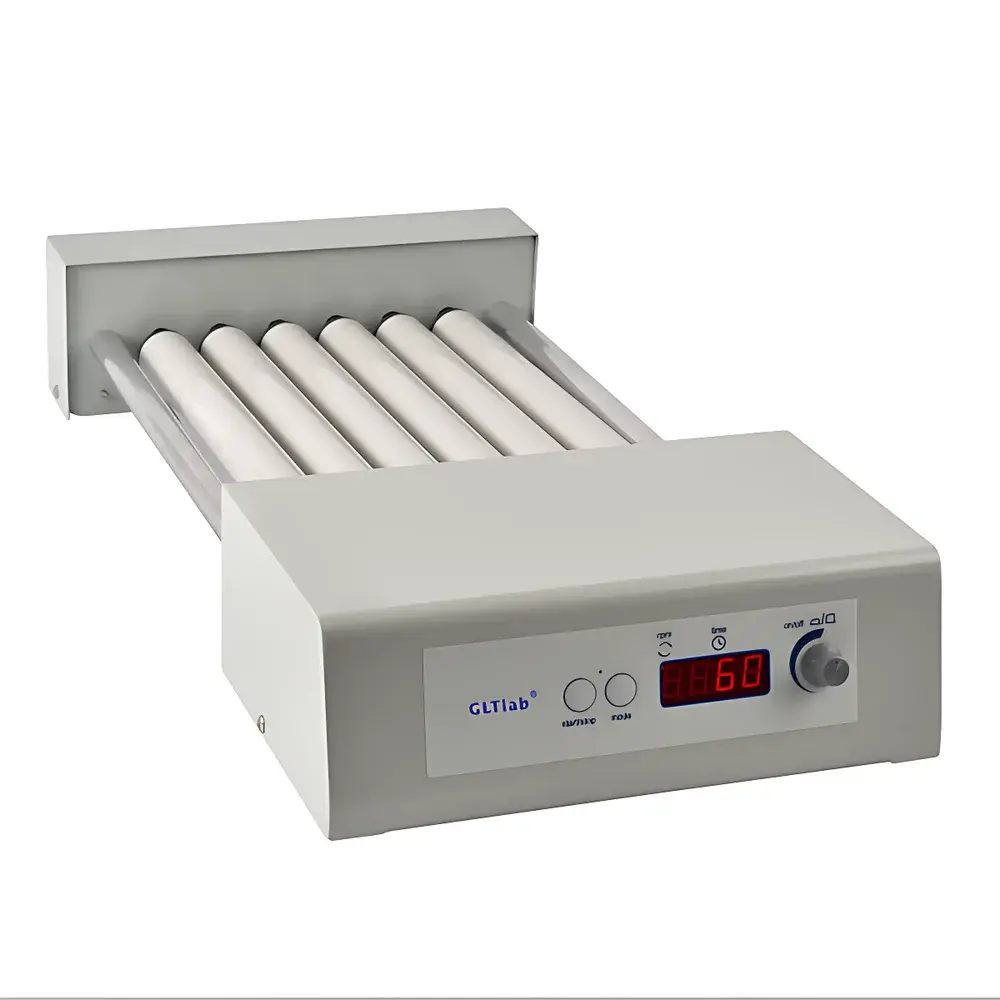
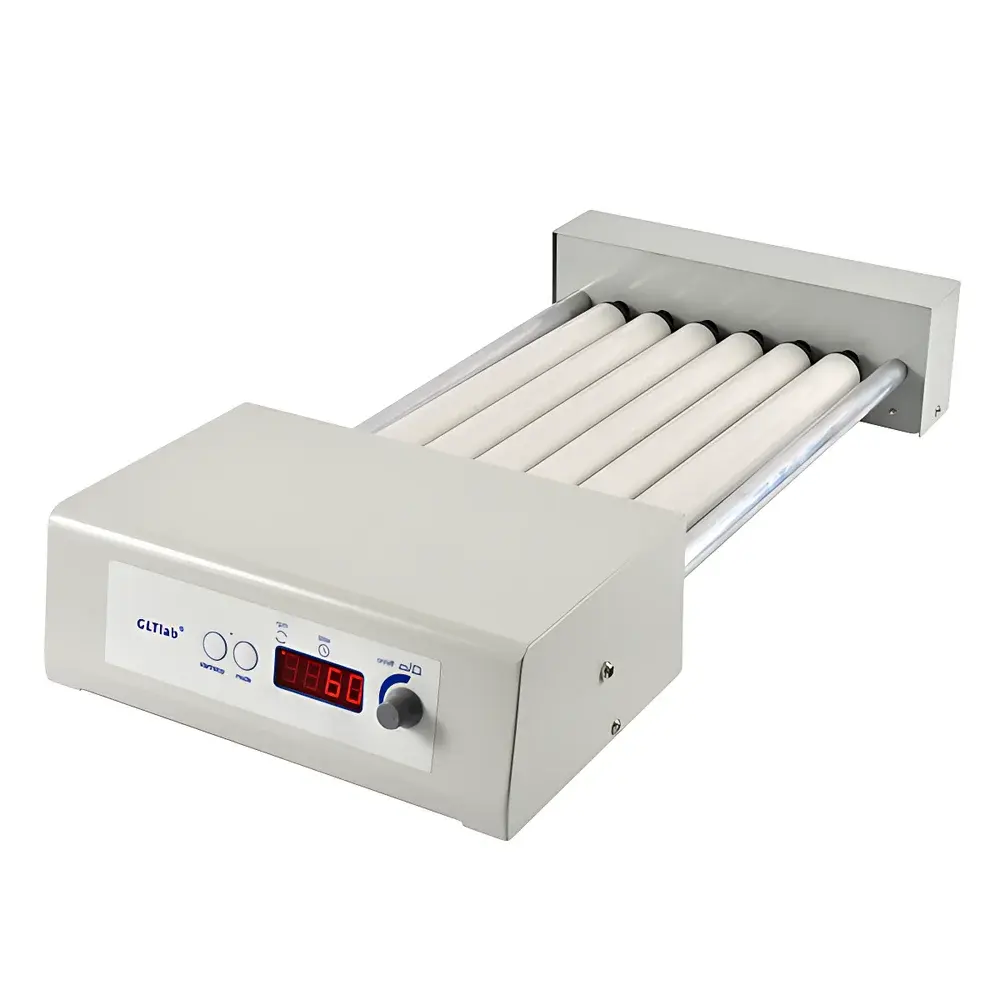
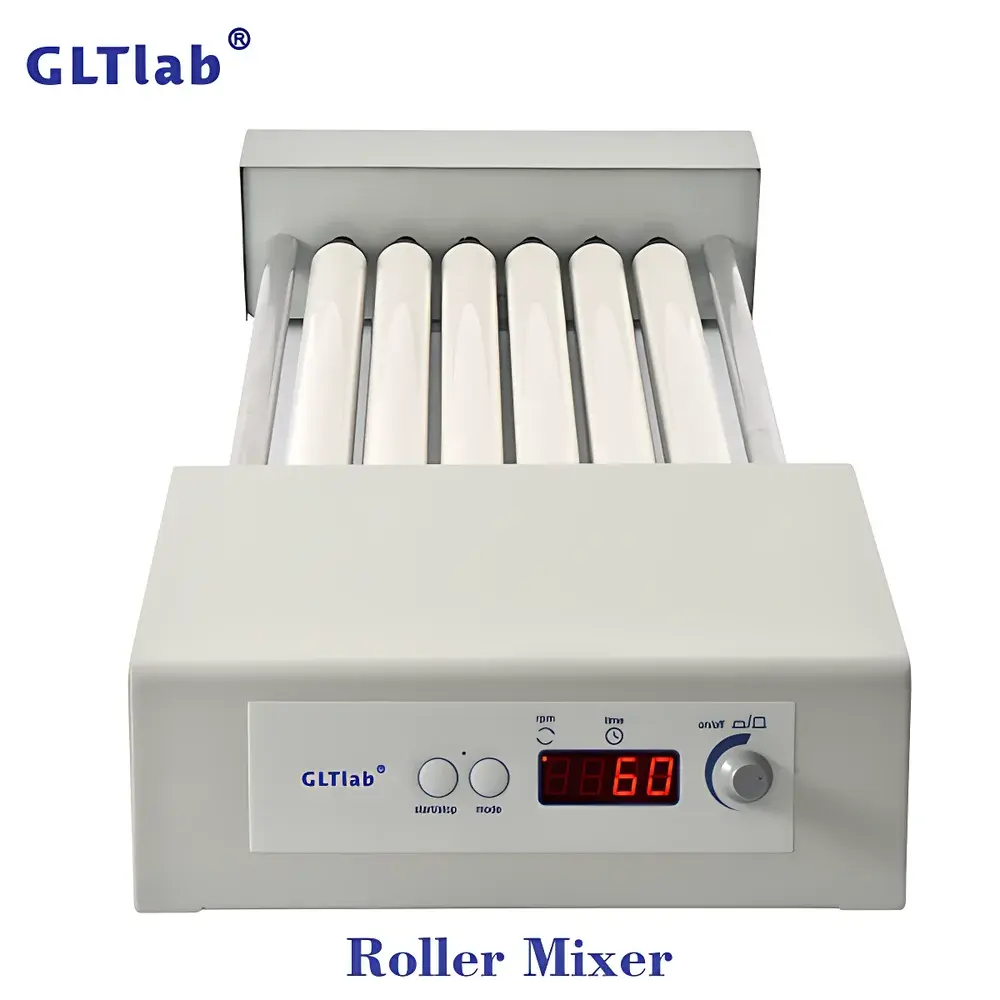
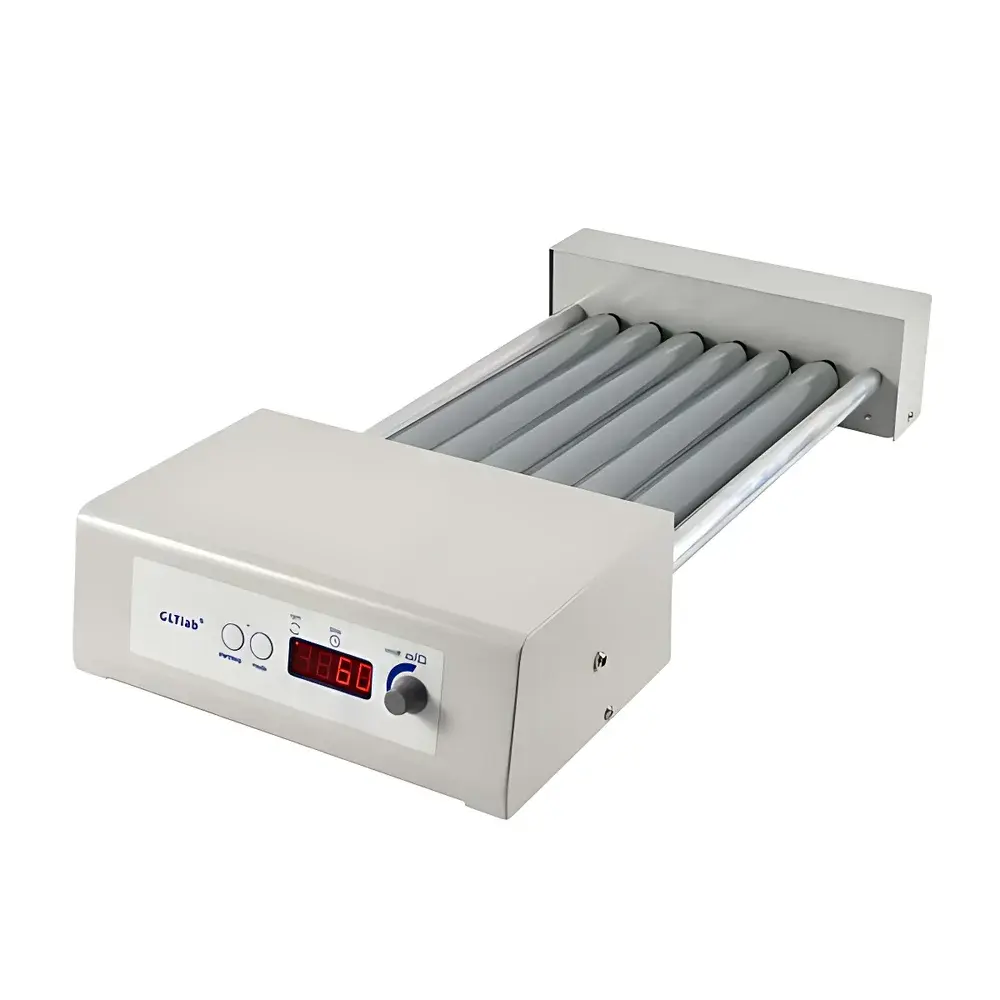
GLTLab MTR-1D 6-Axis Digital Orbital Roller Mixer
| Brand | GLTLab |
|---|---|
| Origin | Guangdong, China |
| Manufacturer Type | Direct Manufacturer |
| Product Origin | Domestic (China) |
| Model | MTR-1D |
| Speed Range | 5–300 rpm |
| Rolling Modes | Orbital Oscillation & Pure Rotation |
| Rollers | 6 |
| Load Capacity | 10 kg |
| Roller Dimensions | 340 × 30 mm (L × D) |
| Unit Dimensions (D×W×H) | 556 × 286 × 98 mm |
| Net Weight | 7 kg |
| Power Supply | DC 12 V, 5 A |
| Timer Range | 1–200 hours |
| Direction Alternation Interval | 1–15 min |
| Bidirectional Operation | Clockwise & Counterclockwise |
Overview
The GLTLab MTR-1D is a precision-engineered 6-axis digital orbital roller mixer designed for consistent, low-shear homogenization of biological, chemical, and pharmaceutical samples. It operates on dual kinematic principles: (1) orbital oscillation—where the roller axis is offset relative to the central drive shaft, inducing gentle vertical displacement during rotation—to facilitate efficient mixing of viscous fluids, blood derivatives, cryopreserved suspensions, and heterogeneous liquid-solid dispersions; and (2) pure axial rotation—where the roller axis aligns with the drive center—optimized for dry powder blending, granule homogenization, and uniform particle redistribution. Unlike conventional tumbling or vortex mixers, the MTR-1D eliminates reliance on tube-specific adapters or clamps, accommodating a broad range of cylindrical vessels—from 0.5 mL microcentrifuge tubes to 50 mL conical tubes—without mechanical reconfiguration. Its modular roller architecture supports field-adjustable inter-roller spacing, enabling compatibility with oversized containers when required.
Key Features
- Dual-mode operation: Selectable orbital oscillation (for shear-sensitive samples) or pure rotational mixing (for powders and granular media) via intuitive front-panel controls.
- High-resolution digital speed control: Precise adjustment from 5 to 300 rpm in 1-rpm increments—exceeding the performance ceiling of legacy analog rollers limited to ≤80 or ≤120 rpm.
- Bidirectional programmability: Independent clockwise and counterclockwise rotation modes, with user-defined alternation intervals (1–15 minutes) to prevent sedimentation bias and enhance mixing symmetry.
- Extended timer functionality: Programmable run durations up to 200 hours, supporting unattended overnight or multi-shift protocols in QC laboratories and biobanking workflows.
- Modular roller design: Individual roller assemblies can be physically repositioned to increase inter-roller clearance—enabling accommodation of large-diameter tubes or custom sample carriers without hardware modification.
- Robust mechanical architecture: All-metal chassis, sealed DC motor (12 V / 5 A), and low-noise gear train engineered for continuous-duty operation under ISO Class 5–7 cleanroom-compatible conditions.
Sample Compatibility & Compliance
The MTR-1D accommodates standard laboratory consumables including polypropylene and glass tubes (0.5–50 mL), PCR strips, multi-well plates (when placed in compatible cradles), and cryovials. Its low-vibration, non-impact mixing mechanism preserves cellular integrity in whole-blood and PBMC preparations, meets ASTM D4067-22 requirements for suspension homogeneity testing, and supports USP and compounding workflow validation. While not certified to IEC 61000-6-2/6-3, its electromagnetic emissions fall within Class B limits for laboratory equipment per FCC Part 15 Subpart B. The device complies with GB/T 14710-2009 environmental adaptability standards for domestic medical and analytical instrumentation.
Software & Data Management
The MTR-1D operates via embedded firmware with no external software dependency. All operational parameters—including speed, direction sequence, alternation interval, and total runtime—are stored in non-volatile memory and retained after power cycling. Though it lacks USB or Ethernet connectivity, its deterministic digital control architecture ensures full repeatability across instruments, supporting GLP-compliant recordkeeping when paired with lab notebook entries or LIMS-integrated manual logging. Audit trails are maintained through timestamped parameter change logs accessible via service mode (password-protected), satisfying basic 21 CFR Part 11 traceability prerequisites for non-networked instruments.
Applications
- Blood bank operations: Uniform resuspension of RBC concentrates and platelet-rich plasma prior to transfusion or analysis.
- Cryopreservation workflows: Controlled thawing and homogenization of frozen cell suspensions without thermal shock or foaming.
- Pharmaceutical QA/QC: Homogenization of suspension formulations (e.g., oral suspensions, topical gels) for content uniformity testing per USP .
- Materials science: Blending of nanoparticle dispersions, polymer precursor solutions, and ceramic slurries where laminar flow preservation is critical.
- Molecular biology: Gentle mixing of binding/wash buffers with magnetic bead-based assays to maximize capture efficiency while minimizing bead aggregation.
FAQ
What types of containers are compatible with the MTR-1D without adapters?
Standard round-bottom tubes (0.5–50 mL), cryovials, PCR strip tubes, and small-diameter glass vials—all secured solely by gravity and surface friction against the rollers.
Can the MTR-1D be used for temperature-controlled applications?
No. The unit is not equipped with integrated heating or cooling; however, it is compatible with externally temperature-regulated enclosures (e.g., cold rooms or incubator chambers) when operated within ambient ranges of 10–35°C and ≤80% RH.
How does the orbital oscillation mode differ mechanically from standard rotary mixers?
The eccentric mounting of the roller shaft introduces a sinusoidal vertical displacement (~±1.2 mm peak-to-peak at 300 rpm), generating mild inertial agitation that enhances mass transfer in high-viscosity media without introducing turbulent shear.
Is the MTR-1D suitable for GMP-regulated environments?
Yes—its deterministic control logic, absence of firmware updates during operation, and parameter retention support IQ/OQ documentation. Full validation requires site-specific risk assessment per Annex 15 and internal SOP alignment.
What maintenance is required for long-term reliability?
Annual inspection of roller bearing preload and motor brush wear (if applicable); no lubrication is required under normal use. Clean rollers with isopropyl alcohol and lint-free wipes to prevent residue buildup affecting grip consistency.



