
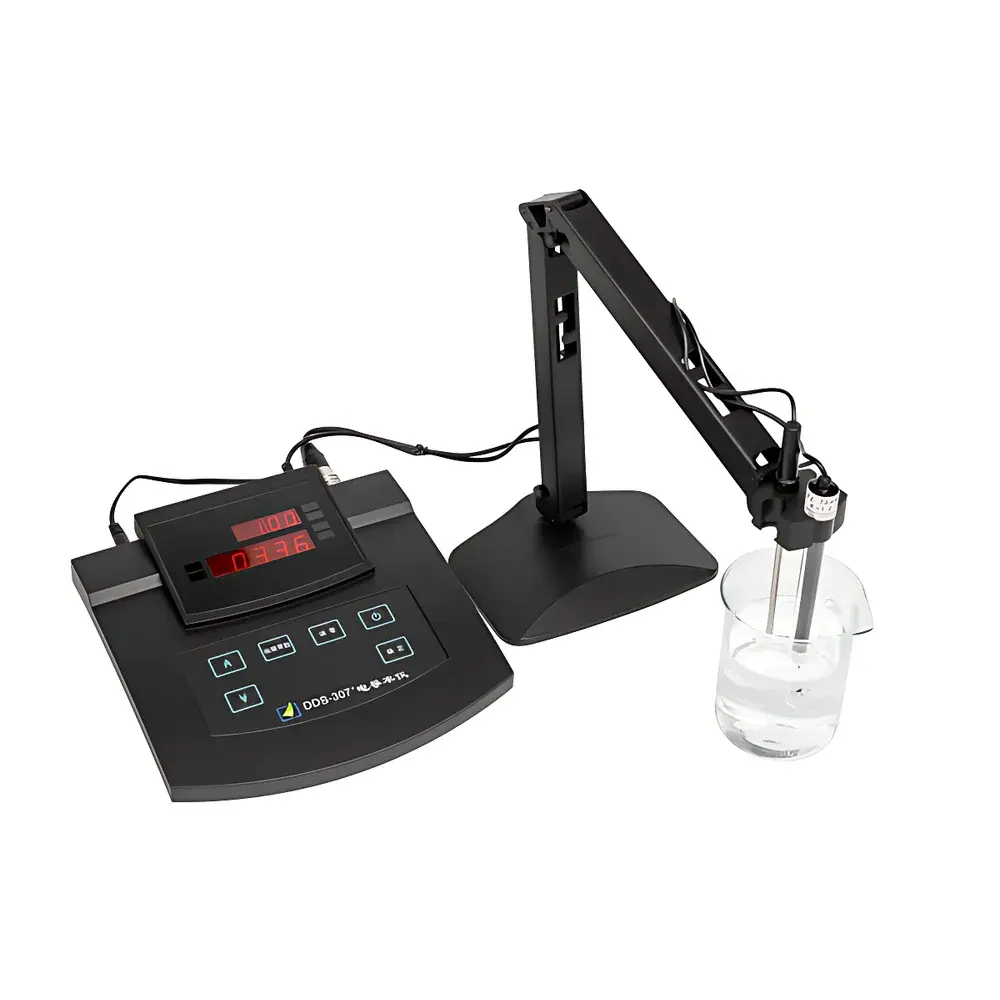
FangZhou DDS-307 Benchtop Conductivity Meter
| Brand | FangZhou |
|---|---|
| Origin | Sichuan, China |
| Manufacturer Type | Authorized Distributor |
| Product Origin | Domestic (China) |
| Model | DDS-307 |
| Detection Parameter | Single-parameter (Conductivity) |
| Form Factor | Benchtop |
| Intended Use | Laboratory |
| Conductivity Range | 0–2×10⁵ µS/cm |
| TDS Range | Not Supported |
| Resistivity Range | Not Supported |
| Salinity Range | Not Supported |
| Temperature Range | −5.0 to 105.0 °C |
| Accuracy | ±1.0% FS |
| Minimum Resolution | 0.001 µS/cm |
| Instrument Class | 1.0 |
| Temperature Compensation | Manual |
| Auto-ranging | 7-step |
| Electrode Compatibility | DJS-0.01, DJS-0.1, DJS-1.0, DJS-10.0 |
| Interface | BNC electrode port, Pt1000 temperature input, RS232 serial output |
Overview
The FangZhou DDS-307 Benchtop Conductivity Meter is a precision-engineered electrochemical instrument designed for routine and quality-controlled conductivity measurements in laboratory environments. It operates on the principle of two-electrode AC conductometry, applying a low-voltage, frequency-modulated excitation signal to minimize polarization effects and electrode fouling—critical for stable readings across diverse aqueous samples. Engineered for reproducibility and long-term stability, the DDS-307 features a high-resolution analog-to-digital converter (A/D), microprocessor-based signal processing, and integrated hardware architecture that ensures consistent performance under variable ambient conditions. Its design complies with general requirements for laboratory-grade conductivity instrumentation as defined in ISO 7888 (Water quality — Determination of electrical conductivity) and supports foundational compliance workflows aligned with GLP (Good Laboratory Practice) documentation protocols.
Key Features
- Seven-step automatic range switching enables seamless measurement across six decades of conductivity—from ultra-low 0.000 µS/cm (with DJS-0.01 cell) up to 200.00 mS/cm (with DJS-10.0 cell)—without manual gain adjustment.
- Manual temperature compensation (0.0–100.0 °C) allows user-defined β coefficient entry (typically 1.9–2.4 %/°C) to align with sample-specific thermal response characteristics, supporting accurate normalization per ISO 7888 Annex A.
- Dedicated support for four standardized cell constants (0.01, 0.1, 1.0, and 10.0 cm⁻¹) via interchangeable DJS-series electrodes; optional DJS-0.01 sensor with flow-through cell enables reliable measurement of ultrapure water (UPW) and pharmaceutical-grade water (PW/WFI) per USP .
- Ruggedized housing with IP54-rated enclosure provides resistance to chemical splashes and dust ingress, suitable for shared lab benches or QC environments handling aggressive buffers or saline solutions.
- RS232 serial interface facilitates direct data export to LIMS or spreadsheet applications; firmware supports ASCII-based command-response protocol for integration into automated test sequences.
- Calibration verification traceability: Each unit ships with calibration certificate referencing NIST-traceable KCl standards (e.g., 1413 µS/cm at 25 °C), and internal diagnostics log last calibration date, electrode ID, and deviation from reference value.
Sample Compatibility & Compliance
The DDS-307 is validated for use with aqueous electrolyte solutions including tap water, wastewater effluents, boiler feedwater, nutrient media, and buffer preparations. It is not intended for non-aqueous solvents, highly viscous fluids, or suspensions. While the instrument itself does not carry CE or UKCA marking, its electrical safety design conforms to IEC 61010-1:2010 (Measurement, control and laboratory equipment – Safety requirements). For regulated environments, users may configure audit trails via external software logging of RS232 output, satisfying basic FDA 21 CFR Part 11 record-keeping prerequisites when paired with timestamped, user-authenticated acquisition systems.
Software & Data Management
No proprietary PC software is bundled; however, the RS232 interface outputs real-time ASCII data packets containing conductivity (µS/cm or mS/cm), temperature (°C), cell constant (cm⁻¹), and measurement status flags. Third-party tools—including LabVIEW drivers, Python pySerial scripts, or Excel’s “Get External Data” function—can parse these streams for trend analysis, SPC charting, or batch reporting. Internal memory retains only the most recent calibration parameters and user-set temperature coefficient; persistent data storage requires external capture.
Applications
- Environmental monitoring labs verifying compliance with national discharge limits (e.g., China’s GB 3838-2002 or EU WFD conductivity thresholds).
- Pharmaceutical water system validation, particularly for conductivity mapping of distribution loops using DJS-0.01 cells per USP Stage 1 and Stage 2 testing.
- Educational laboratories teaching fundamental electrochemistry concepts, including Kohlrausch’s law, molar conductivity, and temperature dependence of ionic mobility.
- Food & beverage QA/QC for incoming ingredient screening (e.g., brine concentration, syrup dilution verification) and cleaning-in-place (CIP) rinse water verification.
- Industrial process support for demineralization system monitoring, RO permeate quality checks, and cooling tower conductivity trending.
FAQ
Does the DDS-307 support automatic temperature compensation (ATC)?
No—it provides manual temperature compensation only. Users must input the sample temperature or use an external Pt1000 probe; no built-in thermistor or auto-sensing capability is included.
Can this meter measure TDS or salinity?
No. The DDS-307 is a single-parameter conductivity-only instrument. TDS and salinity calculations are omitted from firmware; no conversion algorithms or selectable units (e.g., ppm, ppt) are implemented.
What calibration standards are recommended?
NIST-traceable KCl solutions: 84 µS/cm (for low-range verification), 1413 µS/cm (standard mid-range), and 12.88 mS/cm (high-range). Calibration should be performed at 25.0 °C or corrected using the entered β coefficient.
Is the instrument suitable for field use?
It is benchtop-formatted with AC power requirement (100–240 VAC, 50/60 Hz) and lacks battery operation or ruggedized transit casing—therefore not designed for portable or mobile deployment.
How is compliance with ISO 7888 ensured?
By adhering to specified electrode geometry, frequency selection (typically 1 kHz), and temperature normalization procedures outlined in the standard; users must validate cell constant accuracy independently using certified reference solutions.




