
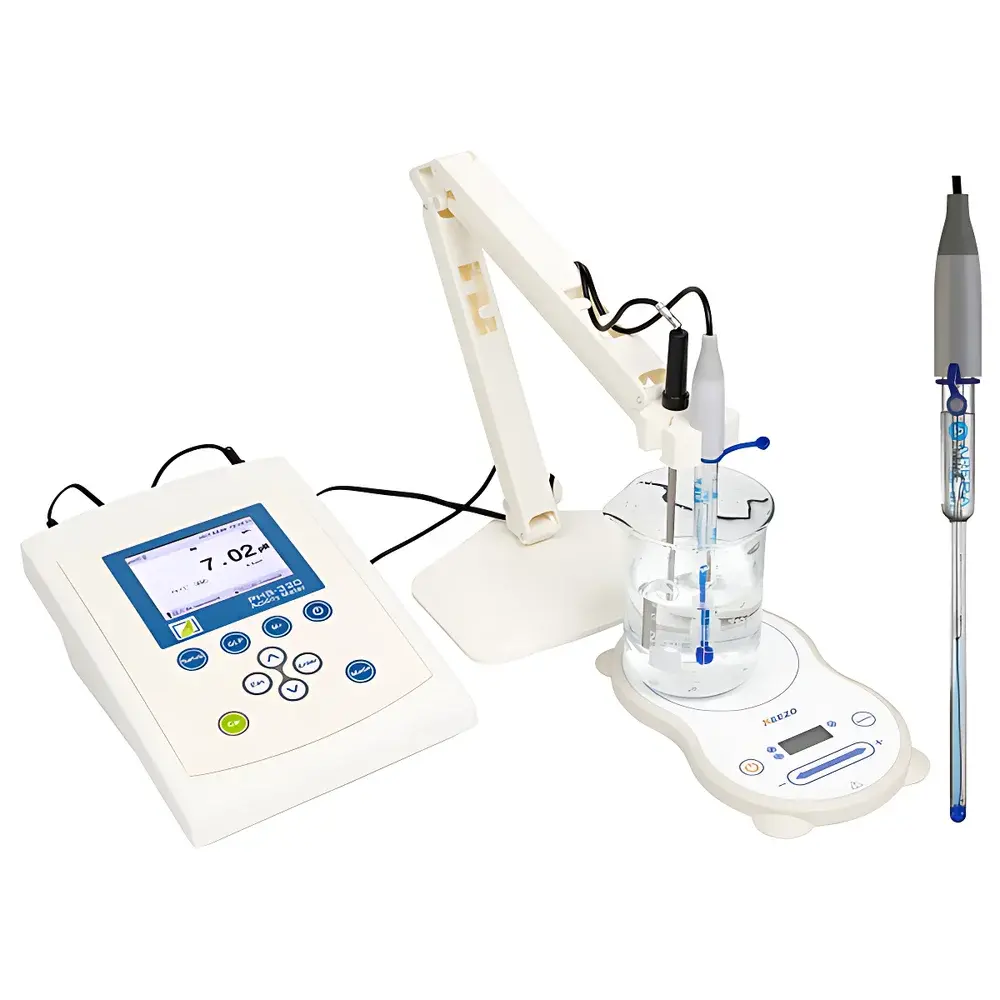
FangZhou PHS-320 Micro-Sample pH Meter
| Brand | FangZhou |
|---|---|
| Origin | Sichuan, China |
| Manufacturer Type | Authorized Distributor |
| Product Category | Domestic |
| Model | Micro-Sample pH Meter |
| Instrument Type | Multi-Function |
| Parameter Types | pH, mV, Rel.mV, ORP, ISE, Temperature |
| Measurement Accuracy | ±0.002 pH |
| pH Range | (−5.000 to 20.000) pH |
| Resolution | 0.001 / 0.01 / 0.1 pH (adjustable) |
| mV Range | (−2000.00 to 2000.00) mV |
| mV Resolution | 0.01 / 0.1 / 1 mV (adjustable) |
| Temperature Range | (−20.0 to 135.0) °C |
| Temp. Resolution | 0.1 °C |
| Temp. Accuracy | ±0.2 °C ±1 digit |
| Input Impedance | ≥3 × 10¹² Ω |
| Calibration Points | 1–5 point auto-recognized calibration |
| Buffer Standards | NIST, DIN 19266/19267, JIS Z8802, ASTM D1293, USP <791>, ISO 3696 |
| GLP Compliance | Full audit trail, sample/personnel ID (10 each), timestamped data logging |
| Data Storage | ≥100,000 entries |
| Interface | RS232 with printer/PC bidirectional protocol |
| Power | DC 9 V, 500 mA (center-positive) |
Overview
The FangZhou PHS-320 Micro-Sample pH Meter is a microprocessor-controlled, high-precision electrochemical instrument engineered for laboratory-grade measurement of hydrogen ion activity in ultra-low-volume and challenging samples. Based on the fundamental principle of potentiometric measurement—detecting the potential difference between a glass pH electrode and a reference electrode—the PHS-320 delivers trace-level resolution and metrological stability across extreme pH ranges (−5.000 to 20.000). Its design addresses critical limitations of conventional pH meters when handling microvolumes (as low as 15 µL), low-conductivity matrices (e.g., ultrapure water, biological buffers), viscous or heterogeneous media (e.g., gels, emulsions, soil suspensions), and surface-bound applications (e.g., agar plates, skin, textiles). The instrument complies with core metrological frameworks including ISO/IEC 17025–aligned validation practices, USP pH measurement guidelines, and ASTM D1293 for water analysis, ensuring data integrity for regulated environments.
Key Features
- True-color TFT LCD display with graphical real-time curve visualization and intuitive menu navigation
- Adjustable resolution modes: 0.001 pH / 0.01 mV (high-precision mode) or coarser steps for rapid screening
- Five adaptive measurement modes: Real-time, Timed, Auto-Fast, Auto-Medium, and Auto-Slow—optimized for kinetic stability in low-buffering or high-resistance samples
- Integrated electrode diagnostics: continuous impedance monitoring, junction status assessment, and slope/offset validation per calibration cycle
- Isopotential adjustment (−20.000 to +20.000 pH) enabling compatibility with non-standard zero-potential reference electrodes
- Automatic temperature compensation (ATC) with dual-mode support: integrated Pt1000 sensor or manual input; compensation range −20.0 to 135.0 °C
- Seven preloaded buffer groups (33 total standards), including NIST-traceable, DIN, JIS, and USP-compliant solutions, with auto-recognition and 1–5 point calibration
- Input impedance ≥3 × 10¹² Ω ensures minimal loading error during high-impedance measurements (e.g., pure water, cell lysates)
Sample Compatibility & Compliance
The PHS-320 supports methodologically diverse sample types through application-specific electrode configurations—each validated for defined matrix challenges. Optional probes include semi-micro (≥200 µL), micro (≥15 µL), flat-surface, food-grade stainless steel puncture, HF-resistant, alkaline-resistant, and low-conductivity optimized electrodes. All configurations maintain compliance with Good Laboratory Practice (GLP) requirements: full audit trail (sample ID, operator ID, timestamp, calibration log, electrode history), electronic signature readiness, and data immutability per 21 CFR Part 11 principles. The system meets ISO 9001:2015 certified manufacturing controls and aligns with environmental testing standards (e.g., EPA Method 9040C) and pharmaceutical water specifications (USP Purified Water, Water for Injection).
Software & Data Management
Data acquisition and export are governed by a robust RS232 interface supporting three interoperable operational modes: (1) Direct printing via thermal or dot-matrix printers using configurable report templates (Simple, Standard, GLP-compliant, or user-defined); (2) Bidirectional PC communication with native protocol support for Microsoft Excel, Word, and plain-text import—enabling automated statistical analysis, trend mapping, and comparative reporting; (3) Remote instrument control and firmware updates. Internal memory stores ≥100,000 timestamped records with full metadata. GLP settings enforce mandatory fields (operator ID, sample ID, calibration verification), while timed storage intervals (0–6000 s) accommodate kinetic studies. All exported data retain embedded calibration certificates and environmental context (temperature, buffer used, electrode ID).
Applications
- Biopharmaceutical QC: pH monitoring of cell culture media, protein purification buffers (TRIS, PBS), and final drug product formulations
- Molecular biology: RNA/DNA solution pH verification in PCR master mixes and microarray hybridization buffers (≥15 µL volume)
- Food & beverage safety: Surface pH of cheeses, fruits, and baked goods; viscosity-compensated measurements in sauces and dairy emulsions
- Environmental analysis: Soil pore-water extraction, wastewater effluent profiling, and low-ionic-strength groundwater characterization
- Materials science: pH mapping of hydrogels, polymer coatings, and battery electrolytes under controlled thermal conditions
- Academic research: Teaching labs requiring NIST-traceable calibration, reproducible ISE measurements (e.g., F⁻, Cl⁻), and multi-parameter correlation studies
FAQ
What sample volumes can the PHS-320 accurately measure?
The instrument supports volumes as low as 15 µL when paired with the optional micro-pH electrode (model 320-08), and ≥200 µL with the semi-micro electrode (320-07). Volume-dependent accuracy is maintained via optimized junction geometry and low-drift reference systems.
Does the PHS-320 meet FDA 21 CFR Part 11 requirements?
While the hardware supports audit-trail generation, electronic signatures, and data immutability, full Part 11 compliance requires site-specific validation protocols, including role-based access control and secure network configuration—both achievable through documented IQ/OQ/PQ procedures.
Can it measure non-aqueous or high-viscosity samples?
Yes—when equipped with the dedicated viscous-sample electrode (320-06), the system compensates for slow diffusion kinetics and junction clogging via extended stabilization algorithms and reinforced double-junction architecture.
How does the isopotential adjustment enhance measurement flexibility?
It allows users to offset the theoretical zero-potential point (7.000 pH at 25 °C) to match non-standard reference electrodes (e.g., Ag/AgCl in non-KCl fill solutions), preserving Nernstian response in specialized electrochemical setups.
Is temperature compensation fully automatic?
The PHS-320 supports both ATC (via integrated Pt1000 probe) and manual temperature entry. Automatic mode applies the standard Nernst equation correction factor across −20.0 to 135.0 °C, with user-selectable temperature coefficients for non-standard electrolytes.






