
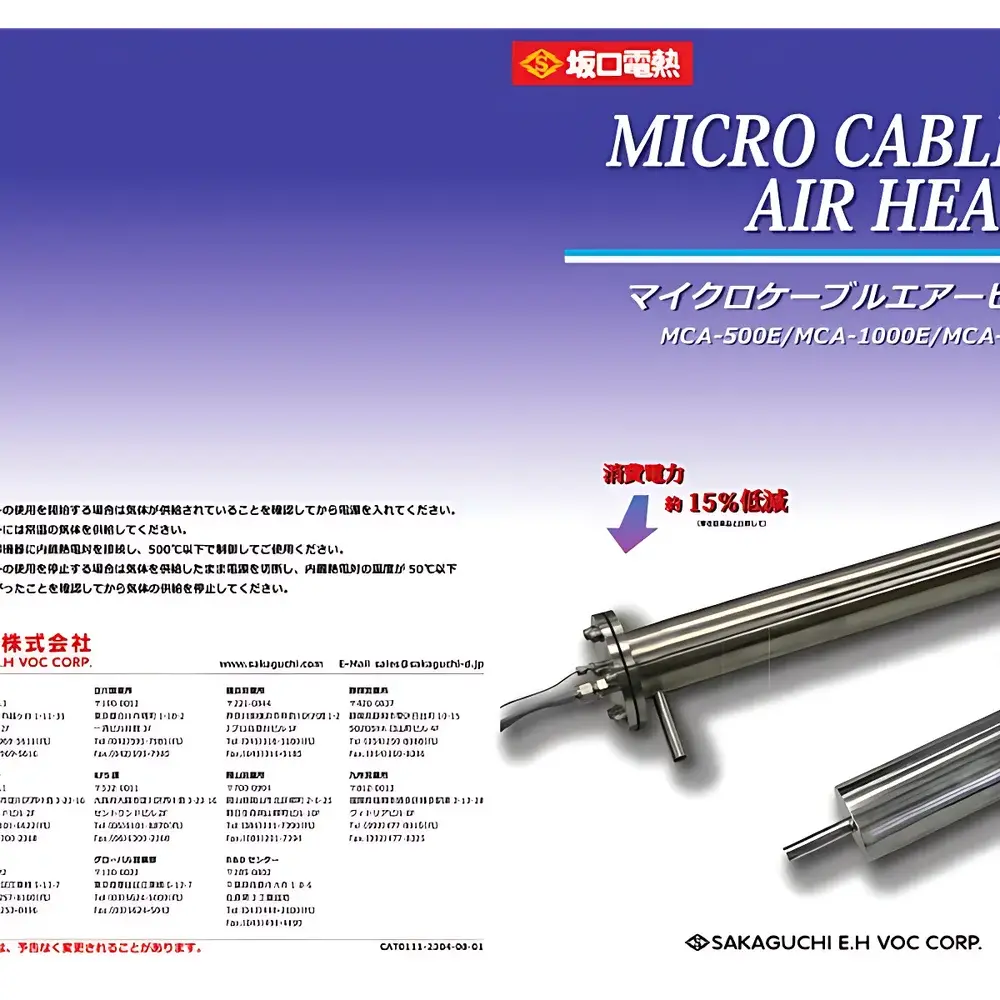
Sakaguchi MCA-1500E Micro-Cable Air Heater by Asahi Sokki
| Brand | Asahi Sokki |
|---|---|
| Origin | Japan |
| Model | MCA-1500E |
| Heating Capacity | 1.5 kW |
| Operating Voltage | Single-phase 200 V AC |
| Temperature Range | 80–500 °C |
| Air Flow Rate | 20–200 Nℓ/min |
| Maximum Operating Pressure | 0.3 MPa |
| Sheath Material | SUS (AISI 304 or equivalent) |
| Insulation Resistance | ≥5 MΩ @ 500 V DC |
| Dielectric Strength | 400 V AC, 1 min, leakage current ≤10 mA |
| Surface Temperature | Reduced via optimized thermal design |
| Energy Efficiency | ~15% lower power consumption vs. conventional air heaters |
Overview
The Sakaguchi MCA-1500E Micro-Cable Air Heater is a precision-engineered, compact industrial heating solution developed by Asahi Sokki Co., Ltd. (Japan) for controlled, high-efficiency heating of gaseous media—primarily ambient air and inert gases such as nitrogen—within process-critical environments. Unlike conventional finned-tube or ceramic-element air heaters, the MCA-1500E employs a proprietary micro-cable heating architecture: a tightly wound, mineral-insulated (MI) resistance wire is embedded within a flexible, stainless-steel-sheathed cable and precisely inserted into a SUS 304 outer tube (φ48.6 mm × 156 mm total length). This coaxial, low-thermal-mass configuration enables rapid thermal response (<30 s to reach stable setpoint), minimal surface temperature rise on the heater housing, and exceptional heat transfer efficiency to the flowing gas stream. The integrated K-type thermocouple (also SUS-sheathed) provides real-time, in-line temperature feedback compatible with PID-based process controllers. Designed for continuous-duty operation up to 500 °C internal element temperature, the unit complies with fundamental safety requirements for Class I, Division 2 hazardous locations when installed per manufacturer guidelines.
Key Features
- Micro-cable heating element: High-density, MI-type resistive wire coiled within a flexible SUS sheath—enabling uniform axial heat distribution and mechanical resilience under thermal cycling.
- Optimized thermal coupling: Direct contact between the heated cable and inner wall of the SUS air duct ensures >92% thermal transfer efficiency, reducing standby losses and improving dynamic control fidelity.
- Low external surface temperature: Housing remains ≤85 °C at full load (measured 25 mm from outlet), minimizing radiation loss and enhancing operator safety in confined installations.
- Energy-efficient operation: Verified 15% reduction in power draw versus legacy coil-type air heaters delivering equivalent thermal output under identical flow and ΔT conditions.
- Rugged construction: Entire assembly—including outer casing, flexible heater, and armored thermocouple—is fabricated from corrosion-resistant SUS 304 stainless steel, suitable for cleanroom and semiconductor-grade gas lines.
- Compact footprint: Total length of 156 mm and outer diameter of φ48.6 mm enable integration into tight spaces, including inline gas purification modules and wafer processing tool manifolds.
Sample Compatibility & Compliance
The MCA-1500E is validated for use with dry, particle-free air and inert gases (N₂, Ar, He) across flow rates of 20–200 Nℓ/min and pressures up to 0.3 MPa (3 bar gauge). It is not rated for combustible, corrosive, or moisture-laden streams without upstream conditioning. While not certified to UL/CSA or ATEX standards out-of-the-box, its construction adheres to JIS C 5441 (Industrial Electric Heaters) and meets baseline requirements for ISO 14644-1 Class 5 cleanrooms when installed with appropriate filtration and leak-tight flange connections (e.g., VCR or Swagelok®). The unit supports traceable calibration per ISO/IEC 17025 when paired with an accredited thermocouple calibrator.
Software & Data Management
As a stand-alone analog heater, the MCA-1500E does not include embedded firmware or digital interfaces. It operates as a passive thermal actuator requiring external control—typically via a DIN-rail-mounted PID controller (e.g., Yokogawa UT550, Eurotherm 2408) with 4–20 mA setpoint input and thermocouple feedback loop. For systems requiring auditability, integration with PLC-based SCADA platforms (Siemens SIMATIC, Rockwell ControlLogix) enables full data logging, alarm history, and 21 CFR Part 11-compliant electronic records when paired with FDA-validated HMI software and timestamped I/O modules.
Applications
- Semiconductor manufacturing: Pre-heating purge gases in CVD, PECVD, and ALD tool chambers to stabilize deposition kinetics.
- Analytical instrumentation: Providing stable, contamination-free carrier gas heating for GC-FID, GC-TCD, and FTIR gas cells.
- Materials testing: Conditioning environmental test chamber inlets for humidity-controlled thermal cycling per ASTM E1525 or ISO 16750-4.
- Research laboratories: Generating calibrated hot-air streams for catalyst activity screening, polymer drying kinetics, and MEMS packaging validation.
- Medical device sterilization: Supporting low-pressure steam-air mixture generation in ethylene oxide (EtO) pre-conditioning stages where metallic purity and thermal repeatability are critical.
FAQ
What gases are compatible with the MCA-1500E?
Dry, filtered air and inert gases (N₂, Ar, He) only. Avoid O₂-rich, H₂, NH₃, Cl₂, or any condensable vapor.
Can the heater be used in vacuum environments?
No—it requires convective gas flow for cooling and heat transfer; operation under vacuum will cause rapid overheating and failure.
Is the built-in thermocouple replaceable in-field?
Yes—the K-type armored thermocouple is mechanically retained and electrically isolated; replacement requires recalibration against a reference standard.
Does Asahi Sokki provide CE or UKCA marking documentation?
The MCA-1500E is supplied as a component—not a complete apparatus—and therefore carries no CE/UKCA marking; end-equipment integrators bear conformity assessment responsibility.
What maintenance is required for long-term reliability?
Annual visual inspection for sheath discoloration or deformation; periodic verification of insulation resistance (>5 MΩ) and thermocouple EMF drift (<±1.5 °C over 500 °C range).



