
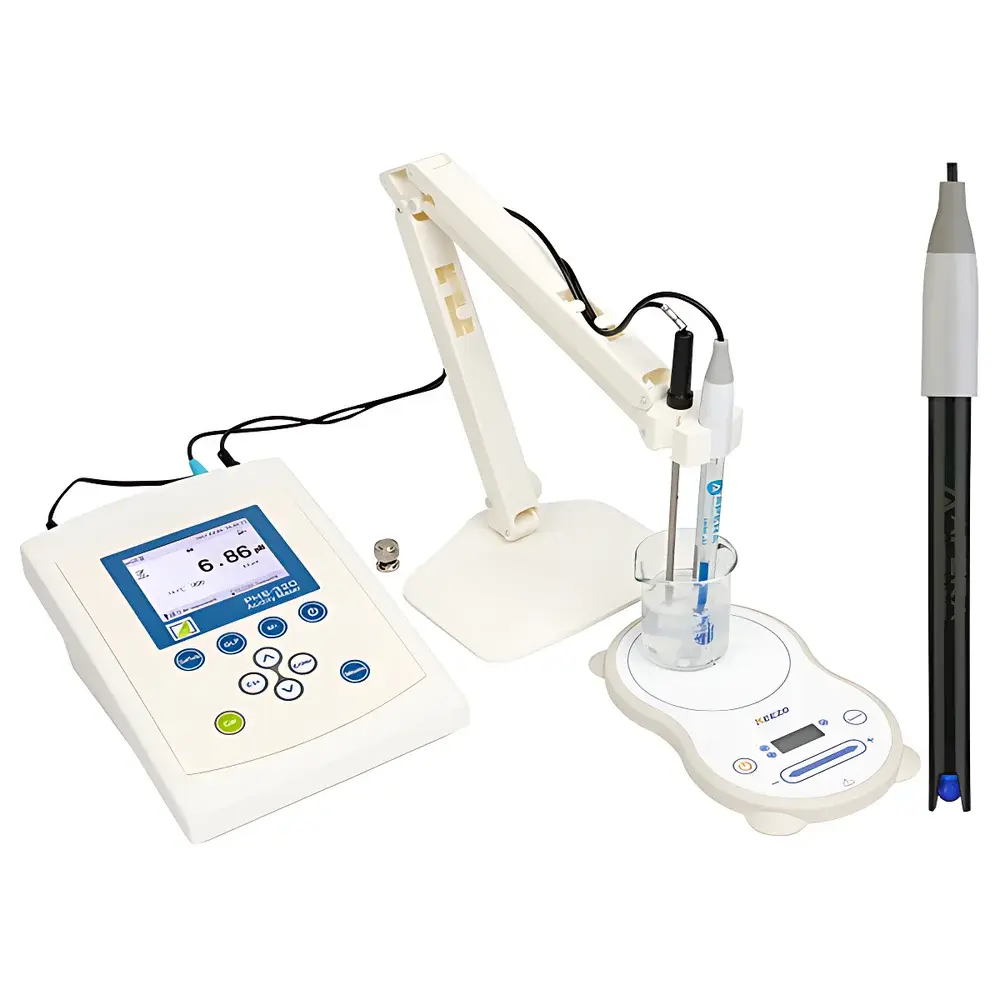
FangZhou PHS-320 Titanium Dioxide pH Meter
| Brand | FangZhou |
|---|---|
| Origin | Sichuan, China |
| Manufacturer Type | Authorized Distributor |
| Product Category | Domestic |
| Model | PHS-320 Titanium Dioxide pH Meter |
| Instrument Type | Multi-Function pH Meter |
| Parameter Types | pH, mV, Rel.mV, ORP, ISE, Temperature (°C) |
| Measurement Accuracy | ±0.002 pH |
| pH Range | (−5.000 to 20.000) pH |
| Resolution | 0.001 / 0.01 / 0.1 pH (user-selectable) |
| mV Range | (−2000.00 to 2000.00) mV |
| mV Resolution | 0.01 / 0.1 / 1 mV (user-selectable) |
| Temperature Range | (−20.0 to 135.0) °C |
| Temp. Resolution | 0.1 °C |
| Temp. Accuracy | ±0.2 °C ±1 digit |
| Input Impedance | ≥3 × 10¹² Ω |
| Calibration | Up to 5-point automatic buffer recognition (NIST, DIN, JIS, ASTM-compatible buffers |
| ATC | Automatic & Manual Temperature Compensation |
| GLP Compliance | Full GLP data logging with sample ID (10), operator ID (10), timestamp, calibration history, and electrode diagnostics |
| Data Storage | ≥100,000 measurements with internal non-volatile memory |
| Interface | RS232 serial port (printer output, PC data export to Excel/Word/Notepad, bidirectional control) |
| Power Supply | DC 9 V, 500 mA (center-positive) |
Overview
The FangZhou PHS-320 Titanium Dioxide pH Meter is a microprocessor-controlled, high-precision electrochemical instrument engineered for rigorous laboratory and industrial quality control applications—particularly in titanium dioxide (TiO₂) pigment manufacturing, where precise pH monitoring of slurry, wash water, surface treatment baths, and post-hydrolysis suspensions is critical to crystal phase stability, particle dispersion, and surface charge optimization. Based on the potentiometric principle, the instrument measures hydrogen ion activity via a glass pH electrode coupled with a reference electrode, delivering Nernstian response across an extended range of (−5.000 to 20.000) pH. Its design incorporates robust input impedance (>3 × 10¹² Ω) to minimize loading errors during low-conductivity or high-resistance measurements—common in TiO₂ process streams, purified rinse waters, and colloidal dispersions. The system supports both standard aqueous and non-aqueous pH determinations, with configurable resolution (0.001/0.01/0.1 pH) and dual-mode temperature compensation (ATC or manual), ensuring traceable, repeatable results under variable thermal conditions.
Key Features
- True-color TFT LCD display with graphical interface, real-time trend plotting, and intuitive menu navigation
- Multi-parameter capability: simultaneous measurement and display of pH, mV, Rel.mV, ORP, ISE (with optional ion-selective electrodes), and temperature
- High-resolution measurement: 0.001 pH and 0.01 mV selectable resolution—meeting ISO 8655 and ASTM E70 requirements for analytical-grade pH instrumentation
- Advanced calibration architecture: automatic recognition of up to 33 NIST-traceable, DIN-, JIS-, and USP-compliant buffer standards across 7 predefined groups; supports 1–5 point calibration with visual curve fitting and residual error reporting
- Comprehensive electrode diagnostics: real-time impedance monitoring, slope calculation (%), offset evaluation, and isopotential adjustment (−20.000 to +20.000 mV) for zero-potential electrode compatibility
- Five adaptive measurement modes: Real-time, Timed, Auto-Fast, Auto-Medium, and Auto-Slow—optimized for dynamic slurries, viscous pastes, and low-ionic-strength TiO₂ wash effluents
- GLP-compliant data management: full audit trail including sample ID (10 slots), operator ID (10 slots), date/time stamp, calibration logs, electrode history, and firmware version
Sample Compatibility & Compliance
The PHS-320 is validated for use with diverse sample matrices encountered in pigment, pharmaceutical, food, and environmental laboratories—including titanium dioxide slurries, deionized rinse water, acidic leachates, alkaline surface treatment baths, and low-conductivity colloids. Optional electrode configurations extend applicability to ultra-pure water (Type I–III), viscous gels (e.g., TiO₂ in silicone carriers), semi-micro volumes (≥200 µL), and micro-volume samples (≥15 µL in PCR tubes). All measurements adhere to international regulatory frameworks: data integrity complies with FDA 21 CFR Part 11 requirements when used with validated RS232 export protocols; calibration traceability aligns with ISO/IEC 17025 and NIST SRM guidelines; and operational documentation satisfies GLP and GMP audit expectations for QC release testing.
Software & Data Management
Data are stored internally in non-volatile memory (≥100,000 entries), each tagged with timestamp, sample/operator IDs, calibration status, and electrode diagnostic flags. The RS232 interface enables three interoperable workflows: (1) direct printing to thermal or dot-matrix printers using GLP-formatted reports; (2) bidirectional data transfer to Windows-based PCs—exporting raw datasets natively into Microsoft Excel (.csv), Word (.txt), or Notepad without proprietary software; and (3) remote instrument control via ASCII command protocol for integration into LIMS or automated test benches. All exported files retain embedded metadata required for regulatory submission, including instrument ID, firmware revision, sensor serial numbers, and calibration certificate references.
Applications
- pH monitoring of TiO₂ hydrolysis and calcination rinse cycles to control surface hydroxyl density and isoelectric point (IEP)
- Quality assurance of pigment dispersibility in coating formulations via zeta potential correlation studies
- Batch release testing of pharmaceutical excipients and biocompatible TiO₂ nanoparticles
- Environmental compliance verification of wastewater pH prior to discharge (EPA Method 9040C)
- Process validation of acid/base titrations in TiO₂ surface modification (e.g., silica/alumina coating baths)
- Stability testing of food-grade TiO₂ (E171) suspensions under varying ionic strength and temperature profiles
FAQ
Is the PHS-320 compliant with FDA 21 CFR Part 11 for electronic records?
Yes—when configured with time-stamped GLP logging, unique user authentication (via operator ID), and secure RS232 data export to validated spreadsheet environments, the system supports Part 11 compliance for record retention and audit trails.
Can it measure pH in low-conductivity TiO₂ rinse water?
Yes—the ≥3 × 10¹² Ω input impedance and adjustable measurement speed minimize drift and noise, enabling stable readings in ultrapure rinse streams (conductivity < 1 µS/cm).
Does it support automatic buffer identification per ISO 8655 Annex B?
Yes—its 7-group, 33-buffer library includes NIST, DIN 19266/19267, JIS Z8802, and ASTM D1293-compliant standards, with auto-recognition and slope/offset validation per ISO 8655-2:2022.
What electrode options are recommended for TiO₂ slurry measurements?
We recommend the FZ-600T heavy-duty combination electrode with ceramic junction and abrasion-resistant glass membrane, optionally fitted with a flow-through cell for continuous inline monitoring.
How is temperature compensation handled during rapid thermal transients?
The ATC function uses a Pt1000 RTD sensor with 0.1 °C resolution and ±0.2 °C accuracy; the algorithm applies real-time Nernst correction using the measured temperature at each sampling interval, not interpolated values.
Related Products






