
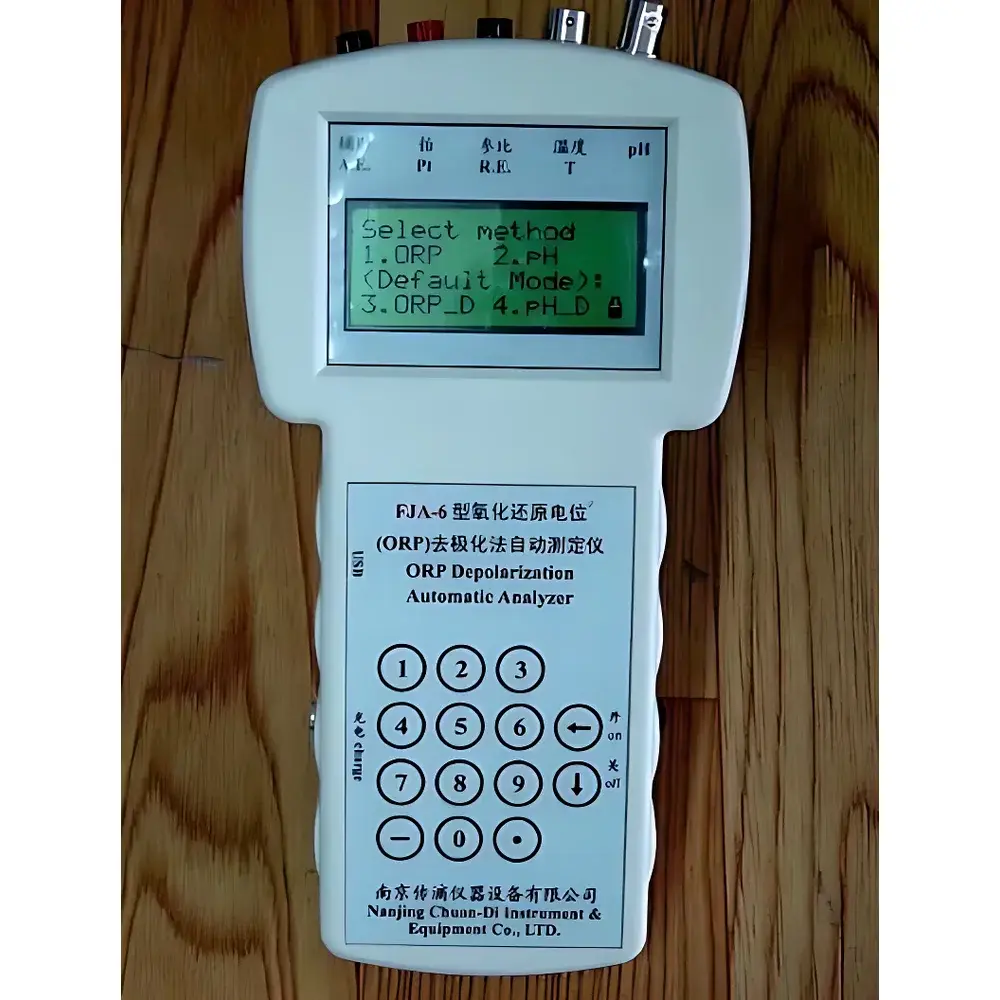
Chuandi FJA-6 Automated ORP Measurement System Using Polarization/Depolarization Method
| Brand | Chuandi |
|---|---|
| Model | FJA-6 |
| Measurement Principle | Polarization/Depolarization Potentiometry |
| ORP Range | ±1999.9 mV |
| Resolution | 0.1 mV |
| Accuracy | <10 mV |
| Input Impedance | >10¹⁰ Ω |
| Minimum Measurement Time | 2 min |
| Temperature Compensation | Automatic Ag/AgCl reference electrode potential lookup via integrated thermistor |
| Power Supply | Rechargeable 8.4 V Li-ion battery with protective charging circuit |
| Interface | USB for PC connectivity |
| Operating Modes | Standalone (field-deployable) or PC-synchronized |
| Data Output | Real-time depolarization curves (E vs. log t), automatic equilibrium potential calculation, CSV export |
| Compliance | Designed for ASTM D1129, ISO 10523, and USP <791> electrochemical measurement practices |
Overview
The Chuandi FJA-6 Automated ORP Measurement System is an engineered solution for high-fidelity determination of redox potential (Eh) in complex, kinetically sluggish media—including saturated soils, anaerobic sediments, microbial culture broths, and natural waters—where conventional platinum electrode potentiometry fails to reach true thermodynamic equilibrium. Unlike standard ORP meters relying on static open-circuit potential readings, the FJA-6 implements a rigorous polarization–depolarization protocol grounded in electrode kinetics. It applies controlled anodic and cathodic polarization (at user-selectable 600 mV or 750 mV overpotential) to the Pt working electrode using an Ag/AgCl auxiliary electrode, followed by timed depolarization phases (>20 s each). During depolarization, the system continuously records the decay of electrode potential versus the logarithm of time. The intersection point of the linearized anodic and cathodic depolarization curves yields the true equilibrium redox potential—free from surface oxide formation, adsorption artifacts, or slow electron-transfer kinetics that plague direct measurement. This method satisfies the theoretical framework established in classic electrochemical literature (e.g., Latimer’s “Oxidation States of the Elements”) and aligns with modern interpretations of mixed-potential theory in heterogeneous systems.
Key Features
- Automated dual-polarity polarization control: Precise timing of anodic and cathodic polarization (≥10 s) and subsequent depolarization (≥20 s)
- Real-time E–log(t) data acquisition at configurable sampling intervals (10–500 ms resolution)
- Onboard microcontroller (8-bit MCU with 64 KB flash) executing full curve fitting, linear regression, and equilibrium potential solving per IUPAC-recommended protocols
- Integrated Pt working electrode, double-junction saturated calomel reference (SCE) or Ag/AgCl reference, auxiliary Ag/AgCl counter electrode, and NTC thermistor (±0.2 °C accuracy)
- Automatic temperature compensation: Reference electrode potential corrected using NIST-traceable polynomial tables for Ag/AgCl (3 M KCl) across 0–50 °C
- Dual-mode operation: Fully autonomous field use (LCD interface, battery-powered) or PC-synchronized mode via USB 2.0 with proprietary Windows-compatible software
- Simultaneous measurement of ORP, temperature, and pH (when connected to optional pH probe)—all time-stamped and synchronized
- Internal data storage (2 MB flash) supports up to 10,000 measurement cycles; exportable as CSV or XLSX with metadata (date, location tag, operator ID, calibration logs)
Sample Compatibility & Compliance
The FJA-6 is validated for use in heterogeneous, low-conductivity, and biologically active matrices where charge transfer resistance dominates interfacial kinetics. It routinely delivers reproducible Eh values in paddy soil slurries (EC 100 mV and drift >5 mV/min. Instrument design adheres to IEC 61000-6-2 (EMC immunity) and IEC 61010-1 (safety for laboratory equipment). Data integrity meets FDA 21 CFR Part 11 requirements when used with audit-trail-enabled software configuration: all raw depolarization traces, regression coefficients (R² > 0.998 typical), and final Eh calculations are immutable and timestamped. Calibration verification follows ISO/IEC 17025 guidelines—reference electrode stability is logged before and after each session; system linearity is verified against Zobell’s certified redox buffer standards (quinhydrone, Fe²⁺/Fe³⁺, Co²⁺/Co³⁺).
Software & Data Management
The FJA-6 Control Suite (v3.2+) provides a GLP-compliant desktop environment for method definition, real-time visualization of dual depolarization curves, automated curve intersection detection, and statistical reporting. Each measurement session generates a structured XML metadata file containing instrument serial number, firmware version, electrode IDs, ambient temperature/humidity (if external sensor attached), and full traceability of all mathematical operations. Raw voltage–time datasets are stored without interpolation or smoothing. Batch processing supports multi-sample comparative analysis: trend plots of Eh vs. depth (soil core profiling), time-series monitoring (bioreactor redox dynamics), and outlier detection via Grubbs’ test. Export modules support LIMS integration via HL7 or ASTM E1384 interfaces. Audit trails record every user action—including parameter edits, calibration events, and data deletion—with SHA-256 hashing and digital signature options.
Applications
- Environmental monitoring: In situ Eh profiling of wetland sediments, landfill leachate plumes, and groundwater redox zonation
- Soil science: Quantifying redox thresholds for Fe/Mn reduction, sulfate reduction, and methanogenesis in agricultural and reclaimed soils
- Bioprocess engineering: Real-time redox control in anaerobic digesters, denitrification reactors, and fermentation tanks
- Corrosion research: Evaluating passivation behavior of stainless steels and Ni-based alloys in chloride-containing electrolytes
- Academic electrochemistry: Teaching electrode kinetics, mixed-potential theory, and the limitations of Nernstian assumptions in non-equilibrium systems
- Regulatory compliance: Supporting EPA Method 9040C (redox-sensitive contaminant speciation) and ISO 11261 (soil redox status assessment)
FAQ
How does the FJA-6 differ fundamentally from conventional ORP meters?
It replaces passive open-circuit voltage reading with an active kinetic interrogation protocol—polarizing the Pt electrode to overcome surface kinetic barriers, then analyzing the relaxation trajectory to extract thermodynamically valid equilibrium potential.
Can the FJA-6 be used in low-ionic-strength samples such as rainwater or distilled water?
Yes—its input impedance >10¹⁰ Ω minimizes current draw and prevents significant solution polarization error, unlike standard meters requiring ≥100 µS/cm conductivity.
Is calibration required before each measurement?
No routine calibration is needed; however, reference electrode potential is automatically corrected for temperature, and system linearity is verified semi-annually using traceable redox buffers per ISO Guide 34.
Does the system support GMP/GLP documentation requirements?
When operated with the audit-trail-enabled software package and electronic signature module, it satisfies ALCOA+ principles (Attributable, Legible, Contemporaneous, Original, Accurate) for regulated environments.
What maintenance is required for the Pt electrode?
Standard electrochemical cleaning—brief immersion in hot 1:1 HNO₃, followed by ultrasonic rinse in deionized water—is recommended after every 20 field measurements or when R² drops below 0.995 during curve fitting.
Related Products






