
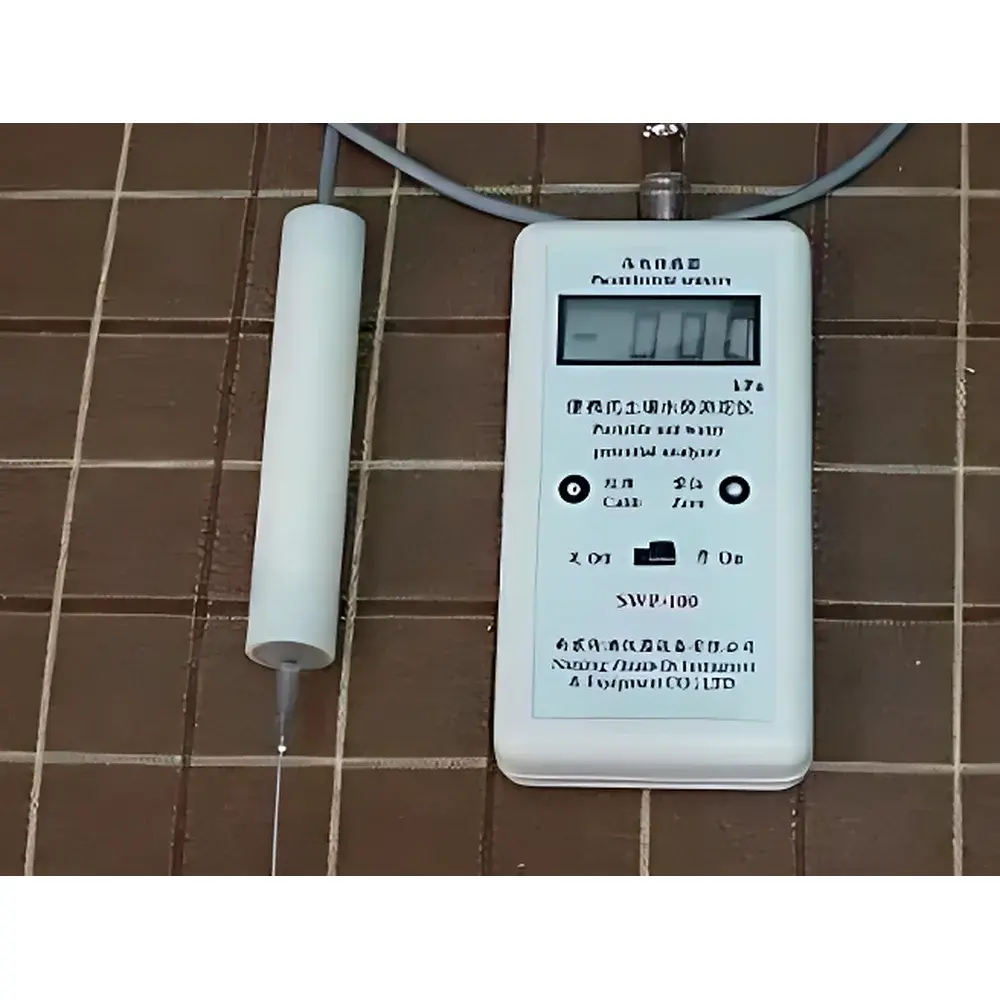
SWP-100 Portable Soil Water Potential Meter
| Measurement Range | 0–100 kPa |
|---|---|
| Accuracy | ±1 kPa |
| Operating Temperature | 0–60 °C |
| Power Supply | Two AA batteries (1.2–3.0 V, zero & sensitivity unaffected by voltage drift) |
| Probe Compatibility | Modular tensiometer probes (user-expandable to >100 points) |
| Display Unit | kPa (digital LCD) |
| Compliance | Designed for field-deployable soil hydrology monitoring per ISO 11274, ASTM D4944, and FAO Irrigation and Drainage Paper No. 56 guidelines |
Overview
The SWP-100 Portable Soil Water Potential Meter is an engineered field instrument designed for direct, in-situ measurement of soil matric potential using the tensiometric principle. Unlike legacy vacuum-gauge tensiometers—prone to zero-drift under sustained negative pressure, mechanical hysteresis from vibration, and limited accuracy (±2.5% full scale)—the SWP-100 employs a stabilized ceramic-tip tensiometer probe interface coupled with a precision pressure transducer and temperature-compensated analog-to-digital conversion. It operates on the fundamental physical relationship between soil water suction and the equilibrium tension developed across a porous ceramic cup (typically 0.1–1.5 µm pore size), enabling quantitative assessment of plant-available water status. The device is calibrated traceably to NIST-traceable pressure standards and validated for continuous deployment in unsaturated zone hydrology studies, irrigation scheduling, and root-zone water stress diagnostics.
Key Features
- High-fidelity tensiometric measurement with ±1 kPa absolute accuracy across the full 0–100 kPa range—sufficient to resolve critical thresholds for crop water stress (e.g., 10–30 kPa for optimal growth; >50 kPa indicating irrigation necessity)
- Modular architecture: A single handheld meter interfaces with up to 100+ independently installed tensiometer probes—eliminating redundant instrumentation while maintaining individual probe calibration integrity
- Field-robust power design: Operates reliably on two standard AA cells (1.2–3.0 V); zero point and sensitivity remain invariant across battery discharge cycles—no recalibration required during multi-day deployments
- Digital LCD display with kPa units, backlight for low-light conditions, and automatic unit consistency—no manual scaling or conversion needed
- Probe-ready interface with IP67-rated connector and moisture-resistant housing—designed for repeated insertion into buried ceramic probes installed at variable depths (10 cm to 120 cm) and spatial locations
- Temperature compensation algorithm embedded in firmware (0–60 °C operating range) ensures stable output under diurnal thermal gradients common in open-field environments
Sample Compatibility & Compliance
The SWP-100 is compatible with standard 0.2–0.5 MPa ceramic tensiometer probes (e.g., 0.15 µm nominal pore size, sintered alumina or stainless-steel composite cups) conforming to ISO 11274 (soil water retention curve determination) and ASTM D4944 (field moisture content estimation). Its measurement protocol aligns with FAO’s Crop Water Stress Index (CWSI) framework and supports data acquisition for USDA-SCS infiltration modeling and Richards’ equation parameterization. All components meet RoHS Directive 2011/65/EU for hazardous substance restrictions. While not FDA-regulated, its data output structure supports GLP-compliant field notebooks when paired with timestamped log sheets and probe location mapping.
Software & Data Management
The SWP-100 operates as a standalone field-readout device without proprietary software dependency. Measurement values are manually recorded in standardized field logs or imported into third-party platforms (e.g., Excel, R, Python pandas) via structured CSV templates. For auditability, users are advised to document probe ID, depth, GPS coordinates, date/time, and ambient temperature alongside each reading. The instrument’s deterministic response and lack of internal memory ensure full transparency—no black-box interpolation or hidden firmware corrections. When integrated into larger monitoring networks, it complies with ISO/IEC 17025 documentation requirements for measurement uncertainty reporting (k = 2, based on ±1 kPa specification + operator repeatability).
Applications
- Irrigation scheduling for high-value row crops (e.g., vineyards, orchards, vegetables) by correlating real-time matric potential with evapotranspiration models (Penman-Monteith, FAO-56)
- Soil hydraulic property characterization—including field capacity (−10 to −33 kPa), permanent wilting point (−1500 kPa, extrapolated via van Genuchten fitting), and saturated hydraulic conductivity estimation via inverse modeling
- Pot-based physiological experiments in greenhouses and growth chambers—enabling longitudinal tracking of substrate drying fronts and root water uptake kinetics
- Ecological research on plant-soil-atmosphere continuum (PSAC) dynamics, including drought resilience screening and rhizosphere moisture heterogeneity mapping
- Educational use in undergraduate soil physics and agronomy laboratories—demonstrating capillary theory, Darcy’s law, and water potential components (matric, osmotic, gravitational)
FAQ
How does the SWP-100 differ from traditional vacuum-gauge tensiometers?
It replaces mechanical Bourdon-tube vacuum gauges with solid-state pressure transducers, eliminating zero-drift from vibration, thermal expansion, and prolonged negative-pressure exposure.
Can the same probe be reused across multiple seasons?
Yes—ceramic tensiometer probes installed with proper backfill and air-bleed protocols remain functional for 2–5 years depending on soil texture and redox conditions.
Is calibration required before each use?
No—factory calibration is stable over time; only a simple air-zero check (open-circuit reading at atmospheric pressure) is recommended prior to field deployment.
What is the minimum measurable water potential resolution?
The digital display resolves to 1 kPa increments, consistent with the stated ±1 kPa accuracy specification.
Does the instrument support data logging or Bluetooth export?
No—it is intentionally designed as a dedicated, interference-free readout tool; external logging requires manual entry or integration with third-party dataloggers via analog voltage output (optional accessory).



