
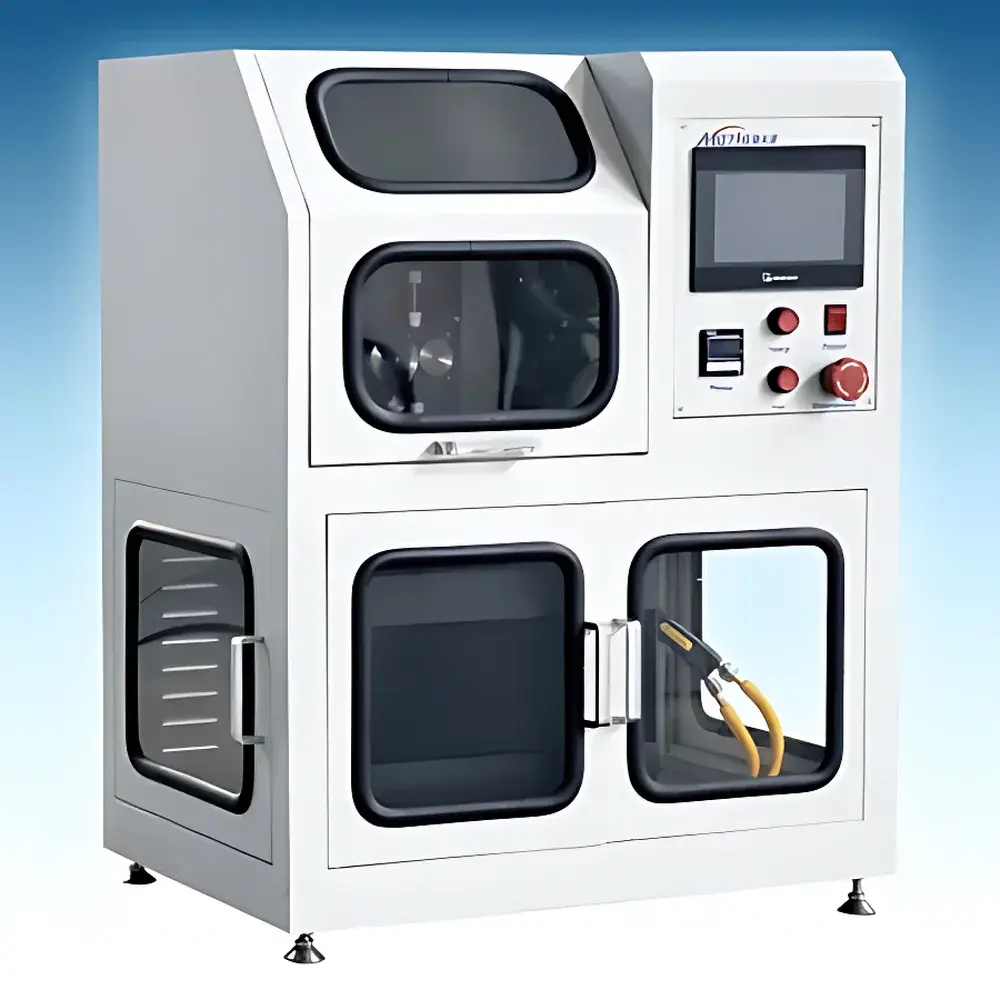
NYX MES Molten Metal Splash Impact Resistance Tester
| Brand | NYX |
|---|---|
| Model | MES |
| Origin | Tianjin, China |
| Manufacturer Type | Direct Manufacturer |
| Regional Category | Domestic (China) |
| Price Range | USD 9,000 – 11,500 |
| Compliance Standards | AQ 6103, ISO 9150:1988, CSN EN 348:1992, GB 8965.2–2009, GB/T 17599–1998, ISO 11611, ISO 11612, EN 407 |
| Burner Type | Oxy-acetylene torch with 1.2 ± 0.1 mm nozzle |
| Metal Feed Mechanism | Stepper motor-driven wire feed system with adjustable linear speed |
| Drip Guidance Angle | 45° |
| Anti-stick Guide Channel | High-temperature ceramic-coated or PTFE-lined (per ISO 9150 Fig.3 / EN 348 Fig.3) |
| Backside Temperature Sensor | Precision thermocouple array (Type K, ±0.5 °C accuracy) |
| Pre-tension Device | Calibrated copper weight assembly (175.0 ± 0.5 g) |
| Data Acquisition | Touchscreen HMI with real-time thermal curve plotting, drip count & frequency logging |
| Safety Enclosure | Interlocked stainless-steel safety hood with optical shielding and ventilation interface |
Overview
The NYX MES Molten Metal Splash Impact Resistance Tester is an engineered test system designed to evaluate the thermal barrier performance of personal protective equipment (PPE) against transient high-energy molten metal impact—specifically simulating industrial exposure scenarios encountered in arc welding, foundry operations, and metallurgical maintenance. It operates on the principle of controlled, repeatable molten metal droplet generation using an oxy-acetylene flame to melt standardized ferrous or aluminum alloy welding rods, followed by gravity-assisted 45° directional impingement onto vertically mounted fabric specimens under defined mechanical pre-tension. The instrument quantifies resistance through real-time measurement of backside temperature rise (ΔT), time-to-reach critical thresholds (e.g., 24 °C above ambient), and visual assessment of penetration, charring, or hole formation per referenced international standards. Its architecture adheres to the physical test geometry, thermal input fidelity, and procedural repeatability requirements specified in ISO 9150:1988 and EN 348:1992, ensuring metrological traceability for certification laboratories and PPE manufacturers subject to CE marking, ANSI/ISEA compliance, or China’s AQ 6103 regulatory framework.
Key Features
- Oxy-acetylene burner subsystem with precision-machined 1.2 ± 0.1 mm nozzle, integrated mass-flow controllers for O2 and C2H2 to maintain stoichiometric flame stability across test cycles
- Stepper motor–driven welding rod advancement mechanism enabling programmable feed rates (0.5–5.0 mm/s) to modulate droplet size distribution and impact energy density
- 45° angled molten metal guidance channel fabricated from high-purity alumina ceramic or medical-grade PTFE lining, conforming to dimensional specifications in ISO 9150 Figure 3 and EN 348 Figure 3
- Calibrated 175.0 ± 0.5 g copper hammer tensioning system that applies consistent uniaxial preload to fabric specimens, replicating realistic garment drape and thermal stress conditions during exposure
- Multi-point Type K thermocouple array embedded beneath specimen mounting frame, sampling at 10 Hz with NIST-traceable calibration for accurate backside ΔT profiling
- Integrated drip counter and frequency monitor synchronized with thermal acquisition, supporting statistical analysis of droplet arrival intervals and cumulative thermal load
- Full-enclosure stainless-steel safety housing with interlocked access doors, UV-filtered viewing window, and passive exhaust port compatible with laboratory fume extraction systems
Sample Compatibility & Compliance
The MES tester accommodates flat textile specimens measuring 150 mm × 150 mm (per ISO 11612 Annex A), including multilayer composite fabrics, aluminized laminates, and inherently flame-resistant (IFR) woven structures used in welding jackets, aprons, gloves, and hoods. Specimen mounting conforms to EN 407 Clause 4.2 and GB 8965.2–2009 Section 6.1 requirements for clamping geometry and edge restraint. All operational parameters—including flame temperature profile (verified via pyrometric calibration), droplet mass (validated gravimetrically per ISO 9150 Annex B), and impact velocity—are auditable against ISO/IEC 17025–accredited test method validation protocols. The system supports dual-mode reporting aligned with both Chinese AQ 6103 classification tiers (Class 1–3) and EU EN 407 Performance Level (PL) grading (PL 1–4), facilitating cross-jurisdictional conformity assessment.
Software & Data Management
The embedded control software runs on a ruggedized ARM-based touchscreen HMI (10.1″ capacitive display, IP65-rated) and provides fully configurable test sequences, parameter logging, and post-test analytics. Real-time thermal curves are plotted with dual-axis scaling (time vs. ΔT), overlaid with annotated threshold markers (e.g., 24 °C, 40 °C). Raw data exports to CSV or XML formats include timestamped temperature readings, drip timestamps, motor position feedback, and gas flow telemetry. Audit trails record user login sessions, method version IDs, calibration due dates, and electronic signatures—ensuring compliance with FDA 21 CFR Part 11 and GLP/GMP documentation requirements. Optional Ethernet/Wi-Fi connectivity enables remote monitoring and integration into LIMS environments via standard OPC UA or Modbus TCP interfaces.
Applications
- Qualification testing of arc-flash and molten metal–resistant garments for ISO 11611 Class 1/2 and ISO 11612 A1–F1 certification
- R&D evaluation of novel ceramic-coated, aerogel-integrated, or phase-change material (PCM)–enhanced textile substrates
- Batch release verification for PPE manufacturers supplying to automotive OEMs, shipyards, and steel service centers
- Root-cause analysis of field failures involving thermal penetration or structural degradation under molten slag exposure
- Interlaboratory comparison studies coordinated under ILAC MRA signatory accreditation bodies
FAQ
What welding rod materials are supported for testing?
Standardized low-carbon steel (E6013) and aluminum alloy (ER4043) rods per ISO 9150 Annex A; custom alloys may be qualified upon thermal emissivity and melting point verification.
Is calibration certification included with delivery?
Yes—factory calibration report traceable to CNAS-accredited reference standards is provided, covering thermocouple linearity, gas flow meter accuracy, and mechanical tension verification.
Can the system be upgraded to support EN ISO 9185:2019 (molten aluminum splash)?
Hardware compatibility exists; firmware update and supplementary calibration kits for Al-specific droplet characterization are available under NYX Service Plan S-MES-AL.
What electrical and gas supply requirements apply?
220 V AC ±10 %, 50 Hz, 3.5 kW max; oxygen supply ≥ 0.8 MPa, acetylene ≥ 0.1 MPa, both with inline particulate filtration and flashback arrestors.
Does the software support multi-language UI and report generation?
English and Simplified Chinese UI are standard; PDF report templates comply with ISO/IEC 17025 Clause 7.8.2 and support customizable headers, logos, and bilingual annotation fields.



