
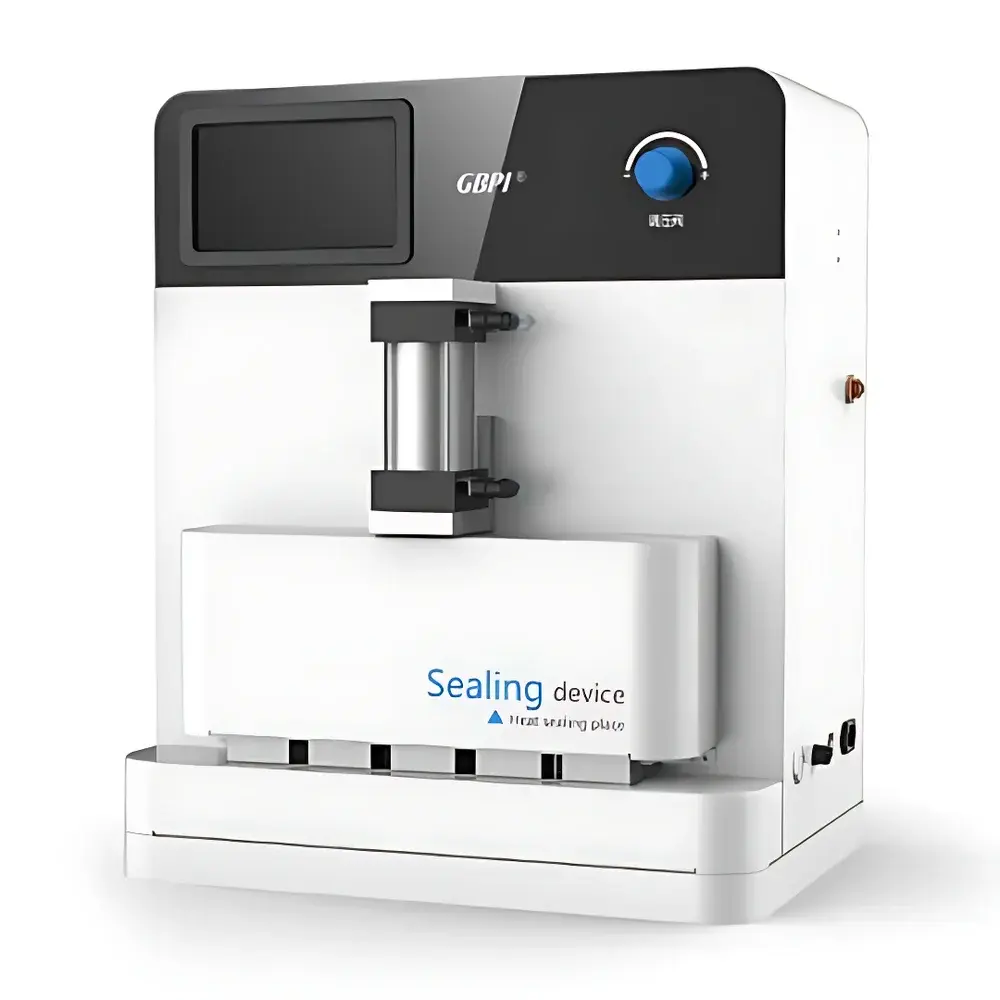
GBPI GBB-F1L Heat Sealing Tester
| Brand | GBPI |
|---|---|
| Origin | Guangdong, China |
| Manufacturer Type | Direct Manufacturer |
| Country of Origin | China |
| Model | GBB-F1L |
| Pricing | Available Upon Request |
| Temperature Range | Ambient to 250 °C |
| Temperature Control Accuracy | ±0.1 °C |
| Sealing Time Range | 0.1 s to 99 h 59 min 59.9 s |
| Sealing Pressure Range | 0.1–0.8 MPa |
| Sealing Surface | Five independent upper sealing bars (35 mm × 10 mm each) + one lower heated sealing bar with silicone pad |
| Heating Method | Dual-zone resistive heating |
| Drive System | Pneumatic (dual-cylinder synchronized circuit, bottom-mounted) |
| Control Interface | 7-inch color TFT touchscreen with embedded controller |
| Operating Modes | Automatic, Manual, and Foot-pedal actuated |
| Compliance Standards | QB/T 2358–1998, ASTM F2029, YBB00122003–2015 |
Overview
The GBPI GBB-F1L Heat Sealing Tester is an engineered solution for precise, repeatable thermal seal evaluation of flexible packaging materials. It operates on the principle of controlled conductive heat transfer under defined pressure and dwell time—mimicking industrial heat sealing processes used in packaging lines for pharmaceutical blister cards, food pouches, medical device pouches, and laminated barrier films. Unlike empirical trial-and-error approaches, this instrument quantifies the thermally induced interfacial adhesion between polymer layers by systematically varying three critical process parameters: temperature, pressure, and residence time. Its dual-zone, five-point independent thermal control architecture enables high-resolution mapping of seal initiation temperature (SIT), seal integrity threshold, and hot-tack onset—key metrics required for validating packaging process windows per ISO 11607-2 and FDA Guidance for Industry on Packaging for Sterile Devices.
Key Features
- Five-Independent-Zone Thermal Control: Five upper sealing bars and one lower heated bar operate with fully decoupled PID temperature regulation—each zone programmable from ambient to 250 °C with ±0.1 °C stability (verified per ASTM E220 calibration traceability).
- Pneumatic Precision Actuation: Dual synchronized bottom-mounted cylinders deliver consistent, non-drifting sealing pressure (0.1–0.8 MPa) across the entire sealing surface; pressure transducer feedback ensures real-time monitoring and repeatability <±0.02 MPa.
- Integrated Embedded Control System: 7-inch capacitive touchscreen interface hosts full test sequencing logic—no external PC required. Supports parameter storage, method recall, and real-time display of current zone temperatures, applied pressure, elapsed time, and cycle status.
- Dual-Mode Operation: Fully automatic sequential testing (including auto-reset and inter-cycle cooling delay), manual step-by-step mode, and foot-switch–triggered single-cycle execution—enabling both R&D screening and QC batch verification.
- Enhanced Safety Architecture: Physical thermal shielding, automatic power cutoff upon door open detection, and insulated sealing surfaces comply with IEC 61010-1 for laboratory electrical safety.
Sample Compatibility & Compliance
The GBB-F1L accommodates a broad spectrum of thermoplastic substrates and multilayer laminates—including PE, PP, PET, OPP, aluminum foil composites, metallized films, paper-plastic hybrids, and peelable medical-grade Tyvek®/polyethylene structures. Seal bar geometry (width, length, edge profile, surface finish) is customizable to replicate production tooling or meet specific standard requirements (e.g., ASTM F88 for peel strength validation). The system meets regulatory expectations for data integrity: optional software module supports 21 CFR Part 11–compliant user authentication, role-based access control (administrator/operator/observer), electronic signatures, and immutable audit trails covering system events, method changes, and result modifications—all timestamped and user-identified.
Software & Data Management
Optional GBPI SealingSuite™ software (v3.2+) provides GLP/GMP-aligned data handling. It enforces structured method templates aligned with ISO/IEC 17025 documentation requirements. All test records include metadata: operator ID, environmental conditions (optional external hygrothermograph integration), equipment calibration status, and raw sensor logs (temperature ramp profiles, pressure decay curves). Export formats include CSV, PDF reports with embedded pass/fail criteria, and XML for LIMS ingestion. Calibration certificates for temperature sensors and pressure transducers are traceable to NIM (China National Institute of Metrology) or equivalent national standards bodies.
Applications
- Establishing optimal sealing parameter windows for new packaging formulations prior to line qualification.
- Comparative hot-tack strength assessment of sealant layers during film development.
- Root-cause analysis of seal failures (leakage, delamination, scorching) in stability or accelerated aging studies.
- Verification of seal integrity consistency across batches per USP <661.2> and Ph. Eur. 3.2.1.
- Supporting submissions to regulatory agencies (FDA, EMA, NMPA) with documented, auditable sealing validation protocols.
FAQ
What standards does the GBB-F1L directly support?
It natively executes test protocols aligned with QB/T 2358–1998 (Chinese national standard for plastic film heat seal strength), ASTM F2029 (standard test method for making heat seals for peel testing), and YBB00122003–2015 (Chinese pharmaceutical packaging standard for sterile barrier systems).
Is external compressed air required?
Yes—a clean, dry, oil-free air supply at ≥0.8 MPa (8 bar) is mandatory. An integrated air filter/regulator unit (included) requires upstream connection to a compressor meeting ISO 8573-1 Class 2:2:2 specifications.
Can sealing bar dimensions be modified post-purchase?
Yes—custom sealing bar inserts (e.g., 10 mm wide, serrated edge, Teflon-coated) can be ordered separately and installed without tools; mechanical interfaces follow ISO 2768-mK general tolerances.
How is temperature calibration performed?
Each zone includes a removable Pt100 RTD sensor; calibration is verified using a NIST-traceable dry-block calibrator (e.g., Fluke 9143) per GB/T 2423.2–2012 Annex B procedures. Certificate of calibration is issued with each annual service.
Does the system support network connectivity?
The base model operates standalone. Optional Ethernet/Wi-Fi module enables remote monitoring, firmware updates, and secure data push to cloud-based QA dashboards—configured to comply with corporate IT security policies (TLS 1.2+, IEEE 802.1X authentication).




