
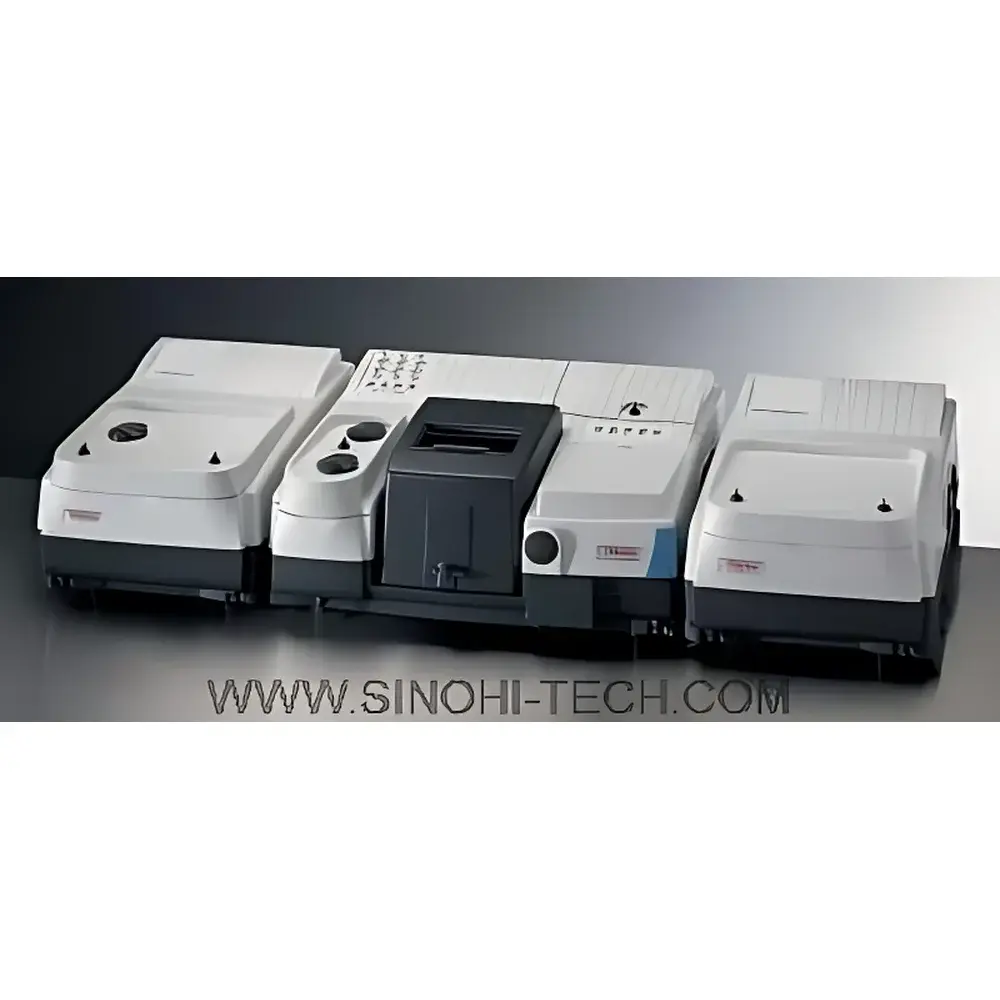
Nicolet FT-SPR Integrated Fourier Transform Surface Plasmon Resonance and Infrared Spectroscopy System
| Origin | USA |
|---|---|
| Manufacturer Type | Authorized Distributor |
| Import Status | Imported Instrument |
| Model | Nicolet FT-SPR |
| Pricing | Available Upon Request |
Overview
The Nicolet FT-SPR Integrated Fourier Transform Surface Plasmon Resonance and Infrared Spectroscopy System is a dual-modal analytical platform engineered for label-free, real-time characterization of molecular interactions at solid–liquid interfaces. It combines surface plasmon resonance (SPR) detection—based on angular or wavelength interrogation of evanescent field perturbations—with high-resolution Fourier transform infrared (FTIR) spectroscopy. This integration enables concurrent acquisition of kinetic binding data (e.g., association/dissociation rate constants, equilibrium dissociation constants) and complementary structural information (e.g., secondary structure changes in proteins, lipid acyl chain ordering, hydrogen bonding patterns) from the same sample spot under identical experimental conditions. The system is optimized for studies requiring both affinity quantification and conformational insight—particularly in biointerface science, membrane protein reconstitution, biosensor development, and functional biomaterial characterization.
Key Features
- Dual-mode operation: Simultaneous or sequential SPR and FTIR data acquisition using shared optical pathways and synchronized sample environments.
- Extended dynamic SPR range: Capable of resolving interactions across a broad molecular weight spectrum—from small molecules (500 nm diameter) and multilayered biofilms—without hardware reconfiguration.
- Modular FTIR functionality: Supports multiple sampling techniques including Attenuated Total Reflection (ATR), Diffuse Reflectance Infrared Fourier Transform (DRIFT), Polarization Modulation IR Reflection Absorption Spectroscopy (PMIRRAS), Vibrational Circular Dichroism (VCD), and Raman spectroscopy via optional coupling modules.
- Integrated liquid chromatography interface: Enables online hyphenation with HPLC or UHPLC systems for fraction-resolved interaction profiling and structural verification of eluting species.
- Temperature- and humidity-controlled sample chamber: Maintains environmental stability during long-duration kinetic experiments (up to 72 h continuous monitoring).
- High-stability gold-coated sensor chips: Compatible with standard SPR chip formats and chemically modified surfaces (e.g., carboxymethyl dextran, SAMs, lipid bilayers).
Sample Compatibility & Compliance
The Nicolet FT-SPR accommodates a wide range of sample types: aqueous biological buffers (PBS, HEPES, Tris), viscous glycerol–water mixtures, low-conductivity organic solvents (e.g., chloroform, hexane for Langmuir–Blodgett film studies), and microfluidic flow cells. It supports immobilization strategies including covalent coupling, streptavidin–biotin capture, Ni–NTA affinity, and physical adsorption. The instrument complies with ISO/IEC 17025 requirements for testing laboratories and meets essential design criteria outlined in ASTM E2573 (Standard Guide for Surface Plasmon Resonance Sensors) and ISO 18384 (Biotechnology — Surface Plasmon Resonance Biosensors). Data integrity features align with FDA 21 CFR Part 11 expectations, including electronic signature support, audit trail logging, and user-access-level controls.
Software & Data Management
Instrument control, data acquisition, and analysis are managed through Thermo Scientific OMNIC software with dedicated FT-SPR modules. The software provides automated baseline correction, multi-channel referencing, global fitting of kinetic models (1:1, bivalent analyte, heterogeneous ligand), and spectral preprocessing (ATR correction, atmospheric compensation, vector normalization). Raw SPR sensorgrams and FTIR interferograms are stored in vendor-neutral HDF5 format. Export options include CSV, TXT, and JCAMP-DX for third-party analysis (e.g., KinExA, GRAMs/AI, OriginLab). All processing steps are logged with timestamps and operator IDs to support GLP/GMP documentation workflows.
Applications
- Real-time monitoring of liposome–membrane fusion and supported lipid bilayer formation.
- Quantitative assessment of antibody–antigen binding kinetics under physiological buffer conditions.
- Conformational analysis of amyloid-beta peptide aggregation at interfaces using PMIRRAS-coupled SPR.
- In situ characterization of polymer brush swelling/deswelling in response to pH or ionic strength changes.
- Hyphenated LC-FT-SPR analysis of monoclonal antibody fragments following proteolytic digestion.
- VCD-enabled chiral discrimination of enantiomeric small-molecule binders interacting with immobilized GPCRs.
FAQ
Is the FT-SPR system compatible with custom sensor chip substrates?
Yes—users may install third-party chips with standard Kretschmann geometry and 25 mm diameter, provided they meet optical flatness (λ/10) and gold film thickness specifications (48–52 nm).
Can the system perform time-resolved FTIR measurements during an SPR binding event?
Yes—using rapid-scan or step-scan FTIR modes synchronized with SPR data collection at user-defined intervals (minimum 1 s per spectrum).
What level of training and application support is provided?
Thermo Fisher Scientific offers on-site installation qualification (IQ), operational qualification (OQ), and comprehensive application workshops covering experimental design, data interpretation, and regulatory documentation.
Does the system support 21 CFR Part 11-compliant electronic records?
Yes—the OMNIC software includes role-based access control, electronic signatures, and immutable audit trails for all acquisition and analysis events.
Are consumables such as sensor chips and ATR crystals available directly from the distributor?
Authorized distributors maintain regional inventory of certified gold sensor chips, ZnSe and diamond ATR crystals, microfluidic cartridges, and regeneration solutions.






